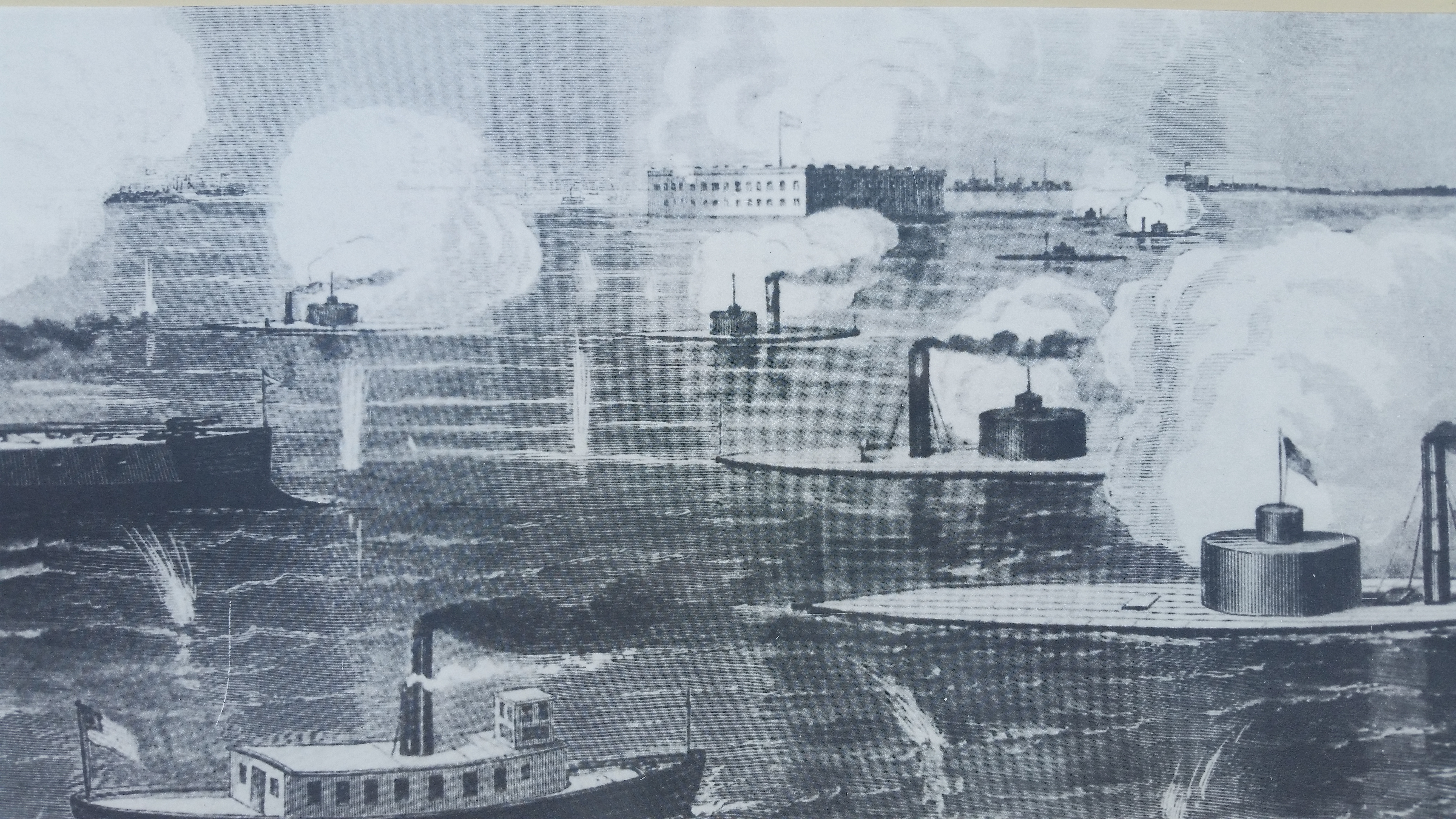
First Battle of Charleston Harbor
A 3,000-pound electrically triggered torpedo lay on the harbor floor, wired to a switch onshore. When the USS New Ironsides, the most powerful warship in the Union fleet, anchored directly above it on the afternoon of April 7, 1863, a Confederate soldier closed the circuit. Nothing happened. Either an ordnance wagon had severed the wires or the cable was simply too long to carry sufficient current. It was that kind of day for the Union Navy at Charleston Harbor - a day when technology failed, plans collapsed, and the most formidable ironclad fleet ever assembled was humbled by brick, sand, and well-placed artillery.
A War Needing a Miracle
By early 1863, the Union cause was faltering. The Army of the Potomac had been mauled at Fredericksburg. The campaign against Vicksburg was bogged down. The Confederates had recaptured Galveston, Texas. War-weariness gripped the North, and fall elections had swung against the Republicans. The Lincoln administration needed a dramatic victory to revive public morale. Assistant Secretary of the Navy Gustavus Vasa Fox saw his chance. Fox had an agenda beyond patriotism: he wanted the Navy to prove it could win battles without the Army. Charleston, birthplace of secession, had immense symbolic value even though its military importance was limited. Fort Sumter, where the war began, loomed in the public imagination as the incarnation of rebellion. If ironclads could reduce it, the Navy would demonstrate a revolutionary new form of warfare. Rear Admiral Samuel Francis Du Pont was handed nearly every armored vessel the Navy possessed - seven Passaic-class monitors, the massive New Ironsides, and the experimental ironclad Keokuk.
The Rings of Fire
General P.G.T. Beauregard, who had ordered the first shots at Fort Sumter two years earlier, had returned to command Charleston's defenses. He knew the harbor intimately and had organized its fortifications into three concentric defensive rings. The outer ring was formidable: Battery Wagner and Battery Gregg on Morris Island, Fort Sumter on its man-made island, and Fort Moultrie with its outlying batteries on Sullivan's Island. Behind them, a second ring included Fort Johnson, Battery Glover, Fort Ripley, Castle Pinckney, and Battery Ramsay at the city's southern tip. A third ring of batteries along the Cooper and Ashley Rivers guarded against land assault. In all, some 385 guns watched the harbor approaches. Beauregard had also strung barriers of railroad iron, timber, and rope across the channel between Forts Sumter and Moultrie, supplemented by underwater torpedoes. The barriers broke repeatedly in strong tides, and most torpedoes were unreliable - but Du Pont did not know that, and the threat weighed heavily on his planning.
Two Hours of Thunder
The attack finally proceeded on the afternoon of April 7, after days of haze. The lead monitor Weehawken, dragging a mine-clearing raft designed by John Ericsson, could manage only three knots, forcing the entire column to crawl. New Ironsides, with severe handling problems in the strong current and shallow water, dropped anchor to avoid grounding - directly atop that enormous dormant torpedo. The four ships behind her had to maneuver around, throwing the battle line into disorder. When Captain John Rodgers of Weehawken spotted buoys he feared marked torpedoes, he swerved from the channel, and the ships following lost all formation. Du Pont's plan disintegrated. For two hours, Confederate gunners poured fire from multiple directions. They fired more than 2,000 shot and shell, hitting Union ships 520 times. The Union fleet managed only 154 shots in return - each monitor carried just two guns, and reloading took seven minutes per shot. Keokuk absorbed 90 hits, 19 at or below the waterline. Captain Rhind barely kept her afloat long enough to escape the killing zone. She sank during the night.
Aftermath of Humiliation
Du Pont consulted his captains that evening. The verdict was unanimous: renewal was pointless. The fleet had not penetrated even the first defensive ring. Keokuk was lost. Several monitors needed weeks of repair. The captains agreed that even destroying Fort Sumter would not matter - hundreds of other guns remained. Secretary of the Navy Gideon Welles was furious. The tiny casualty list - one Union sailor killed, twenty-one wounded, against five Confederate dead and eight wounded - suggested the attack had lacked vigor. Only when the aggressive Captain John Rodgers confirmed the fleet had no chance did Welles accept the truth: Charleston could not fall to naval power alone. Du Pont was relieved of command in June 1863. Yet his captains thrived - seven eventually became rear admirals. Even Keokuk had a final chapter: she sank in water shallow enough that her smokestack protruded above the surface. A Charleston civilian named Adolphus LaCoste salvaged her two heavy guns by night, right under the blockaders' noses, a feat Du Pont did not discover until the Charleston Mercury announced it.
From the Air
Located at 32.75°N, 79.87°W at the mouth of Charleston Harbor, South Carolina. The harbor entrance is clearly visible from altitude, with Sullivan's Island and Fort Moultrie to the north, Morris Island to the south, and Fort Sumter on its island between them. The defensive geography - multiple forts creating crossfire zones across the narrow channel - is striking from the air. Charleston International Airport (KCHS) is 12 miles northwest. The Cooper and Ashley Rivers converge at the Charleston peninsula visible to the west.