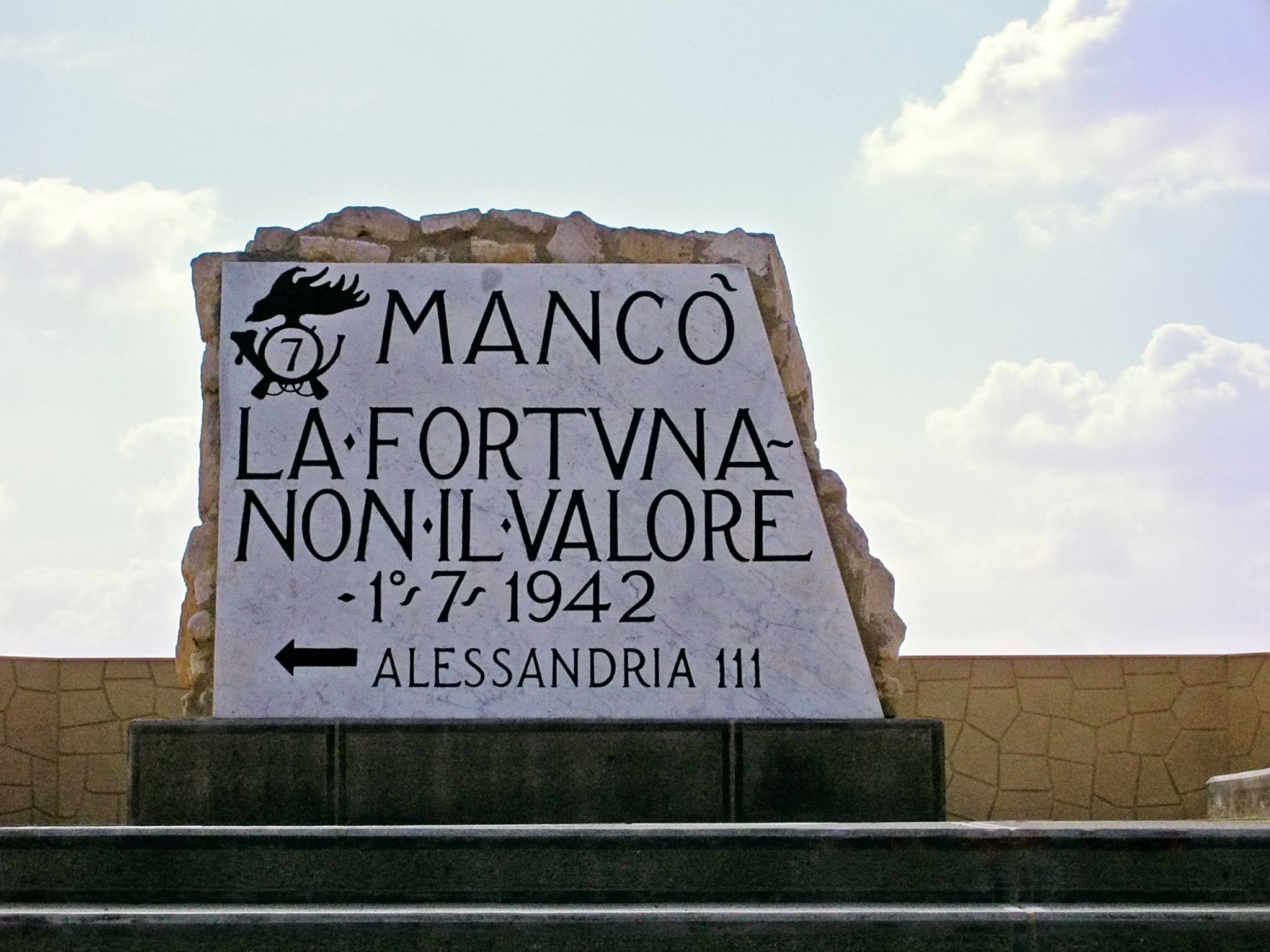
First Battle of El Alamein
By July 1942, the Afrika Korps had pushed the British Eighth Army nearly out of Egypt. Tobruk had fallen. The road to Alexandria lay open, and beyond it, the Suez Canal and the oil fields of the Middle East. Erwin Rommel, riding a wave of victories across Libya, needed one more breakthrough to change the course of the war. He did not get it. At a narrow strip of desert between the Mediterranean coast and the impassable Qattara Depression, the Eighth Army turned and fought, and for the first time in months the Axis advance ground to a halt.
The Bottleneck at Alamein
El Alamein's geography dictated everything. The Mediterranean Sea anchored the northern flank, and sixty kilometers to the south, the Qattara Depression, a vast salt marsh hundreds of meters below sea level, made any flanking movement impossible. For the first time in the seesaw desert war, neither army could be outflanked. Every attack had to come head-on. General Claude Auchinleck, Commander-in-Chief of Middle East Command, chose this ground deliberately after the fall of Tobruk. He withdrew the battered Eighth Army to within striking distance of Alexandria and positioned his forces across the bottleneck. If the line held, Egypt would hold. If it broke, the Suez Canal was lost.
A Month of Grinding Combat
The battle lasted from July 1 to July 27, 1942, and it bore little resemblance to the fluid armored warfare that had characterized the desert campaign. Both sides attacked and counterattacked across the same ground, suffering heavy casualties for gains measured in hundreds of meters. Rommel's forces, exhausted and at the end of a supply line stretching back to Tripoli, threw everything at the British positions. The Italian Ariete Division, Rommel's armored spearhead alongside the Afrika Korps, was worn down to just five operational tanks by the end of one day's fighting. The British 22nd and 4th Armoured Brigades consistently outgunned the Axis armor, though neither side could deliver a knockout blow. Auchinleck's counterattacks in late July also failed to break through, and by month's end both armies were spent.
The Soldiers from the Furthest Distance
The battle holds particular significance in New Zealand, where it is remembered as a defining moment of national sacrifice. The New Zealand 2nd Division played a central role in the defense, and the Maori Battalion distinguished itself in some of the heaviest fighting. Commander Frederick Baker, James Henare, and Eruera Te Whiti o Rongomai Love, the last of whom was killed in action, became national figures for their service. The Indian 5th Division and South African forces also bore significant portions of the fighting. For these nations, El Alamein was not a distant imperial war but a battle fought by their own sons on a continent most of them had never seen, in defense of a canal they would never use.
Buying Time for Montgomery
Auchinleck called off his counterattacks at the end of July to rebuild the army. In early August, Winston Churchill and General Sir Alan Brooke visited Cairo and replaced Auchinleck as Commander-in-Chief. Lieutenant-General Bernard Montgomery was appointed to command the Eighth Army after his predecessor, William Gott, was killed when his transport aircraft was shot down by Luftwaffe fighters. Montgomery would inherit an army that had been bled and battered at First Alamein but had accomplished something essential: it had stopped Rommel cold. The three months between the first and second battles allowed massive reinforcements to arrive, including American Sherman tanks, new 6-pounder anti-tank guns, and Spitfire fighters. The first battle did not win the desert war, but it made winning possible.
The Line That Held
Churchill famously said of El Alamein, "Before Alamein we never had a victory. After Alamein we never had a defeat." He was speaking of the second battle, but the first deserves a share of that credit. Had Rommel broken through in July, there would have been no second battle. The Eighth Army's stand at El Alamein in the summer of 1942 was not a victory in the conventional sense. No territory was gained, no army was routed. But in a war of logistics and attrition, holding the line was enough. Rommel had reached his high-water mark, and though he did not know it yet, the tide of the North African campaign had already begun to turn against him in the Egyptian desert.
From the Air
Located at 30.84N, 28.94E on Egypt's Mediterranean coast at El Alamein, approximately 106 km west of Alexandria and 240 km northwest of Cairo. The battlefield stretches from the coast south toward the Qattara Depression, a vast below-sea-level salt marsh visible from altitude as a white expanse. El Alamein International Airport (HEAL) is nearby. The war cemeteries and memorials are visible as green rectangles along the coastal highway. Best viewed at 5,000-10,000 ft AGL to appreciate the narrow corridor between the Mediterranean and the Depression that made this position so defensible.