First Battle of Fort Fisher
Two hundred tons of gunpowder packed into the hull of a disguised steamer -- that was Benjamin Butler's grand idea. On the night of December 23, 1864, the USS Louisiana was towed toward the seawall of Fort Fisher, set ablaze, and detonated in a blast that was supposed to level the strongest Confederate fortification on the Atlantic coast. Instead, the ship blew up too far offshore. Inside the fort, the garrison barely noticed. What followed was one of the most humiliating Union failures of the entire Civil War, a debacle that cost a political general his command and delayed the capture of the South's last major seaport by three critical weeks.
The Gibraltar of the Confederacy
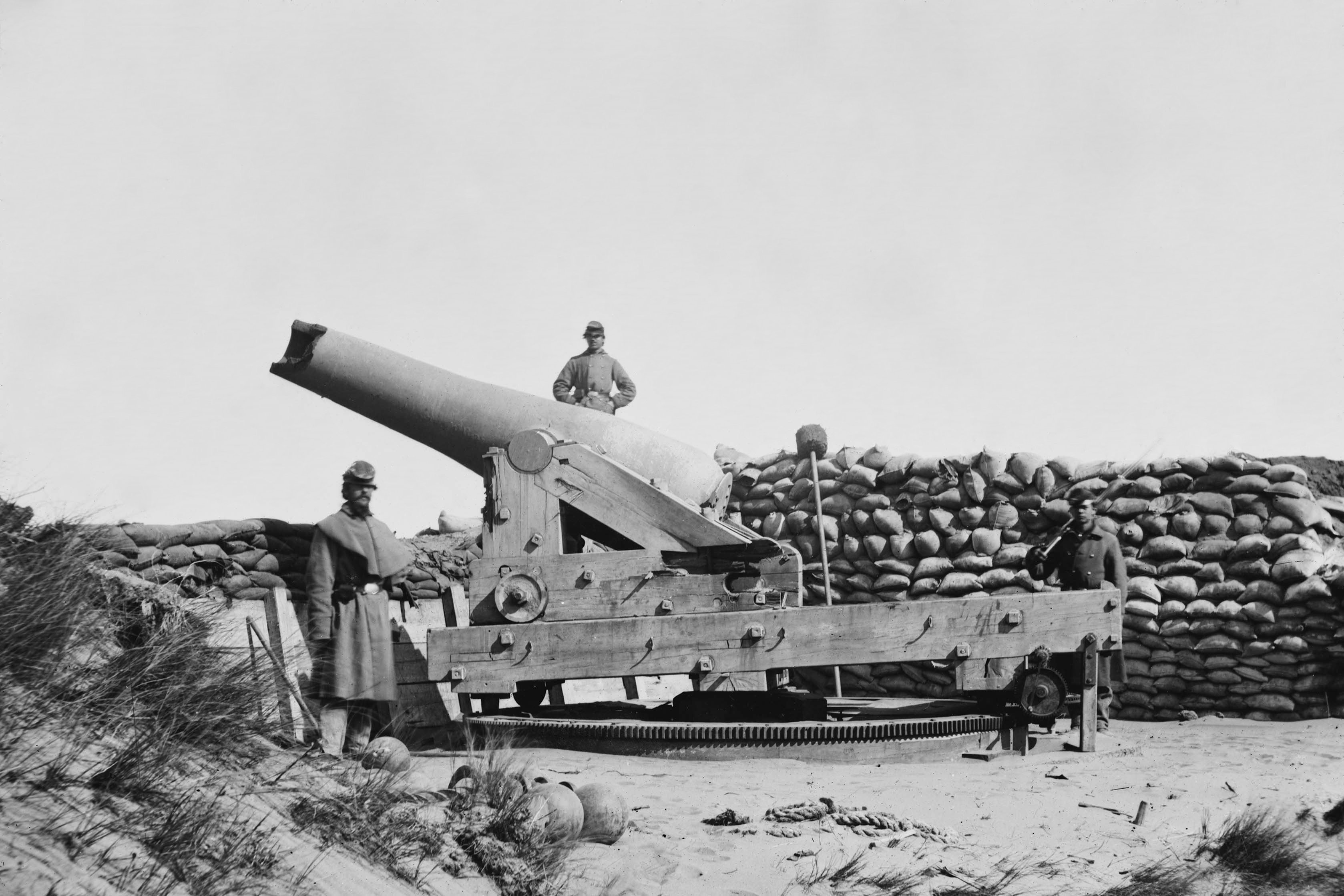
Fort Fisher earned its fearsome nickname honestly. Sitting at the tip of Confederate Point where the Cape Fear River meets the Atlantic, the fort commanded the approach to Wilmington, North Carolina -- by late 1864, the only major port still funneling supplies to Robert E. Lee's starving army. The fortification was a marvel of earthwork engineering: 14,500 square feet of defensive works ringed by a ten-foot parapet and a web of bombproofs rising thirty feet high. More than fifty heavy cannon bristled from its walls, including fifteen massive Columbiads and a 150-pounder Armstrong gun mounted behind a sixty-foot mound of earth called the Mound Battery. Land mines, sharpened timber abatis, and deep ditches guarded every approach. Colonel William Lamb commanded a garrison of 1,400 men, with General Braxton Bragg holding additional reinforcements just four miles away at Sugar Loaf.
Butler's Gamble
The plan to take Fort Fisher was as ambitious as it was troubled. Lieutenant General Ulysses S. Grant wanted Major General Godfrey Weitzel to lead the ground assault, but Benjamin Butler -- a politically powerful Democrat commanding the Department of Virginia and North Carolina -- insisted on taking charge himself. Grant reluctantly agreed. The naval component was staggering: Rear Admiral David D. Porter assembled nearly sixty warships, the largest Union fleet of the war, to escort transports carrying Butler's troops from Hampton Roads. Butler's secret weapon was the Louisiana, a ship rigged with explosives meant to be detonated near the fort's walls. Though Grant, Navy Secretary Gideon Welles, and others doubted the scheme, President Lincoln approved it. The fleet was supposed to depart December 10, but winter storms delayed departure until the 14th, and further delays at Beaufort for refueling threw the timetable into chaos.
Christmas on the Beach
When Porter's warships finally reached Fort Fisher on December 19, another storm scattered the fleet and forced the army transports back to Beaufort. By December 23, Porter had tired of waiting for Butler and launched the attack alone. The Louisiana's midnight detonation proved a spectacular dud -- the ship had drifted perhaps a mile from the fort. The next morning, the navy opened a furious bombardment, firing close to 10,000 shells in a single day. The results were meager: four gun carriages damaged, one caisson destroyed, and just twenty-three Confederate casualties. Meanwhile, exploding guns aboard the Union ships killed or wounded forty-five of their own sailors. When Butler's transports finally arrived that evening, Christmas morning saw the first Union troops wading ashore. Brigadier General Adelbert Ames got his division onto the beach and pushed a reconnaissance force under Brigadier General N. Martin Curtis toward the fort. Curtis found the land wall lightly defended and was ready to attack -- but Ames held him back.
Retreat and Reckoning
Butler had seen enough. Word came that Robert F. Hoke's division from the Army of Northern Virginia was approaching from the north, and another storm was building offshore. Convinced the bombardment had barely scratched the fort's defenses, Butler declared Fort Fisher impregnable and ordered his troops back to the ships. The fleet withdrew to Hampton Roads. Confederate losses for the entire engagement amounted to five killed, fifty-six wounded, and six hundred captured -- mostly junior reserve troops who had been cut off during the Union landings. The fort's damage was quickly repaired, and blockade runners slipped back into Wilmington the very night the Union fleet departed. The political fallout was swift. Butler's decision to abort directly contradicted Grant's orders to lay siege if a direct assault failed -- orders Butler had never communicated to Porter or Weitzel. Lincoln, freshly reelected, no longer needed the influential Democrat in uniform. On January 8, 1865, Butler was relieved of command.
The Second Chance
Grant replaced Butler with Major General Alfred H. Terry, a professional soldier who would not let politics override military judgment. Exactly one week after Butler's dismissal, Terry led a second expedition against Fort Fisher. This time, there would be no powder boats or hesitation. The second battle succeeded where the first had failed, and the fall of Fort Fisher sealed Wilmington's fate. But the three-week delay caused by Butler's failure had real consequences -- three more weeks of supplies flowing through the blockade to Confederate forces, three more weeks of a war that might have ended sooner. Today the waters off Confederate Point are quiet, and the sandy peninsula where nearly sixty warships once lined the horizon has returned to the rhythm of tides and seabirds. The story of the first battle endures as a cautionary tale about what happens when ambition outpaces competence.
From the Air
Fort Fisher sits at 33.97N, 77.92W on the tip of the peninsula where the Cape Fear River meets the Atlantic Ocean, south of Wilmington, NC. From the air, the narrow spit of Confederate Point (now Pleasure Island) is unmistakable, with the river on one side and open ocean on the other. Best viewed at 2,000-3,000 feet AGL. Nearest airports: Wilmington International (KILM) approximately 15 nm north, and Cape Fear Regional Jetport (KSUT) in Southport roughly 8 nm west across the river.