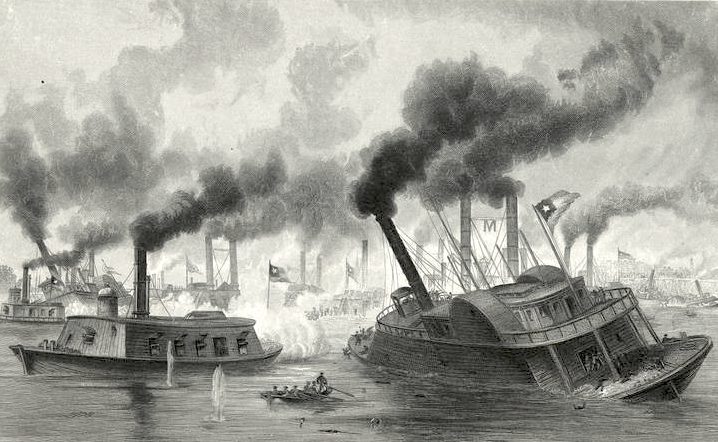
First Battle of Memphis
The citizens of Memphis got front-row seats to the destruction of their own navy. On the morning of June 6, 1862, thousands of people gathered along the bluffs overlooking the Mississippi River to watch eight Confederate vessels steam out to meet nine Union gunboats and rams. The battle lasted less than two hours. By noon, every Confederate ship but one had been destroyed or captured, Memphis had surrendered to federal authority, and the Mississippi River lay open from Cairo, Illinois, to the outskirts of Vicksburg. It was one of only two purely naval battles of the entire Civil War, fought hundreds of miles from the nearest ocean. Its most lasting significance was a lesson in command: both sides entered with fatally flawed leadership structures, and the debacle ensured that civilians would never again be permitted to command American warships in combat.
Cottonclads and Rams
The Confederate fleet was a desperate improvisation. Fourteen river steamers had been seized at New Orleans and converted into rams to defend the city, their bows reinforced for ramming and their engines protected by double bulkheads of heavy timber skinned with railroad iron. The gap between the bulkheads was packed with cotton -- the least important layer of armor but the one that caught public imagination, earning the vessels the nickname "cottonclads." Eight of these ships were sent north to Memphis under James Montgomery, a civilian riverboat captain with no military training. His subordinate captains were also former civilian rivermen, chosen by Montgomery and equally untrained. Once a battle began, Montgomery's authority evaporated: each captain operated independently. Gun crews had to be borrowed from the Confederate Army, and these soldiers took orders from their own army officers rather than the ship captains. Military men recognized the arrangement as unworkable, but their protests were ignored.
Two Fleets, No Unity
The Union side had its own command problems. The five ironclad gunboats belonged to the Mississippi River Squadron under Flag Officer Charles H. Davis, who reported to Major General Henry Halleck -- making the gunboats technically part of the Army despite being crewed by Navy officers. The four rams belonged to a completely separate organization, the United States Ram Fleet, commanded by Colonel Charles Ellet Jr., who reported directly to Secretary of War Edwin Stanton in Washington. The two units shared no common commander short of the president himself. The rams carried no guns at all -- their only weapon was their reinforced bow, designed to slam into enemy vessels at speed. Their crews were civilians, their captains had no naval training, and coordination with the gunboats was essentially voluntary. It was an arrangement built for chaos.
Melee on the Mississippi
By early June 1862, the railroads linking Memphis to the eastern Confederacy had been cut after the federal victory at Corinth, Mississippi. The Confederate army abandoned Memphis, leaving only a rear guard and the River Defense Fleet, which could not flee because it lacked coal. Montgomery chose to fight rather than scuttle his ships. His cottonclads steamed out at dawn on June 6 to meet the federal fleet, with Memphis citizens cheering from the bluffs. The battle quickly devolved into a melee. Ellet's ram flagship charged ahead of the gunboat line and slammed into CSS Colonel Lovell. One or more cottonclads rammed back. Ellet took a pistol shot to the knee -- the only Union casualty of the entire engagement -- a wound that, combined with measles contracted in the hospital, killed him two weeks later. The federal ironclads poured fire into the cottonclads from close range, their heavy guns tearing apart the lightly armed Confederate vessels. Eyewitness accounts of the confused action contradict each other wildly, but the result was unambiguous: seven of eight Confederate ships were destroyed or captured.
The River Opens
Only CSS General Earl Van Dorn escaped, fleeing to the Yazoo River near Vicksburg. Confederate casualties totaled roughly 100 killed or wounded and 150 captured. The Union Navy repaired four captured Confederate vessels -- General Price, General Bragg, Sumter, and Little Rebel -- and added them to the Mississippi River Squadron. Memphis surrendered by noon. The Mississippi was now open from the north all the way to Vicksburg, but federal commanders failed to grasp the strategic significance for nearly six months. Not until November 1862 did Ulysses Grant begin the campaign to complete control of the river. The battle remains a cautionary tale about divided command and amateur leadership in military operations. It also represents a turning point in American naval professionalism: after the spectacle of civilian rivermen commanding warships in a pitched battle, the practice was permanently retired. Memphis itself would see another military engagement in August 1864, when Nathan Bedford Forrest led a nighttime cavalry raid into the city, but the river battle of June 1862 was the day the city changed hands.
From the Air
Located at 35.129°N, 90.156°W on the Mississippi River immediately north of downtown Memphis, Tennessee. The battle took place on the river itself, with the Memphis bluffs providing the spectator gallery on the east bank. The river is wide and clearly visible from any altitude. Memphis International Airport (KMEM) is approximately 10 nm southeast. The downtown Memphis waterfront, including the Hernando de Soto Bridge and Mud Island, are prominent landmarks. Best viewed at 3,000-5,000 feet AGL to appreciate the river width and bluff topography that shaped both the battle and its audience.