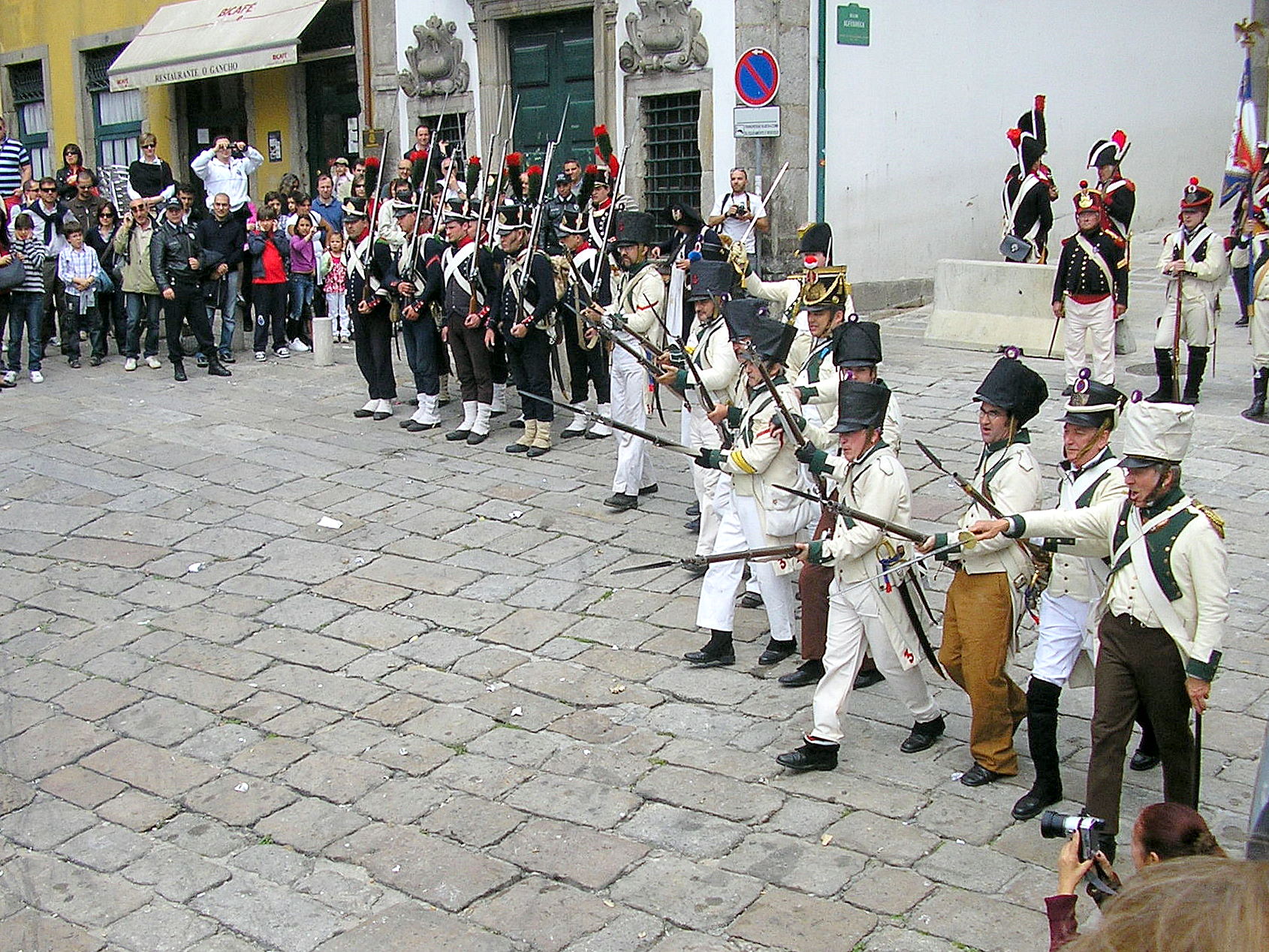
First Battle of Porto
The Ponte das Barcas -- the Bridge of Boats -- was a permanent pontoon bridge spanning the Douro River at Porto. On March 29, 1809, it became a death trap. As Marshal Soult's French forces overwhelmed the city's defenders and cavalry poured through the streets, thousands of civilians stampeded toward the bridge, desperate to reach the south bank and safety. Portuguese soldiers, trying to prevent the French from crossing, began sabotaging the structure. Artillery fire from the south bank, aimed at the French cavalry pursuing the refugees, struck the bridge instead. Under the combined weight of fleeing humanity, the Ponte das Barcas collapsed. Thousands drowned in the Douro.
Napoleon's Impossible Timetable
After the Battle of Corunna in January 1809, Napoleon ordered Marshal Nicolas Soult to invade Portugal from the north. The timetable was characteristically Napoleonic in its ambition and its disregard for reality: Porto was to fall by February 1, Lisbon by February 10. Napoleon failed to account for the state of the roads, the condition of Soult's troops, or the fact that a guerrilla war had erupted across northern Portugal and Spain. Soult's II Corps comprised 23,500 men including 3,100 cavalry, organized into four infantry divisions under generals Merle, Mermet, Heudelet, and Delaborde, with two attached dragoon divisions. His first attempt to cross into Portugal was stopped cold by local militia on February 16.
The Road Through Braga
Blocked at the border, Soult circled northeast into Spain through Ourense, found an unguarded bridge, and marched south. The French crossed into Portugal and occupied Chaves on March 9. Moving west to Povoa de Lanhoso, Soult encountered Baron Eben's 25,000-man force -- mostly Portuguese militia armed with muskets, pikes, and agricultural implements. At the Battle of Braga on March 20, the result was a massacre. The outmatched Portuguese lost 4,000 killed and 400 captured against French casualties of just 40 dead and 160 wounded. Soult also seized 17 cannons. The road to Porto lay open, and the defenders who remained knew what was coming.
A City Under Arms
Bishop Castro organized Porto's defense, assembling 24,000 men: 4,500 regulars from the 6th, 18th, and 21st Infantry Regiments supplemented by 10,000 ordenancas -- militia -- and 9,000 armed citizens. It was not enough. Soult concentrated his assault on the weakest part of the Portuguese defensive line north of the city, sending Merle, Mermet, Heudelet, Franceschi, and La Houssaye against positions held by undertrained troops. The Portuguese line dissolved almost immediately, and the battle became a rout. French cavalry chased the defenders through the streets of Porto, and the regular Portuguese units were annihilated. The civilians of Porto, caught between an army in retreat and an army in pursuit, had nowhere to go but south -- toward the river, toward the bridge.
Catastrophe on the Douro
The collapse of the Ponte das Barcas was not a single event but a cascade of failures. Refugees packed the pontoon bridge so densely that movement became nearly impossible. Portuguese troops, knowing the bridge was the only crossing point, attempted to destroy it to prevent French pursuit. Artillery from the south bank of the Douro fired on the French cavalry behind the crowd, but rounds fell short into the mass of people on the bridge. The structure gave way. In the battle and the storming of the city, the Portuguese lost approximately 8,000 killed. The French captured 197 cannons and seized a squadron of Spanish naval vessels and 30 merchant ships in the roadstead, along with large British military stores. French casualties totaled 72 officers and 2,000 soldiers.
A Victory That Unraveled
Soult had Porto, but his triumph was already crumbling. Almost immediately, the ordenancas -- the same militia forces he had dismissed as inferior -- cut his communications with Spain. A 1,800-man French garrison at Chaves was forced to surrender to Francisco Silveira's Portuguese force. Isolated in a hostile city, Soult began planning retreat rather than the march on Lisbon that Napoleon had demanded. The Second Portuguese campaign continued: at the Battle of Grijo, Portuguese forces engaged the French again, and Porto itself was liberated weeks later when the British and Portuguese under Arthur Wellesley -- the future Duke of Wellington -- won the Second Battle of Porto. The Ponte das Barcas disaster left a scar on the city's memory that persists to this day, a reminder that in war, the heaviest toll often falls on those who carry no weapons.
From the Air
Located at 41.15N, 8.61W in the historic center of Porto, Portugal. The battle took place across the northern approaches to the city and along the Douro riverfront. The site of the Ponte das Barcas disaster is near the present-day Dom Luis I Bridge. Nearest airport is LPPR (Francisco Sa Carneiro, ~11 km northwest). The Douro River, the Ribeira waterfront, and the steep granite banks where civilians were trapped are all visible from altitude. The battlefield extended north from the river into what is now Porto's urban core.