First Battle of Springfield
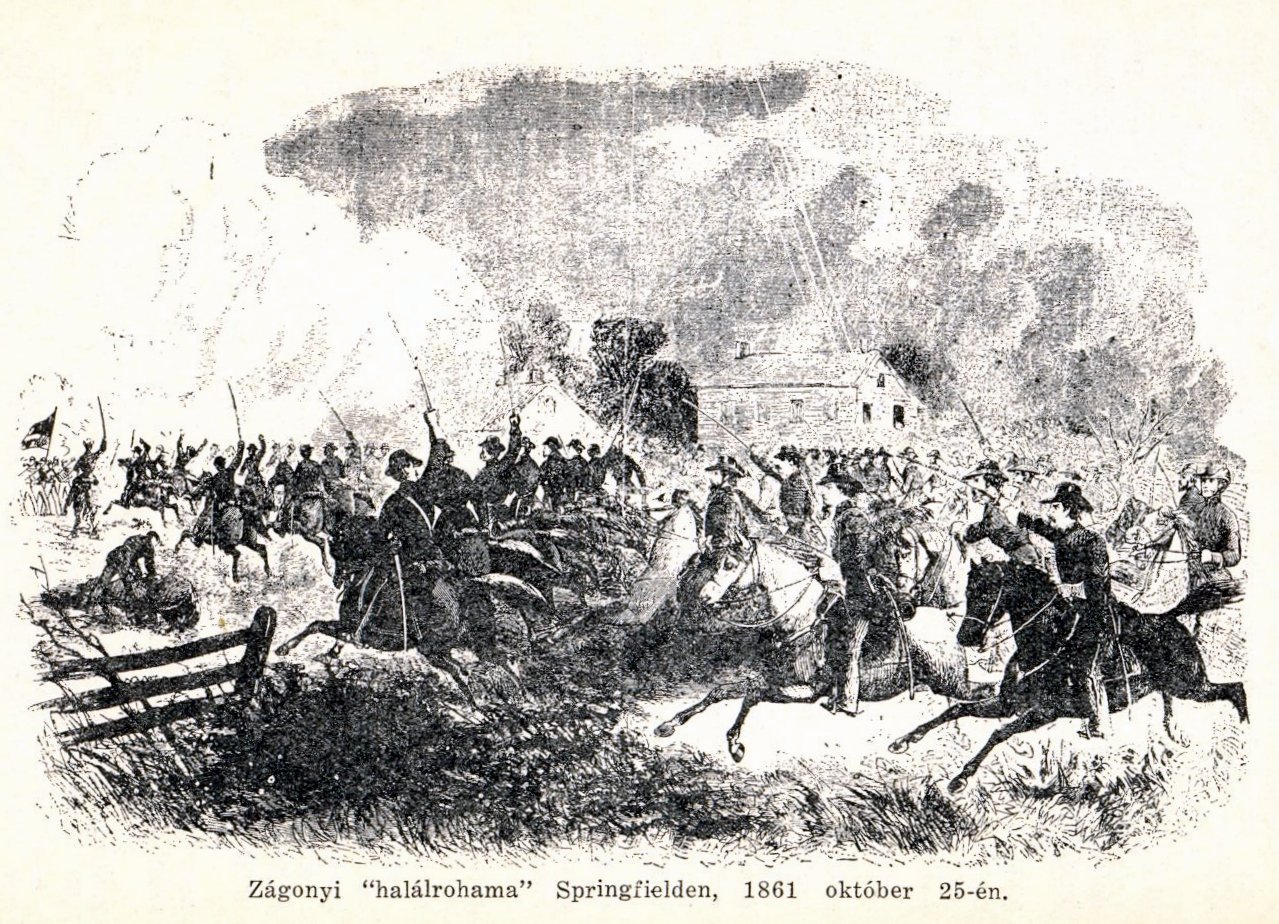
"The truth of what happened in Springfield on this October day is lost beyond recovery." So wrote historian Stephen Z. Starr about the First Battle of Springfield, fought on October 25, 1861. The battle's fog was thickened not by weather but by deliberate fabrication. Major Charles Zagonyi, a Hungarian cavalry officer serving as General John C. Fremont's personal bodyguard commander, led roughly 300 horsemen in a charge against 1,000 Missouri State Guard recruits dug in on a wooded ridge. After the fight, Zagonyi filed an official report designed to glorify his own troops while erasing the contributions of the Prairie Scouts who fought alongside him. He claimed to have raised the American flag over Springfield. Evidence suggests that never happened either. What is certain: it was a wild, confused cavalry action that accomplished very little but became celebrated in the Northern press as "Zagonyi's death-attack."
A General's Bodyguard Goes to War
The battle's origins lie in the chaotic autumn of 1861 in Missouri. After the Union defeat at Wilson's Creek in August and the fall of Lexington to Sterling Price's Missouri State Guard in September, Major General John C. Fremont launched a campaign to reclaim southern Missouri. Fremont outnumbered Price roughly 38,000 to 18,000, and Price fell back toward Neosho. But Fremont had brought with him from the East a retinue of foreign-born officers, including Zagonyi, who had recruited a cavalry unit called the Body Guard. On October 24, Fremont dispatched Zagonyi on a scouting mission toward Springfield. The next day, Zagonyi linked up at Bolivar with the Prairie Scouts, a cavalry force drawn from companies of the 3rd Illinois Cavalry and the 23rd Illinois Infantry, under Major Frank J. White. White was sick and followed in a carriage.
The Charge on the Ridge
Springfield was defended by Colonel Julian Frazier and roughly 1,000 badly armed and trained Missouri State Guard recruits. Zagonyi approached from the north with about 300 men, but a chance encounter with a small Guard patrol blew the element of surprise. One guardsman escaped to raise the alarm. Zagonyi swung west to approach from a different direction. White, unaware of the route change, arrived from the north and was captured. At around 4:00 p.m., Zagonyi's cavalry encountered Frazier's position on a partially wooded ridge with Crane Creek in front. Accounts of the charge diverge wildly. One version has a single successful charge driving off the defenders. Another describes an initial repulse followed by a second successful attack. A third has three separate charges. What the conflicting sources agree on is that fences had to be torn down or gaps found for the cavalry to pass through, that fighting was hand-to-hand in places, and that Frazier's men eventually fled toward Neosho.
The Rewritten Record
Zagonyi entered Springfield but withdrew north at dark, concluding he did not have enough men to hold the city. His wounded were abandoned. Then came the paperwork. Zagonyi's official report claimed the Prairie Scouts had not participated in the charge. The Prairie Scouts' own report contradicted this: two companies under Captain Charles Fairbanks had fought near the Guard's rear and launched three flanking attacks. Captain Patrick Naughton's company had fought alongside Captain Foley's Body Guard unit due to a battlefield mix-up. Zagonyi reported killing at least 106 guardsmen and capturing 27 more. A postwar Confederate account claimed Frazier lost only two or three men. The truth lies somewhere in the gap. George Boker wrote a poem about the charge. Fremont compared it to the Charge of the Light Brigade. The Northern press celebrated it as a heroic action. Federal troops occupied Springfield without opposition two days later.
A Monument to a Mystery
The battle's aftermath proved as chaotic as its execution. Fremont had already damaged his position with the unauthorized Fremont Emancipation, which attempted to free enslaved people in Missouri. Political enemies, accusations of contractor graft, and a negative report from the Adjutant General sealed his fate. He was relieved in early November and replaced by Major General David Hunter, who promptly abandoned Springfield, letting Price reoccupy the city. Hunter was soon replaced himself by Henry W. Halleck. A Federal offensive in early 1862 finally drove Price out of Missouri for good. Fremont and Zagonyi were reassigned to what is now West Virginia. Zagonyi left the military entirely in June 1862. Today, Springfield's Zagonyi Park contains a 1931 monument commemorating the charge, though the accuracy of the monument's text has been challenged. It is a fitting tribute: a memorial to an event whose details remain as contested as they were the day they happened.
From the Air
Located at 37.204N, 93.321W on the western edge of Springfield, Missouri, at approximately 1,300 feet MSL. Springfield-Branson National Airport (KSGF) lies approximately 8 nm to the northwest. The battle site was on a wooded ridge near Crane Creek, west of the city center. The terrain has been heavily urbanized since 1861. Zagonyi Park, containing the 1931 monument, is within the modern Springfield city limits. Wilson's Creek National Battlefield lies approximately 10 nm to the southwest. Best viewed at 3,000-5,000 feet AGL to see Springfield's urban footprint and its relationship to the surrounding Ozark terrain. The city serves as a central reference point for multiple Civil War battle sites in southwest Missouri.