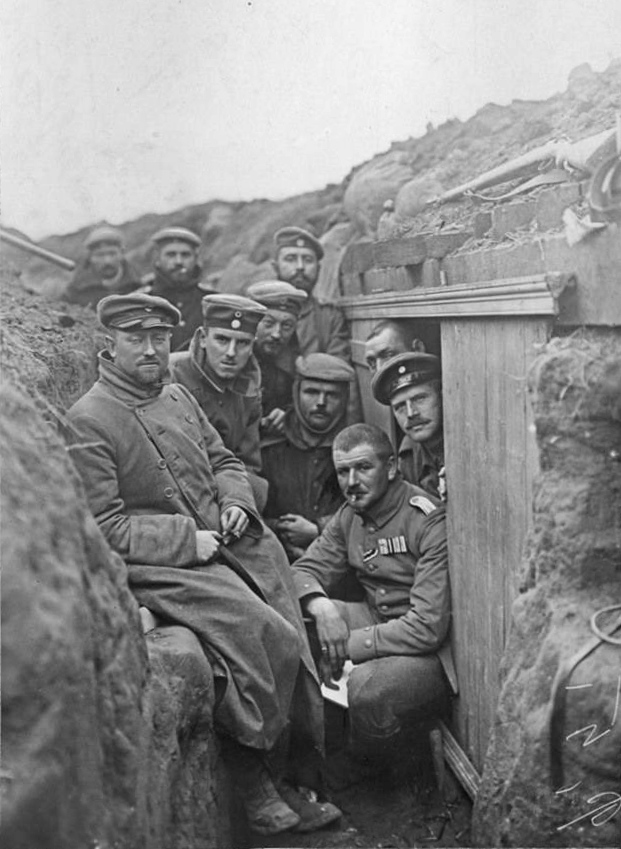
First Battle of Ypres
The men who fought here in October 1914 had been soldiers before the war began. They were the long-service professionals of the British Regular Army - Tommies who had served in India, on the North-West Frontier, in South Africa, men who could fire fifteen aimed rifle rounds a minute and called it the 'mad minute.' By the end of November, most of them were dead. The First Battle of Ypres is the place where the old army that crossed to France in August was extinguished, and where the war of movement ended. Everything that came after - the trenches, the mud, the long bleeding stalemate - began here, on the low Flemish ground between Diksmuide and the Lys.
The Race That Ended in a Town
Through September and October 1914, the German and Allied armies sidestepped each other northward, each trying to outflank the other's open right wing. Historians call it the Race to the Sea, though no one was racing toward water - they were running out of room. When the last open ground closed up around the Belgian coast on 17 October, the only gap left was the low rise of land east of an ancient cloth-trading town called Ypres. The British I Corps reached Ypres on 19 October with orders to attack toward Bruges. The German 4th Army, freshly assembled with four corps of volunteer reservists, was advancing in the opposite direction with orders to break through to Calais. The two forces collided in the rain east of Ypres, and the manoeuvre warfare of 1914 began its final convulsion.
Kindermord at Langemarck
The German reserve corps were full of young volunteers - students, schoolboys, factory clerks - who had enlisted in August and trained for barely two months. From 21 to 24 October they were thrown in dense waves against the British line near Langemarck, where regulars who could shoot fifteen rounds a minute waited in shallow trenches. German accounts called it the Kindermord von Ypern, the Massacre of the Innocents at Ypres - a myth that grew in the telling, but built on a real horror. Whole companies fell singing in the autumn fields. The British, outnumbered and astonished, often thought they were facing far more men than they were, because each German wave came so close before being cut down. Both sides lost the future they had imagined for themselves in those four days.
Gheluvelt and the Worcester Charge
By the end of October the British line east of Ypres was held together by exhaustion and stubbornness. On 31 October, the German 30th and 54th Reserve Divisions broke through at the village of Gheluvelt on the Menin Road, threatening to cut the British army in half. Field Marshal Sir John French believed the battle was lost. Then approximately 370 men of the 2nd Battalion, Worcestershire Regiment, fixed bayonets and charged across open ground into the gap. They retook Gheluvelt chateau and stabilised the line. It was the kind of action that would have been impossible a year later, when machine guns and artillery had matured into the killers they would become. In November 1914, a battalion charge could still change the day. It would be one of the last times that was true.
The Old Army Goes
By the time the fighting faded in mid-November, the British Expeditionary Force that had landed in August was effectively gone. The BEF's losses from August through November were catastrophic - the cohort of regulars who had crossed the Channel that summer was hollowed out. Some battalions came out of the line with fewer than a hundred men. The Belgians had lost roughly half their army. The French had lost hundreds of thousands across the whole 1914 fighting. The Germans had lost tens of thousands of their young volunteers in the Flanders attacks alone. The professionals who had taught the British army how to fight in small wars at the edges of empire were no longer there to teach anyone. From now on, Britain would fight this war with citizen soldiers, Kitchener volunteers, and eventually conscripts - men learning under fire.
What the Battle Decided
At a tactical level, First Ypres ended in stalemate. The Germans had failed to reach Calais. The Allies had failed to drive them out of Belgium. The bulging salient around the town, with Ypres at its tip and German guns on three sides, would stay roughly where November left it for nearly four years. But strategically the battle decided everything. Erich von Falkenhayn, the German chief of staff, concluded over the winter that Germany could no longer hope for a decisive victory in the West by manoeuvre. He shifted to a strategy of attrition - of making the war so costly that one side would simply break. The trenches that the exhausted armies dug in November 1914 were meant to be temporary. They became the geography of the next four years, and the Ypres Salient became the most fought-over patch of ground on the Western Front.
Walking the Old Front Line
Today the ridge east of Ypres is gentle farmland, sugar beet and winter wheat, broken by small Commonwealth cemeteries placed with great care - some holding fifty men, some holding thousands. The village of Gheluvelt is rebuilt. The Menin Road runs straight as it always did. On the rise where the Worcesters charged, a small memorial marks the chateau grounds. In the Hooge Crater Museum and at Sanctuary Wood, you can still see fragments of the 1914 lines - the shallow scrapes that the regulars dug with entrenching tools because no one had thought to issue them anything better. The cemeteries here hold many headstones inscribed simply: A Soldier of the Great War, Known Unto God. Many of those unknowns belong to the autumn of 1914 - the regulars who held Ypres and disappeared into the Flanders mud.
From the Air
The First Battle of Ypres battlefield centres on the ridge east of Ypres (50.85 N, 2.88 E), extending roughly 10 km eastward through Gheluvelt, Polygon Wood, and Langemarck. Approach from the west at 1,500-3,000 ft AGL to see the gentle rise that determined the battle - it looks like nothing, which is the point. The nearest civil airport is Wevelgem (EBKT), about 25 km southeast. Ostend-Bruges (EBOS) on the coast and Lille-Lesquin (LFQQ) just over the French border are useful diversions. Flat terrain throughout, frequent low cloud and mist - autumn visibility on the salient is often poor, just as it was in October 1914.