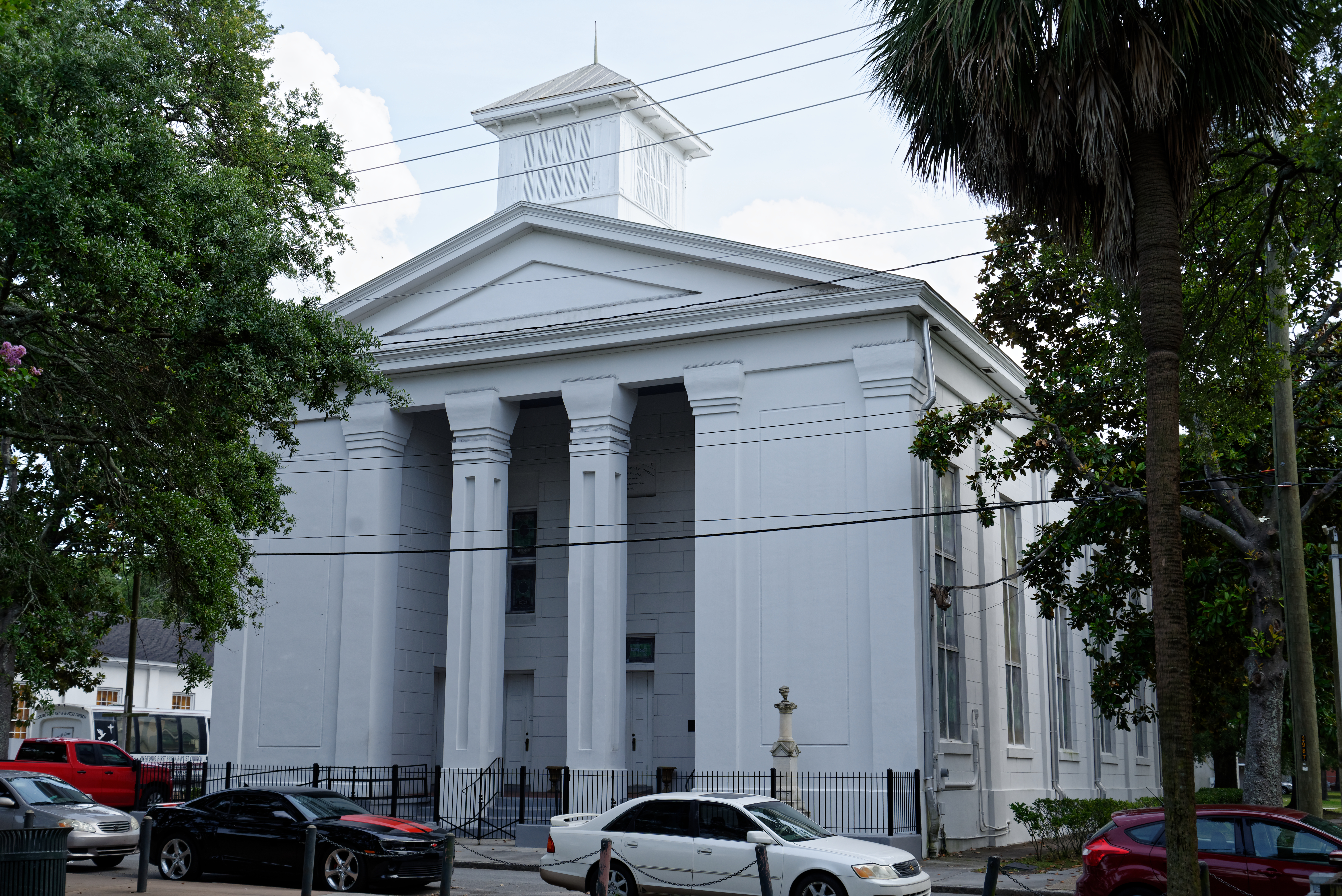
First Bryan Baptist Church: The Oldest Black-Owned Land in America
The deed is dated September 4, 1793. For thirty pounds sterling - roughly one hundred fifty dollars - a formerly enslaved preacher named Andrew Bryan purchased lot number seven in Middle Oglethorpe Ward, Savannah, Georgia. It measured ninety-five feet across and one hundred thirty-two and a half feet deep. On that ground, Bryan erected a church. That parcel has been owned continuously by Black people ever since, making it the oldest such property in the United States. First Bryan Baptist Church still stands at 575 West Bryan Street, still holds services, still carries the name of the man who bought his own freedom and then built something that would outlast him by centuries.
From Plantation to Pulpit
The story begins not with Andrew Bryan but with George Liele, an enslaved man whose talent for preaching was recognized by both Black and white congregants at a Baptist church in Burke County, Georgia. Liele's master, Henry Sharpe, a deacon in that church, permitted him to travel to neighboring plantations along the Savannah River to preach to the enslaved. On one visit to Brampton, a plantation owned by Jonathan Bryan, four people converted and were baptized: Andrew Bryan, his wife Hannah, Kate Hogg, and Hagar Simpson. They became the nucleus of the first Black missionary Baptist church. Andrew Bryan proved equally gifted. With permission, he began preaching along the river as far as Yamacraw, drawing both Black and white listeners. On January 20, 1788, the Reverend Abraham Marshall baptized forty-five converts and ordained Bryan to the ministry with full authority to preach the gospel. On that same date, he organized the congregation that would become First Bryan Baptist Church.
Thirty Pounds Sterling
The early years were marked by worship "under adverse and painful conditions" - services held at Brampton plantation and in a temporary wooden building in Yamacraw. Bryan secured his freedom for a minimal sum, then devoted himself entirely to ministry. Thomas Gibbons donated a lot on Mill Street for a third meeting place. But it was the purchase of the current site in 1793 that anchored the congregation permanently. Bryan, with help from church members and sympathetic white supporters, bought the lot and erected a proper church. The significance of that transaction extends far beyond religion. In a society built on the dispossession of Black people, this was an act of radical permanence - a formerly enslaved man claiming ground and building on it, creating an institution that would endure. The church was incorporated by the State of Georgia in 1866. By 1800, the congregation had grown large enough to split, spawning First African Baptist Church, Second African Baptist, and Third African Baptist.
The Emancipation Connection
First Bryan Baptist Church was not merely a house of worship - it was a center of Black political power in Savannah. James Merilus Simms, a trustee and ordained minister, traveled to Richmond, Virginia in 1862 and returned with the preliminary draft of the Emancipation Proclamation, sharing it with Savannah's Black leadership. On January 1, 1863, Black Savannah held a celebration dinner. Church clerk Edward Wicks served as a Union soldier in the 24th United States Colored Infantry Regiment. Pastor Ulysses L. Houston and trustee Simms both served in Georgia's Reconstruction legislature from 1869 to 1871. Most remarkably, on January 12, 1865, Houston joined nineteen other Black ministers in a meeting with General William T. Sherman, Secretary of War Edwin Stanton, and General Oliver Otis Howard at the Green-Meldrim Mansion. That meeting produced Special Field Order No. 15 - the origin of the phrase "forty acres and a mule." Houston subsequently led one thousand freedpeople to Skidaway Island, where they farmed until 1866.
Built by Black Hands
On August 18, 1873, the congregation voted to tear down Andrew Bryan's original structure and build anew. Civil engineer John B. Hogg, the city surveyor, drew the plans free of charge. The cornerstone was laid on October 13, 1873, by the Grand Lodge of Georgia, Prince Hall, with two subordinate lodges in attendance. Inside the cornerstone sits a copper box purchased by the Sunday School for twenty-two dollars, containing jewelry, coins, receipts, newspaper clippings, and church records donated by members. The labor was done exclusively by Black craftsmen under the architect's supervision. The result is a nearly pure Corinthian edifice - seventy-five feet long, fifty-six feet wide, forty-five feet from foundation to roof peak, with a belfry and bell above. A spacious gallery on three sides gives the sanctuary seating for fifteen hundred. The building cost approximately thirty thousand dollars, not including furnishings. A pipe organ, built in 1856 by the H. Knauff Company of Philadelphia and originally installed at the Independent Presbyterian Church, was purchased in the early 1890s and remains in the sanctuary as a showpiece.
Two Centuries and Counting
First Bryan Baptist Church celebrated its centennial on the evening of January 20, 1888, exactly one hundred years after Andrew Bryan's ordination. That same year, James Merilus Simms published the first history of the congregation through J. B. Lippincott and Company of Philadelphia. The church continued shaping its community through the twentieth century. In 1826, the first Sunday School for Black people in Savannah was organized here by Lowell Mason, the same man who founded the first Sunday School in the city at Independent Presbyterian Church. That Sunday School still operates. The Education Building, dedicated in 1956, houses classrooms, offices, and an assembly hall. The church was listed on the National Register of Historic Places in 1978. Today, the site, buildings, and furnishings are valued at approximately one and a half million dollars. But the real value is incalculable: a place of continuous Black ownership, worship, and community leadership since 1793.
From the Air
Located at 32.08°N, 81.10°W in the historic district of Savannah, Georgia. The church at 575 West Bryan Street is not individually distinguishable from flight altitude, but it sits within the grid of Savannah's distinctive ward-and-square layout, which is clearly visible from above. Savannah's historic district - with its famous tree-lined squares and grid streets planned by James Oglethorpe in 1733 - stands out against the surrounding modern development. The Savannah River forms the city's northern boundary. Nearest airport is Savannah/Hilton Head International Airport (KSAV), approximately 10 miles northwest. Best appreciated from 1,500-2,500 feet when approaching from the south, where the entire historic grid becomes visible against the river.