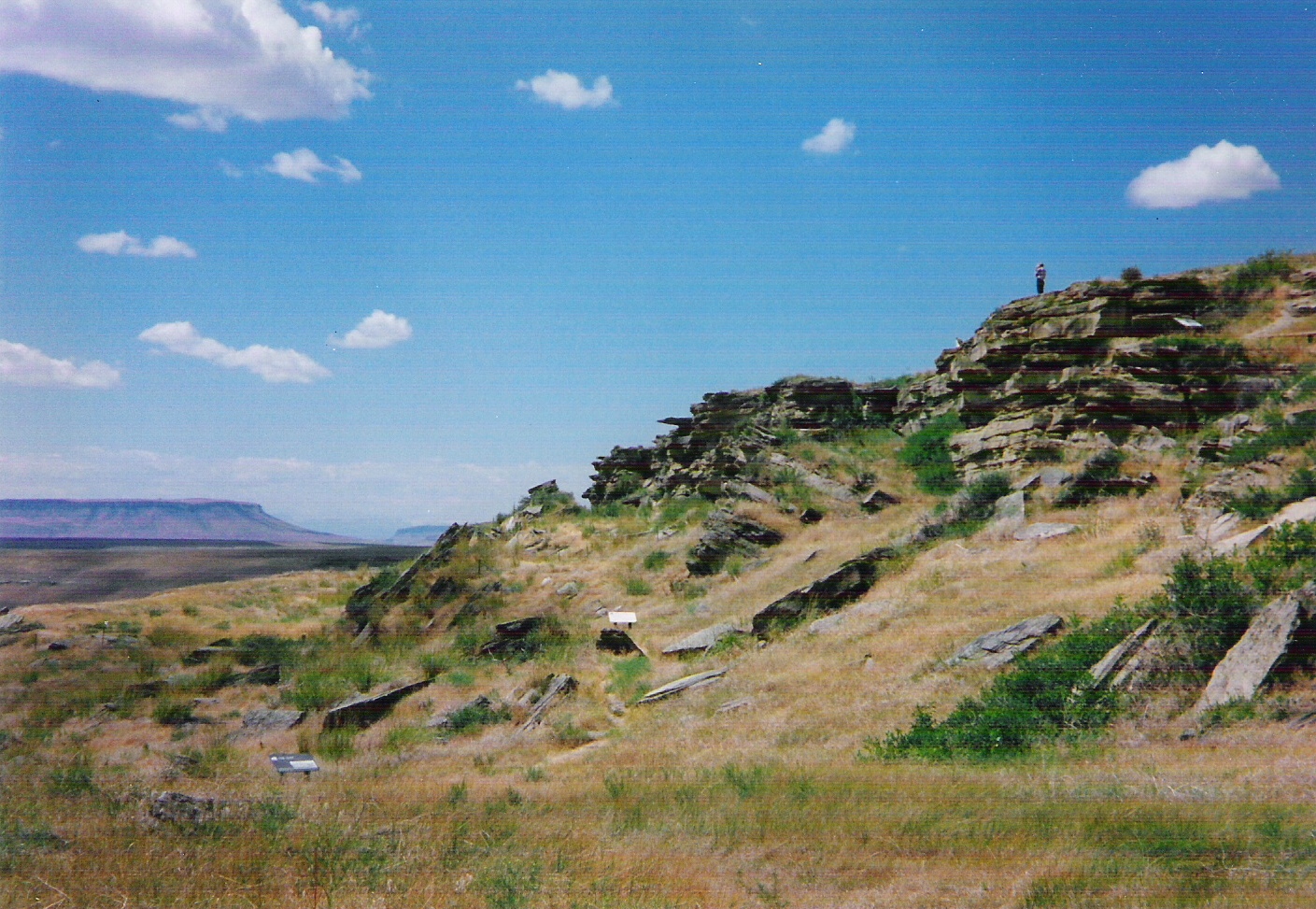
First Peoples Buffalo Jump State Park
The Blackfoot word "pishkun" translates roughly to "deep blood kettle" - a name that captures both the violence and the profound utility of what happened here for over a millennium. At First Peoples Buffalo Jump State Park, a mile-long sandstone cliff rises above the Montana plains northwest of Great Falls, its base concealing a bone bed that stretches the entire length of the precipice. This is North America's largest buffalo jump, and possibly the most heavily used in the world. The evidence lies beneath your feet: layers of bison bones accumulated over centuries, in places reaching depths that archaeologists are still measuring.
The Dog Days Hunt
Before horses arrived on the northern plains around 1700, Native American hunters relied on dogs for transportation and companionship during hunts. This era, known among many tribes as the "Dog Days," required extraordinary coordination to harvest bison. Hunters would slowly encircle a herd several miles from the jump, subtly guiding the massive animals toward the base of the hill that climbed to the cliff's edge. The drive required patience, intimate knowledge of bison behavior, and seamless cooperation among dozens of participants. Once the herd began moving uphill toward the precipice, there was no turning back. Archaeological evidence suggests this pishkun was heavily frequented beginning around 900 CE, though a point discovered in 2011 may push initial use back 5,000 years.
Blood and Bone
Nothing was wasted. After the fall, hunters descended to process the carcasses completely. Meat was dried or smoked for preservation. Hides became clothing, shelter, and containers. Bones were fashioned into tools - knives, scrapers, and needles. Even the blood served a purpose: cooked and mixed with ground grain, it became protein-rich biscuits; combined with other foods, it formed a gelatinous sustenance that could sustain hunters through lean seasons. Evidence of unborn and young calf skeletons at the site suggests that slaughter may have occurred year-round, not just during traditional fall hunts. Seven tribes maintain oral histories connected to this place: the A'aninin, Assiniboine, Cree, Kalispel, Piegan Blackfeet, Salish, and Shoshoni.
Scars of Commerce
The twentieth century nearly erased this sacred landscape. Several buildings in Great Falls and Helena were constructed with sandstone quarried directly from the cliff face. More devastating still, commercial operations removed tons of bison bones from the site, pulverizing them for shipment to the West Coast. There, this ancient accumulation of Indigenous sustenance became fertilizer and explosives. The pishkun was one of the two largest buffalo jumps in America to be mined this way. Amateur archaeologists in the 1950s and 1960s, though well-intentioned, further disturbed the stratigraphy that tells the story of centuries of use. Stone drive lines and tipi rings that survived on adjacent lands offer glimpses of what once spread across this landscape.
Reclaiming the Cliff
The park's modern story is one of patient reassembly. Added to the National Register of Historic Places in 1974 and designated a National Historic Landmark in 2015, the site has grown through decades of land acquisitions and tribal partnerships. The All Nations Pishkun Association, formed by all Native American tribes in Montana, now supports educational programming and helps steward the site. In 2001, land transactions finally connected all portions of the jump and secured almost the entire cliff face. Spanish Barb horses now graze the park's grasslands - direct descendants of horses brought by the Spanish in the 16th century, obtained from the Bureau of Land Management's Pryor Mountains Wild Horse Range. They represent both the animals that transformed Plains culture and a living connection to pre-contact Montana.
Walking the Edge
Today's visitors can walk trails connecting the visitor center to the cliff face, tracing paths that parallel those ancient drive lines. Artifacts remain visible - arrowheads, pottery fragments, bone tools emerging from the soil or barely buried beneath the surface. Each September, the Native American Cultural Fair brings contemporary Indigenous culture to these grounds. In 2000, University of Idaho music professor Dan Bukvich composed "Buffalo Jump Ritual" after visiting the park, a symphonic piece that uses Native American instruments and rocks crashing together as percussion. The music attempts to capture what this landscape witnessed: thunder of hooves, the moment of decision at the cliff's edge, and the profound silence that followed.
From the Air
First Peoples Buffalo Jump State Park lies at coordinates 47.4897N, 111.5292W, approximately 10 miles northwest of Great Falls, Montana. The mile-long east-west sandstone cliff is visible from altitude as a distinct linear feature breaking the otherwise rolling terrain. From the air, look for the pronounced escarpment running perpendicular to the general drainage patterns. The visitor center sits near the cliff base. Nearby airports include Great Falls International (KGTF), approximately 15 nautical miles southeast. Best viewing at 2,000-4,000 feet AGL; the cliff's full extent becomes apparent from altitude but its modest height requires lower approaches for detail. Clear weather recommended for shadow definition along the cliff face.