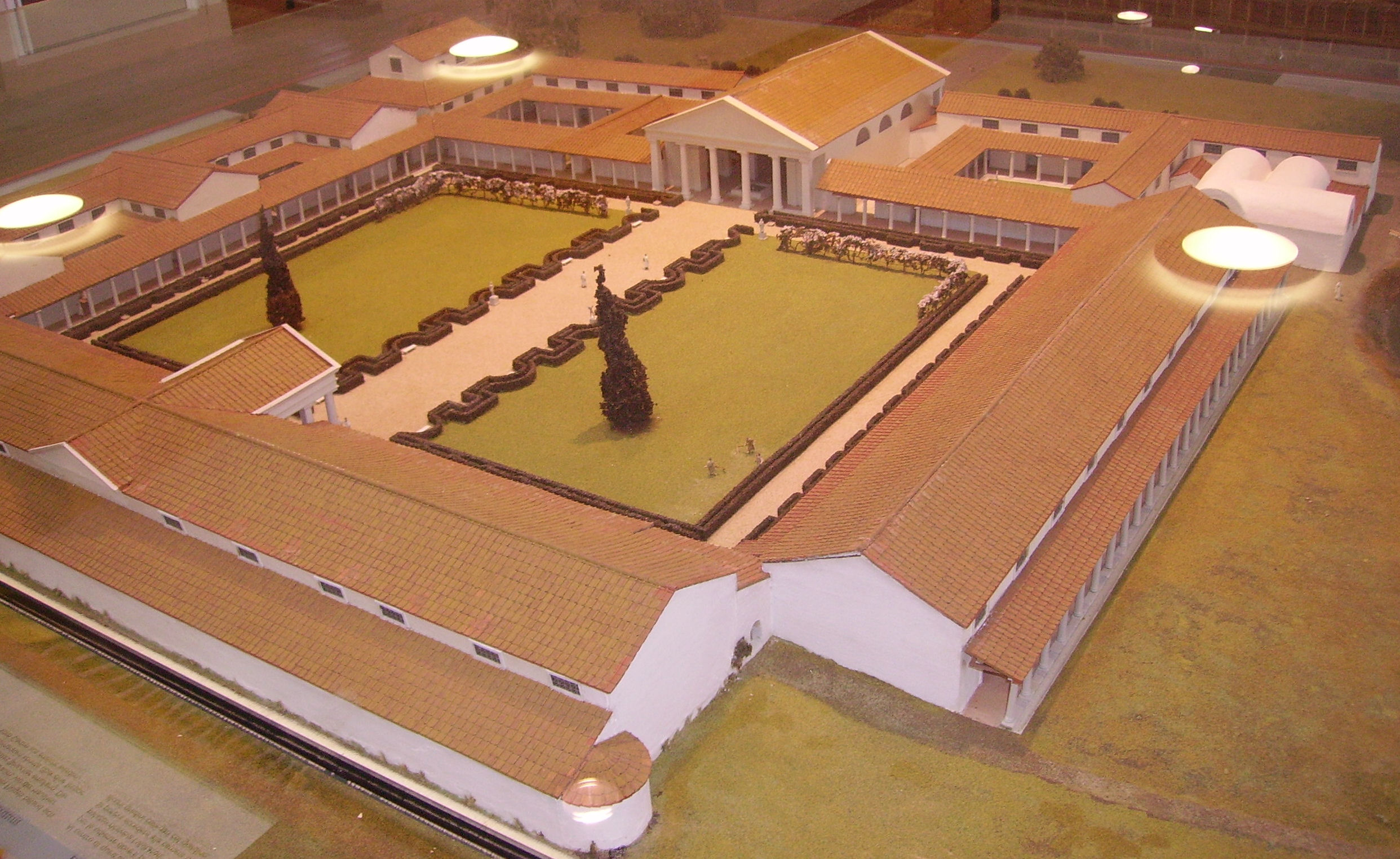
Fishbourne Roman Palace
In 1960, an engineer named Aubrey Barrett was digging a trench for the Portsmouth Water Company near the village of Fishbourne when his shovel hit masonry. Beneath a quiet Sussex field lay the foundations of the largest Roman domestic building ever discovered north of the Alps -- a palace with four wings surrounding formal gardens, fifty mosaic floors, underfloor central heating, and its own harbour opening to the sea. It had been there, forgotten, for seventeen centuries.
A Palace for a Client King
Fishbourne was not built by Romans from Rome. The leading theory, proposed by archaeologist Barry Cunliffe, holds that the palace was the residence of Tiberius Claudius Cogidubnus, a pro-Roman British chieftain installed as king after the Roman conquest of Britain in AD 43. Tacitus praised his loyalty; an inscription found in nearby Chichester commemorates a temple he dedicated to Neptune and Minerva. Around AD 60, Cogidubnus received the rare title of legatus Augusti -- a rank normally reserved for Roman aristocrats. The elevation may explain the scale of what followed: a massive stone palace built between AD 75 and 80, taking five years to complete, with Italian craftsmen imported to execute the decorative work.
Fifty Mosaic Floors
The palace enclosed a formal courtyard garden of roughly 250 feet per side, surrounded by colonnaded walks in the form of a peristyle. The north and east wings contained suites of rooms arranged around smaller courtyards, with a monumental entrance in the center of the east wing and a huge aisled assembly hall in the northeast corner. The west wing held state rooms, a ceremonial reception room, and a gallery. At its peak, the palace contained as many as fifty mosaic floors, the most celebrated being the Cupid on a Dolphin mosaic in the north wing -- a perfectly preserved masterpiece of Roman craftsmanship that visitors can still see today. The south wing overlooked an artificial terrace extending 300 feet toward the sea, planted as a naturalistic landscape with trees, shrubs, a pond, and a stream.
Transformations and Fire
The palace outlasted its original owner and was extensively remodeled in the early 2nd century, possibly subdivided into two or more separate villas. A striking Medusa mosaic was laid over an earlier floor around AD 100. Further major redesigns followed in the mid-2nd century, including new polychrome mosaics featuring cupids, dating to about AD 160. But around AD 270, fire destroyed the north wing. The evidence is vivid: collapsed roof rubble, melted fittings, and burnt doors still standing in their frames when archaeologists excavated the site. The palace was abandoned after the fire, its remains slowly buried under centuries of Sussex soil.
Under the Sussex Soil
Fragments of the palace had actually surfaced before Barrett's discovery. In 1805, workers building a house on the site found a 13-foot pavement and column fragments, but nobody connected the finds to a larger structure. It took Cunliffe's systematic excavations, beginning in 1961, to reveal the palace's full extent. His team unearthed nearly twelve thousand artifacts, including flint tools dating to the Mesolithic period -- evidence that people had lived near this spot for seven thousand years before the Romans arrived. Today, a museum encloses the most significant wing, and the gardens have been replanted with authentic Roman-period species: roses, lilies, rosemary, fruit trees, and boxed hedges. A marble head found during excavations in 1964, identified as a likeness of Nero carved when he was thirteen, hints at the palace's connections to the highest levels of imperial power.
From the Air
Located at 50.84N, 0.81W in the village of Fishbourne near Chichester, West Sussex. The museum and excavated palace are in a low-lying area near the Fishbourne Channel. Chichester/Goodwood Airport (EGHR) is approximately 4nm east-northeast. The Chichester harbour area and South Downs are prominent nearby features. Best viewed at 1,500-2,500 ft AGL.