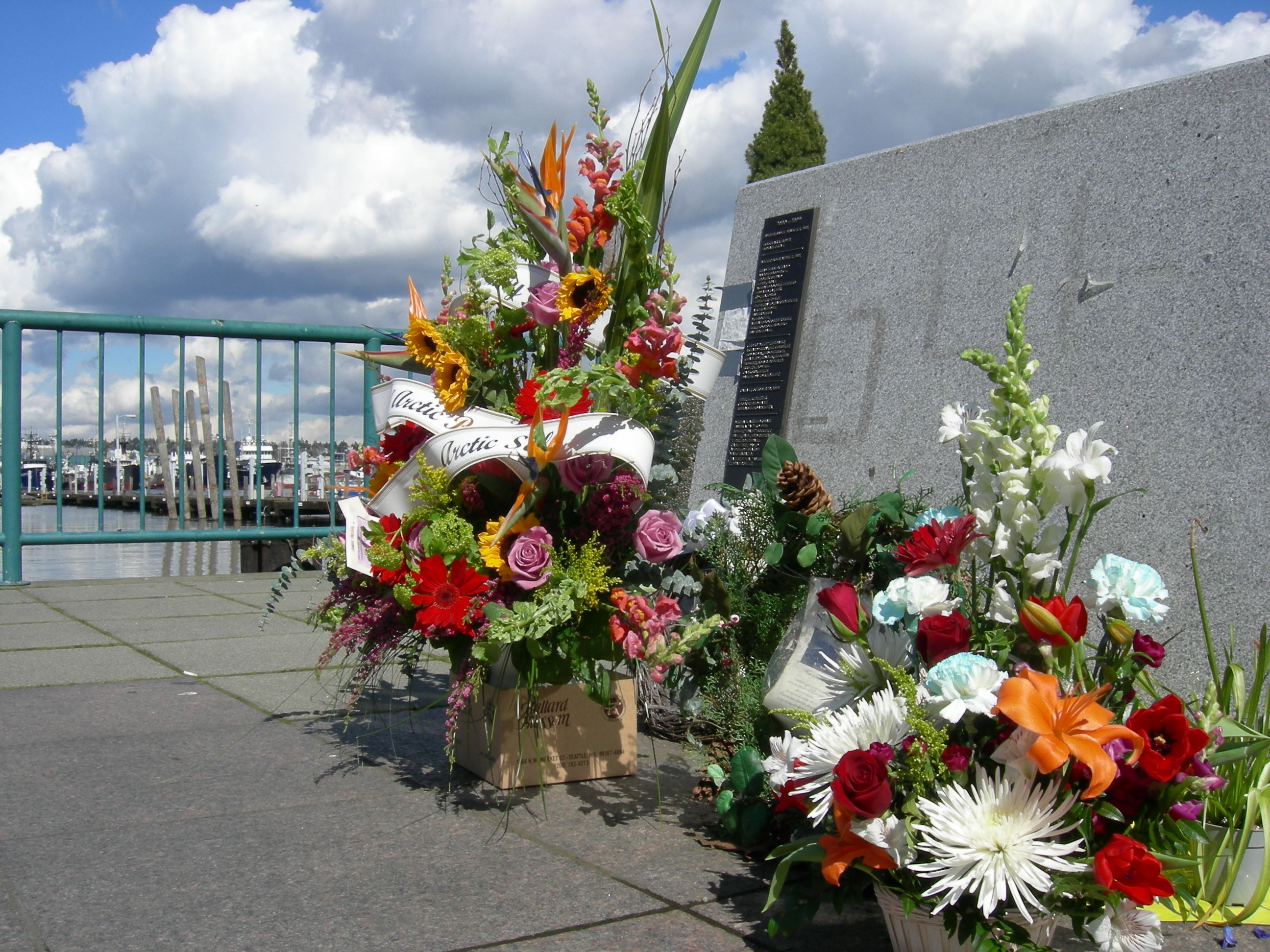
Fishermen's Terminal
The bronze and stone memorial faces the water, positioned between the docks and the Terminal building where it cannot be ignored. Its plaques carry more than 670 names -- commercial fishermen and women from the Seattle area who have been lost at sea since the beginning of the twentieth century. Fresh flowers appear regularly, left by families and crewmates. Fishermen's Terminal has been the home port of Seattle's commercial fishing fleet since it opened in 1914, and the Seattle Fishermen's Memorial is its conscience: a reminder that the boats tied up at these docks go places where the sea can kill you.
A Working Waterfront
Operated by the Port of Seattle, Fishermen's Terminal sits on Salmon Bay in the Interbay neighborhood, east of the Hiram M. Chittenden Locks and immediately west of the Ballard Bridge. It provides freshwater moorage for more than 700 vessels -- an important detail, since freshwater kills the marine organisms that foul hulls in saltwater. The terminal's 227,000 square feet of shoreside space include offices, warehouses, light industrial facilities, three restaurants, a seafood market, a bookstore, and a gift shop. A public access float offers free moorage for up to four hours, making it one of the few places in Seattle where anyone can walk out onto a working commercial dock and stand alongside boats that fish the North Pacific.
The Deadliest Catch Connection
Several of the vessels featured in the Discovery Channel's Deadliest Catch call Fishermen's Terminal home. The show, which documents the crab fishing season in the Bering Sea, brought national attention to a fleet that Seattle had known about for decades. The terminal was also the subject of its own documentary film, Fishermen's Terminal, which examined the tension between commercial fishermen and pleasure boaters after non-commercial craft were allowed to moor at the facility beginning in 2002. For the fishing fleet, the terminal is not a tourist attraction or a backdrop for television -- it is a workplace, the place where gear is stowed, hulls are repaired, and crews assemble before heading north to Alaska.
The Names on the Wall
Since 1988, the terminal has hosted the annual Fishermen's Fall Festival to welcome back the North Pacific fishing fleet. The celebration marks the end of a season that always claims lives. The Seattle Fishermen's Memorial, managed by its own nonprofit organization, serves as the permanent record of that cost. More than 670 names are inscribed on its plaques. Among them are the fifteen crew members of the Arctic Rose, a trawler that sank in the Bering Sea in 2001 with all hands -- the worst American fishing vessel disaster in over fifty years. Each name on the memorial represents a person who went to work on the water and did not come home, in an industry where that remains a possibility every season. The memorial does not romanticize their deaths. It simply records them, facing the water where they happened.
From the Air
Located at 47.659N, 122.379W on Salmon Bay in Seattle's Interbay neighborhood. The terminal is visible from the air as a large dock complex on the south shore of Salmon Bay, between the Ballard Bridge to the east and the Hiram M. Chittenden Locks to the west. The rows of fishing vessels moored at the docks are distinctive. Best viewed at 1,500-2,500 feet AGL. Nearest airports: Boeing Field/King County International (KBFI), 6 nm south; Kenmore Air Harbor (S60), 8 nm northeast.