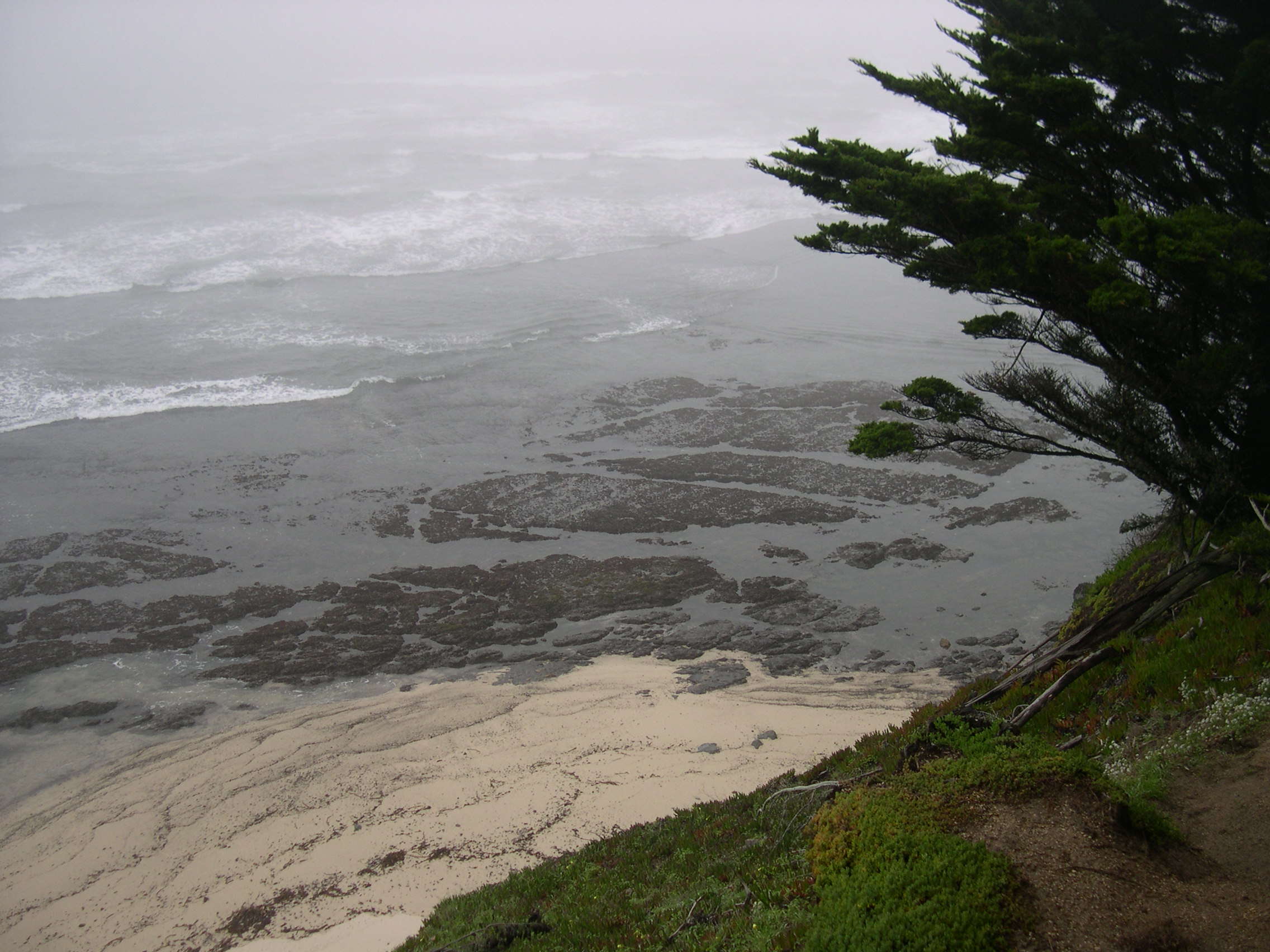
Fitzgerald Marine Reserve
Kneel at the edge of a tide pool at Fitzgerald Marine Reserve and you are looking into one of the most biologically significant stretches of coastline in California. The state has designated only 34 coastal habitats as having "Special Biological Significance," and this three-mile ribbon of beach, bluffs, and reef just south of Montara ranks among them. Sea urchins bristle in rocky crevices. Anemones pulse in the wash. Hermit crabs negotiate their borrowed shells across granodiorite reef that has endured the Pacific's grinding for millennia. Twenty miles south of San Francisco, the reserve feels like another world entirely.
Five Thousand Years at the Tideline
Native Americans first settled this coast approximately 5,800 years ago, drawn by the same abundance of marine life that draws visitors today. Remains of the Smith-Doelger homesite from the early 1900s still mark the bluffs, but the site's modern identity began with the Ocean Shore Railroad, which reached Moss Beach in 1908 and transformed it into a tourist destination. By the mid-twentieth century, decades of collecting by marine biologists and casual visitors had taken a visible toll on the tide pools. In 1969, San Mateo County urged the state to intervene. On August 5 of that year, the reserve was officially designated and named for James V. Fitzgerald, former mayor of San Bruno and a longtime county supervisor who had championed the coast's protection.
A Living Laboratory at Low Tide
The reserve's ecology is layered and intricate. At its northern edge, San Vicente Creek empties into the Pacific, supporting red willow and other riparian species along its banks. A footbridge crosses the creek to a bluff trail that rises roughly 100 feet above the beach, offering views down to Frenchmans Reef, one of the richest marine ecological zones in the area. The reserve extends seaward to depths of over 300 meters. On the bluffs above, the rare Hickman's potentilla clings to existence. First observed near the mouth of San Vicente Creek in 1933, this tiny plant was listed as a federal endangered species in 1998. Nearby, the San Bruno elfin butterfly, one of the most range-restricted species in North America, has been sighted adjacent to the reserve in Montara.
Where the Earth Cracks Open
A geologic fault line forms much of the reserve's eastern boundary. The Seal Cove Fault, first mapped by William Glen in 1959, was originally recognized as a northward extension of the San Gregorio Fault. Later submarine surveys revealed it continues northward under the Pacific Ocean, presumably connecting with the San Andreas Fault near Bolinas. The fault's trace was once clearly visible in a sea cliff at the reserve's northern end, though human modifications have since obscured it. This tectonic activity has shaped the coastline itself, creating the eroded bluffs and exposed reef that make the tide pools possible. The reserve sits, quite literally, on the edge of a moving world.
Speakeasy Views and Silver Screen Moments
The reserve's southern edge borders the Moss Beach Distillery, a clifftop restaurant that has served patrons since 1927, when it opened as a Prohibition-era speakeasy. The bluffs overlooking the reserve gained a different kind of fame when the opening sequence of the film Memoirs of a Geisha was filmed there. But the reserve's most constant attraction requires no Hollywood lens. At low tide, the coastal strand comes alive with California sea lions, harbor seals, snowy egrets, great blue herons, and cormorants. Dense pickleweed in the salt marshes shelters rodents, reptiles, and rabbits, while arroyo willows along the freshwater seepage draw migrating warblers each season. It is a place where the boundary between land and sea dissolves twice daily, revealing a world most people never think to look for.
From the Air
Located at 37.51°N, 122.51°W on the San Mateo County coast. Visible from low altitude as a stretch of rocky coastline between Montara and Pillar Point. The Moss Beach community and Pillar Point Harbor are nearby visual references. Half Moon Bay Airport (KHAF) is approximately 3 nm to the south. San Francisco International (KSFO) is 15 nm to the north-northeast. Best viewed at 1,500-2,500 ft AGL for coastal detail.