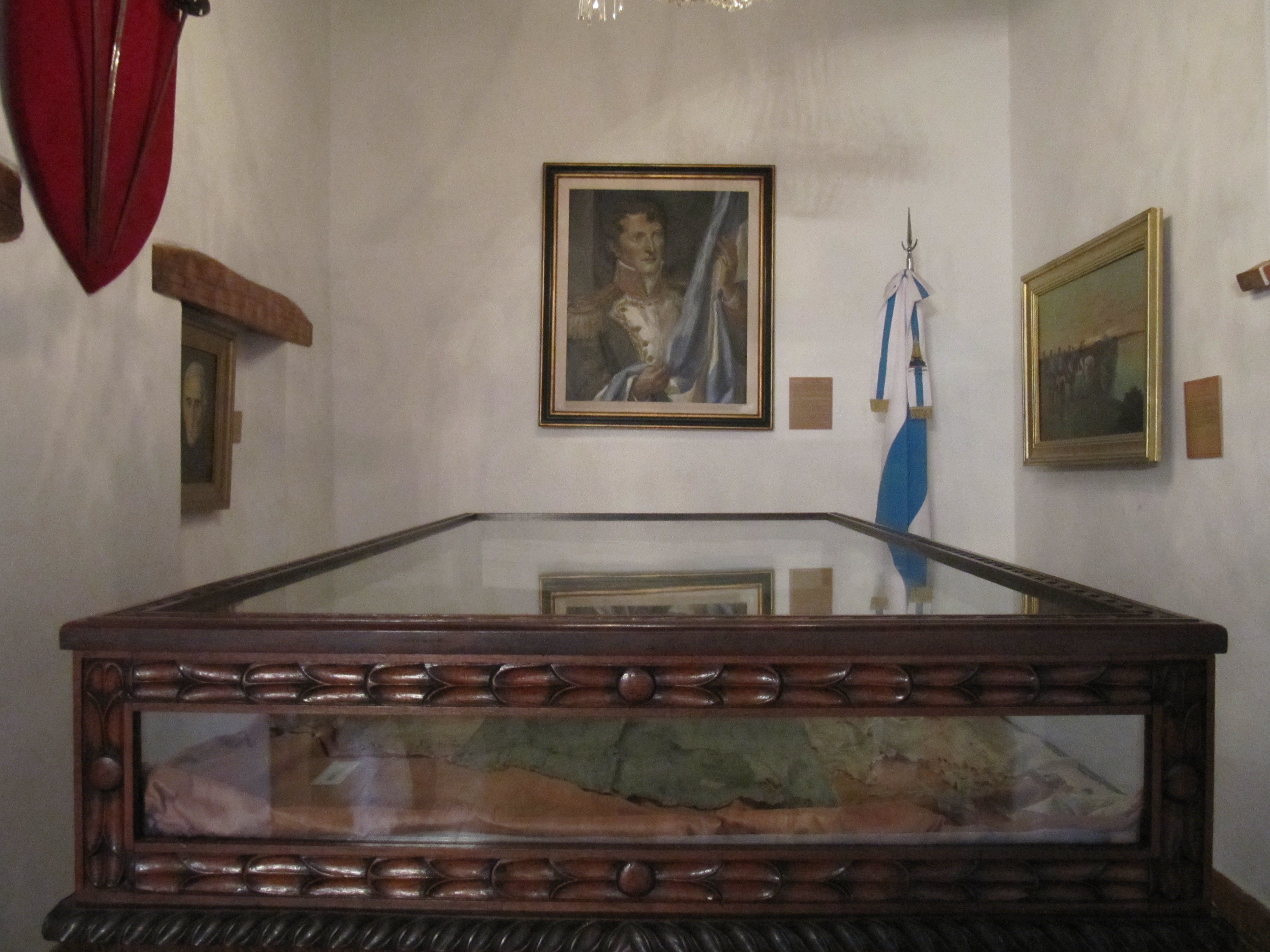
Flags from Macha
Behind a portrait of Saint Teresa of Avila, in a chapel in the hamlet of Titiri near the village of Macha, two silk flags lay folded in darkness for over seven decades. No one alive remembered they were there. The parish priest who hid them in November 1813 had done so under orders from Manuel Belgrano, the Buenos Aires-born lawyer turned revolutionary general who created the Argentine flag and then, facing defeat on the high plateau of Upper Peru, resolved that the enemy would never capture it. When a new priest found the flags in 1885 while restoring the chapel, he was holding the oldest surviving physical flags of Argentina — artifacts from the very first years of a nation that did not yet officially exist.
A Flag Born in Defiance
Manuel Belgrano's decision to create a national flag was, in the political logic of 1812, an act of insubordination. The First Triumvirate governing Buenos Aires was still officially claiming to rule on behalf of Ferdinand VII, the Spanish king held captive by Napoleon. Creating a new flag was an unmistakable declaration of independence — exactly the message the cautious government wanted to avoid. Belgrano did it anyway. On February 18, 1812, the Triumvirate approved a new cockade in white and light blue, and nine days later, Belgrano raised a flag of those same colors at the Bateria Libertad along the Parana River in Rosario. When the Triumvirate ordered him to stop using the flag, the message arrived too late. Belgrano had already marched north to reinforce the Army of the North in Upper Peru, and at San Salvador de Jujuy, he had the flag blessed by the local church on the second anniversary of the May Revolution.
Triumph and Retreat
The Second Triumvirate, more liberal in its outlook, authorized the flag as a war banner in early 1813 through the Asamblea del Ano XIII. The first oath to the newly sanctioned flag took place on February 13, 1813, beside the Salado River — a ceremony so significant that the waterway became known as the Rio Juramento, the Oath River. The Battle of Salta followed, a decisive patriotic victory that crushed royalist commander Pio Tristan's forces. But momentum reversed quickly. At Vilcapugio and Ayohuma, the independence army suffered devastating defeats, and Belgrano's forces retreated south through the harsh Andean landscape. Fearing that pursuing royalist troops would seize the standards as trophies, Belgrano entrusted them to the parish priest of Macha, who concealed them behind a religious painting in a small chapel near Titiri.
Seventy-Two Years in Shadow
Belgrano was recalled to Buenos Aires and sent to Europe on a diplomatic mission. The flags he had created, fought under, and hidden were presumed lost. Decades passed. Bolivia became an independent nation in 1825. The chapel at Titiri continued its quiet existence in the highlands north of Potosi, and the portrait of Saint Teresa kept its secret. Then in 1885, a priest undertaking renovations discovered the two silk banners. They were transferred to the Museum of the Independence in Sucre, where Bolivia kept one. Argentina's ambassador to Bolivia, Adolfo Carranza, requested the return of the other, and in 1896 it was delivered to the National Historical Museum in Buenos Aires. A curious detail divides them: the flag Argentina holds is a triband of blue, white, and blue, matching the modern Argentine flag, while the one Bolivia kept is white, blue, and white.
Silk Against Time
By the time conservators at the National Historical Museum began restoring the Argentine flag in 2007, only seventy percent of the silk remained. Maria Pia Tamborini and Patricia Lissa led the painstaking work, studying fibers that had spent centuries in conditions no textile was meant to endure. The original colors — indigo blue and ivory white — had faded beyond recovery. Today the flag rests in a closed cabinet in a low-light room, shielded from the damage that air and illumination would inflict on what remains. In 2010, the year Argentina celebrated its bicentennial, the flag was displayed publicly for the first time. That same year, Tucuman Province adopted the Macha flag as its official provincial emblem, linking a modern Argentine province to a silk banner that a revolutionary general hid in a Bolivian church two centuries earlier.
From the Air
The hamlet of Titiri near Macha sits at approximately 18.96°S, 65.98°W, in the northern Potosi highlands of Bolivia at roughly 3,800 meters (12,500 feet) elevation. The terrain is arid, mountainous, and sparsely populated. From altitude, the landscape reveals scattered small settlements across the high plateau. Potosi (SLPO) is the nearest airport, approximately 100 km to the south. Sucre (SLSU) lies to the southeast. Expect thin air, strong winds, and rapidly changing mountain weather conditions.