Fleet Prison: Six Centuries of Debt, Cruelty, and Clandestine Marriages
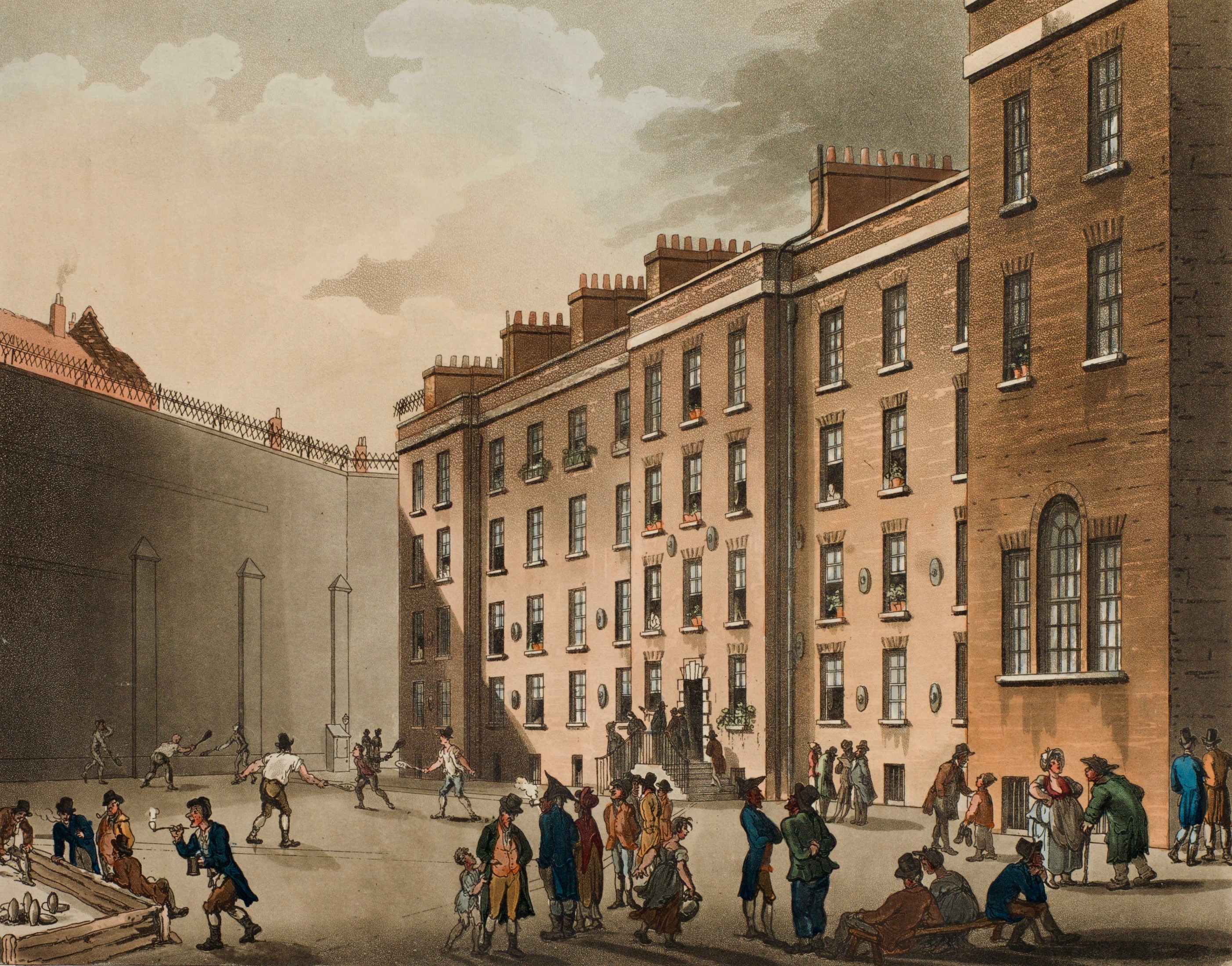
The grille in the wall was for begging. Built into the Farringdon Street facade of Fleet Prison, it allowed prisoners to reach through the bars and plead for alms from passersby. This was not an aberration but a feature of the system. In the Fleet, prisoners paid for everything: food, lodging, the turning of keys, the removal of irons. Those who could not pay starved, or survived on whatever charity they could extract from strangers walking past the wall. The prison stood on the east bank of the River Fleet from 1197 to 1846, destroyed and rebuilt four times, surviving the Peasants' Revolt, the Great Fire of London, and the Gordon Riots. Its story is a concentrated history of how England treated its poor, its debtors, and anyone who fell on the wrong side of power.
A Prison for Debt, Not Crime
Fleet Prison was not primarily for criminals. From its earliest centuries, it held people committed by the Star Chamber and the Court of Chancery, and it became England's most notorious debtors' prison. Being unable to pay what you owed was treated as a moral failing severe enough to warrant incarceration, but the prison itself operated as a profit-making enterprise that kept its inmates perpetually indebted. Prisoners paid for their cells, which ranged from luxurious private rooms for the wealthy to shared beds for the poor. There were fees for entering and leaving, tips expected for servants, and charges for having irons removed. Fleet Prison had the highest fees of any prison in England. The system was circular: you were imprisoned for debt, then charged money you did not have for the privilege of being imprisoned.
The Liberty and the Marriages
Not every prisoner lived within the walls. Those who could afford to compensate the keeper for his lost earnings could take lodgings in a surrounding area known as the 'Liberty of the Fleet' or the 'Rules of the Fleet,' a zone stretching from Ludgate Hill to the Old Bailey to Fleet Lane. This created an extraordinary urban geography: a semi-free zone around the prison where debtors lived in a limbo between confinement and liberty. From 1613, the Liberty also became famous for clandestine Fleet Marriages, weddings performed without banns or license by disgraced clergymen who had taken up residence in the area. These marriages were legally valid but unregulated, attracting couples seeking to marry quickly, secretly, or against their families' wishes. The practice was finally ended by the Marriage Act of 1753.
A Cast of Inmates
The prison's roll call reads like a novel that no one would believe. William Penn, the champion of democracy and religious freedom who founded Pennsylvania, was imprisoned here for debt in 1707. Theodore von Neuhoff, the only person ever to be crowned King of Corsica, died in the Fleet in 1756. Richard Hogarth, father of the painter William Hogarth, spent five years here for debt -- an experience that profoundly marked his son, whose savage engravings of prison life drew on childhood memories. Sir Richard Grosvenor, ancestor of the Dukes of Westminster, spent nearly ten years here after his brother-in-law defaulted on debts that Grosvenor had guaranteed. The warden Thomas Bambridge, who took charge in 1728, became so notorious for torturing prisoners with irons and dungeons that a House of Commons committee investigated and he was committed to Newgate Prison himself.
Three Million Bricks
Fleet Prison was demolished in 1846, yielding three million bricks, 50 tons of lead, and 40,000 square feet of paving. The site lay empty for seventeen years before being sold to the London, Chatham and Dover Railway for their new Ludgate station. Charles Dickens, who knew the prison's successor, the Marshalsea, from his own father's imprisonment there, put the Fleet at the center of The Pickwick Papers, giving Samuel Pickwick a fictional stay that captured the prison's bizarre customs and casual brutalities. Shakespeare sent Falstaff there at the end of Henry IV, Part 2. Thackeray confined Barry Lyndon within its walls for nineteen years. The Fleet Prison is gone, its site buried under railway lines and office buildings, but the world it represented -- a world where poverty was punished and punishment was monetized -- left its mark on English literature, English law, and the English conscience.
From the Air
The site of Fleet Prison is near modern Farringdon Street, central London (51.516N, 0.105W), close to where the underground River Fleet flows south toward the Thames. The area is now occupied by commercial buildings near Ludgate Circus. Nearest airports are London City (EGLC) 10km east and London Heathrow (EGLL) 26km west. From the air, the site is identifiable by its position between St Paul's Cathedral to the south and Smithfield Market to the north, along the route of Farringdon Street.