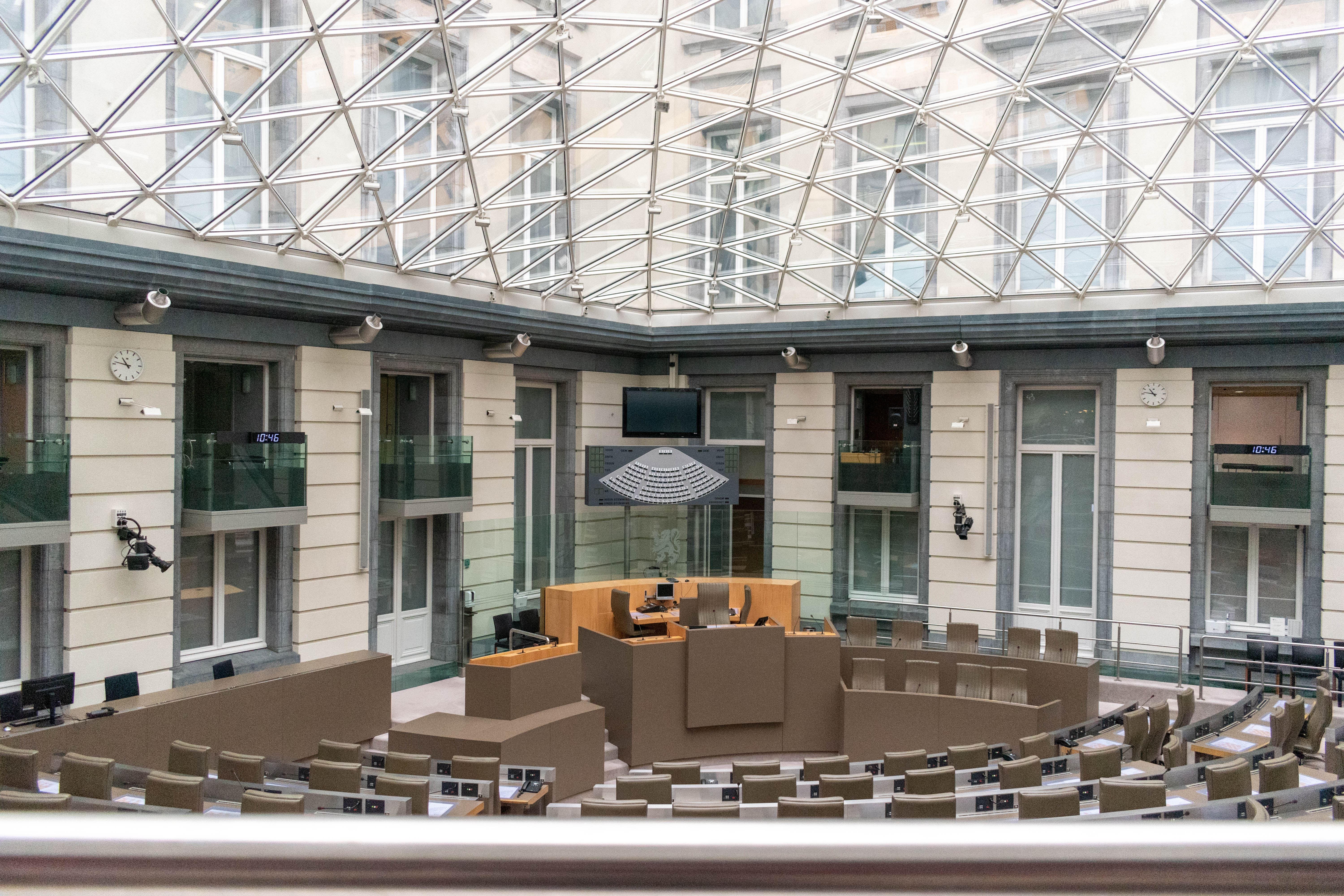
Flemish Parliament
There is a quiet contradiction baked into the address of the Flemish Parliament. It sits on the Hertogsstraat in Brussels, a few minutes' walk from the Royal Park and the federal parliament. But Brussels is officially bilingual, and the Flemish Parliament has authority over the Flemish Region, which does not include Brussels. So 118 of its 124 members are elected by voters who live somewhere else: in Antwerp, Ghent, Bruges, Hasselt, Leuven, Mechelen, the towns and villages of Flanders. Only six members are chosen from within Brussels itself, by those Brussels voters who cast their regional ballots for Dutch-speaking parties. The institution that legislates for one of Europe's most distinct cultural communities does so from a building inside a city it cannot directly govern.
How Belgium Stopped Being Unitary
From its founding in 1830 until 1970, Belgium worked the way most European countries did: one parliament, one government, one set of laws for everyone. The country's two main linguistic communities had long argued about whether this was working, but the structure held. Then between 1970 and 2001, in five successive constitutional reforms, the Belgian parliament voted itself out of its own monopoly. Power was devolved first to the language communities, then to the geographic regions, then to both at once in overlapping ways that diagrams alone can barely capture. Flanders made an unusual choice early on. In 1980, the Flemish Community and the Flemish Region merged. While the French-speaking south kept its Community Parliament and its Wallonia Parliament as separate bodies, Flanders consolidated into one parliament, one government, one address. That decision is why a single legislature on the Hertogsstraat now handles everything from kindergarten curricula to the Port of Antwerp.
What the Decrees Cover
The Flemish Parliament does not pass laws. It passes decrees, the term Belgian constitutional law reserves for legislation issued by communities and regions rather than the federal state. Decrees have the same force as federal law within their domain. There is no hierarchy: federal and Flemish legislators are supposed to operate in separate spheres defined by the Special Law on Institutional Reform. In practice, the Flemish Parliament governs an enormous slice of daily life. Culture, including the public broadcaster VRT. The Dutch language and how it is used in schools, workplaces, and government. Education from kindergarten through university. Health care, except for insurance and hospital financing. Economy, employment, energy. Town planning, housing, environment. Transport and the regional airports. Agriculture, including most of what used to be federal agricultural policy after the 2001 Lambermont Agreement. The provincial and municipal layer below the parliament, all three hundred Flemish municipalities and five provinces, falls under its supervisory authority too.
The September Declaration
The legislative year begins on the fourth Monday of September, when the Speaker of the Flemish Parliament is elected and the Government delivers its September Declaration, modeled on a speech from the throne. Plenary sessions are usually Wednesdays. Bills can come from either the Government, which calls them ontwerp van decreet, or from individual members, whose private bills are called voorstel van decreet. The asymmetry is sharp: during the 2009 to 2014 legislative term, 407 government bills became decrees while only 102 members' bills did. Much of the actual work happens not in plenary but in eleven standing committees, each with fifteen members specializing in subjects like Brussels affairs, education, public works, or the dedicated Subcommittee on Arms Trade, which exists because Flanders inherited from federalism a meaningful role in regulating the country's weapons exports.
An Outsized Foreign Policy
The Flemish Parliament is unusual among regional legislatures in that it can sign international treaties. Within its areas of competence - and only within them - the Flemish Region negotiates directly with other governments, including foreign states. Flanders has its own development cooperation programs in Africa and Latin America, its own trade promotion agency in Flanders Investment and Trade, its own representatives in capitals abroad. The Committee for Foreign Policy, European Affairs, International Co-operation and Tourism is one of the eleven standing committees. This authority emerged from the constitutional principle, called in foro interno in foro externo, that a level of government with internal jurisdiction over a matter also has external jurisdiction. A region that runs its own education system, the reasoning goes, must be allowed to sign treaties about education with foreign partners. Few federal systems take the principle as far as Belgium has.
From De Batselier to Van den Bossche
The Speaker chairs plenary sessions, sets agendas with the Extended Bureau, and is the only Flemish official before whom the Flemish Minister-President does not have to take an oath - because the Minister-President swears in front of the King, not the Speaker. The list of Speakers since direct elections began in 1995 reads like a tour through Flemish politics: Norbert De Batselier of the Socialists held the chair until 2006, followed by the liberal Marleen Vanderpoorten, then a decade of the Flemish nationalist Jan Peumans of the N-VA from 2009 to 2019. Liesbeth Homans, also N-VA, served from 2019 to early 2025. In January 2025, Freya Van den Bossche of Vooruit became the first Socialist Speaker in nearly two decades, taking over a parliament whose 124 members continue to legislate for six million Flemings from a building in a city that votes mostly in French.
From the Air
The Flemish Parliament building sits at 50.85°N, 4.37°E on the Hertogsstraat in central Brussels, between the Royal Park and the EU Quarter. Brussels Airport (EBBR) lies 11 km northeast. From cruising altitude the parliament is part of the dense government district immediately east of the Royal Palace, identifiable by the green expanse of Parc de Bruxelles.