Flin Flon: The Mining Town Named After a Science Fiction Character
The city was named after a science fiction character. In 1914, prospector Tom Creighton found gold-bearing ore along the Manitoba-Saskatchewan border. According to legend, he'd been reading 'The Sunless City,' an 1905 novel by J.E. Preston Muddock, featuring Professor Donatorblotz and his submarine pilot Josiah Flintabbatey Flonatin - 'Flinty' for short. When Creighton discovered the ore body, he supposedly exclaimed something about finding Flinty's land. The shortened 'Flin Flon' stuck, becoming the name of the mine, the town, and eventually a city of 6,000 that straddles Manitoba and Saskatchewan. The story is probably apocryphal; the name is definitely real. A 24-foot statue of Flinty greets visitors.
The Novel
'The Sunless City' (1905) is forgotten science fiction by forgotten author J.E. Preston Muddock. The plot involves Professor Donatorblotz and his assistant Josiah Flintabbatey Flonatin traveling by submarine to a hollow Earth civilization. The book was cheap, popular, and carried by prospectors as entertainment. Whether Creighton actually read it, whether the name really came from the book, remains uncertain - the story appeared years after the naming, possibly as explanation rather than fact. What's certain is that 'Flin Flon' is too strange to be arbitrary. Something inspired it; the novel is the most plausible candidate.
The Mine
The Flin Flon mine complex operated from 1930 to 2017, producing copper, zinc, gold, and silver. The ore body Tom Creighton found proved massive and long-lasting, supporting a city in otherwise remote country. The Hudson Bay Mining and Smelting Company built the town, the infrastructure, the reason for anyone to live here. At its peak, Flin Flon reached 14,000 residents. The decline came slowly - ore depletion, automation, fluctuating commodity prices. The main mine closed in 2022; smaller operations continue. The city named after fiction now faces the very real challenge of post-mining survival.
The Statue
Josiah Flintabbatey Flonatin stands 24 feet tall at Flin Flon's entrance. The fiberglass statue, designed by cartoonist Al Chicken and erected in 1962, depicts Flinty in diving suit and helmet, ready for submarine exploration. It's a landmark, a mascot, a reminder that this city took its name from pulp science fiction. The statue was restored in the 2000s after weathering damaged the original. For visitors, the statue requires explanation - why is a science fiction character welcoming you to a mining town? The answer is as strange as the name: because someone was reading a cheap novel in 1914, and language stuck.
The Border
Flin Flon straddles the Manitoba-Saskatchewan border, with most of the city in Manitoba but portions in Saskatchewan. Residents literally cross provincial lines walking to neighbors. Some houses sit on the border itself. The complication was accidental - the ore body didn't respect political boundaries, neither did the city that grew around it. Coordination between provinces manages the oddity. Visitors can stand in two provinces simultaneously. The confusion is modest compared to the name, which requires explanation in either province.
Visiting Flin Flon
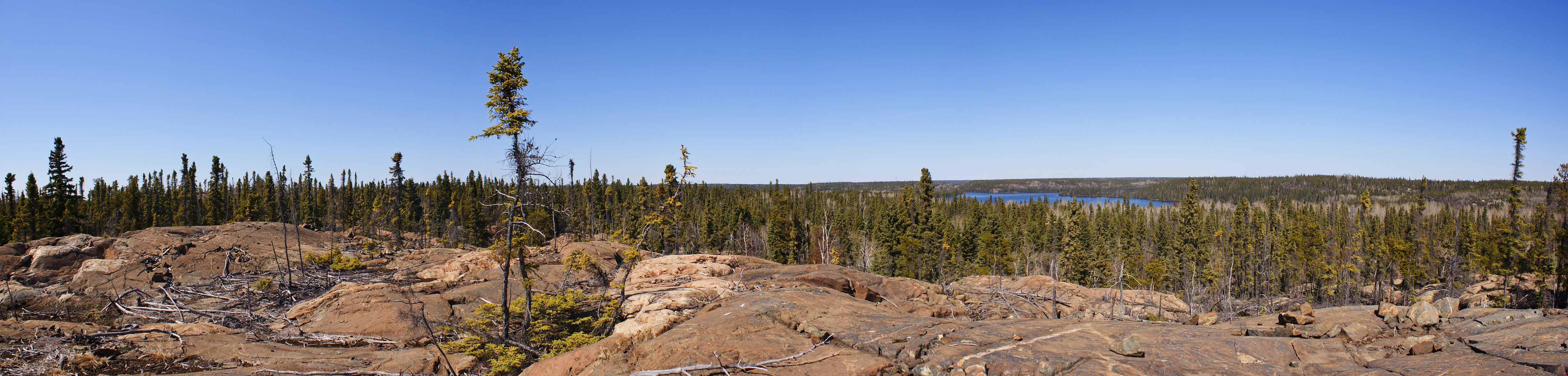
Flin Flon is located in northern Manitoba, roughly 750 km north of Winnipeg via Highway 10. The Flinty statue greets visitors at the town entrance. The Flin Flon Station Museum covers mining history and the name's origin. The city sits on the Canadian Shield - rocky terrain, boreal forest, abundant lakes. Fishing and outdoor recreation attract visitors in summer. Ross Lake is within city limits. Northern lights are visible in fall and winter. Lodging and services are available but limited. The remoteness is the experience: a mining city on the Shield's edge, named after a character nobody remembers, surviving into an uncertain future.
From the Air
Located at 54.77°N, 101.88°W on the Manitoba-Saskatchewan border. From altitude, Flin Flon appears as an island of development in boreal wilderness - the city, the mine workings, and then forest and lakes in all directions. The provincial border runs through the city, invisible from altitude but legally significant. The Canadian Shield's rocky terrain is apparent - lakes, exposed rock, sparse forest cover. The nearest significant city, Winnipeg, is 750 km south. The isolation explains the mining economy - you don't build cities this remote without extractable resources. The statue of Flinty isn't visible from altitude; neither is the explanation for the strangest city name in Canada.