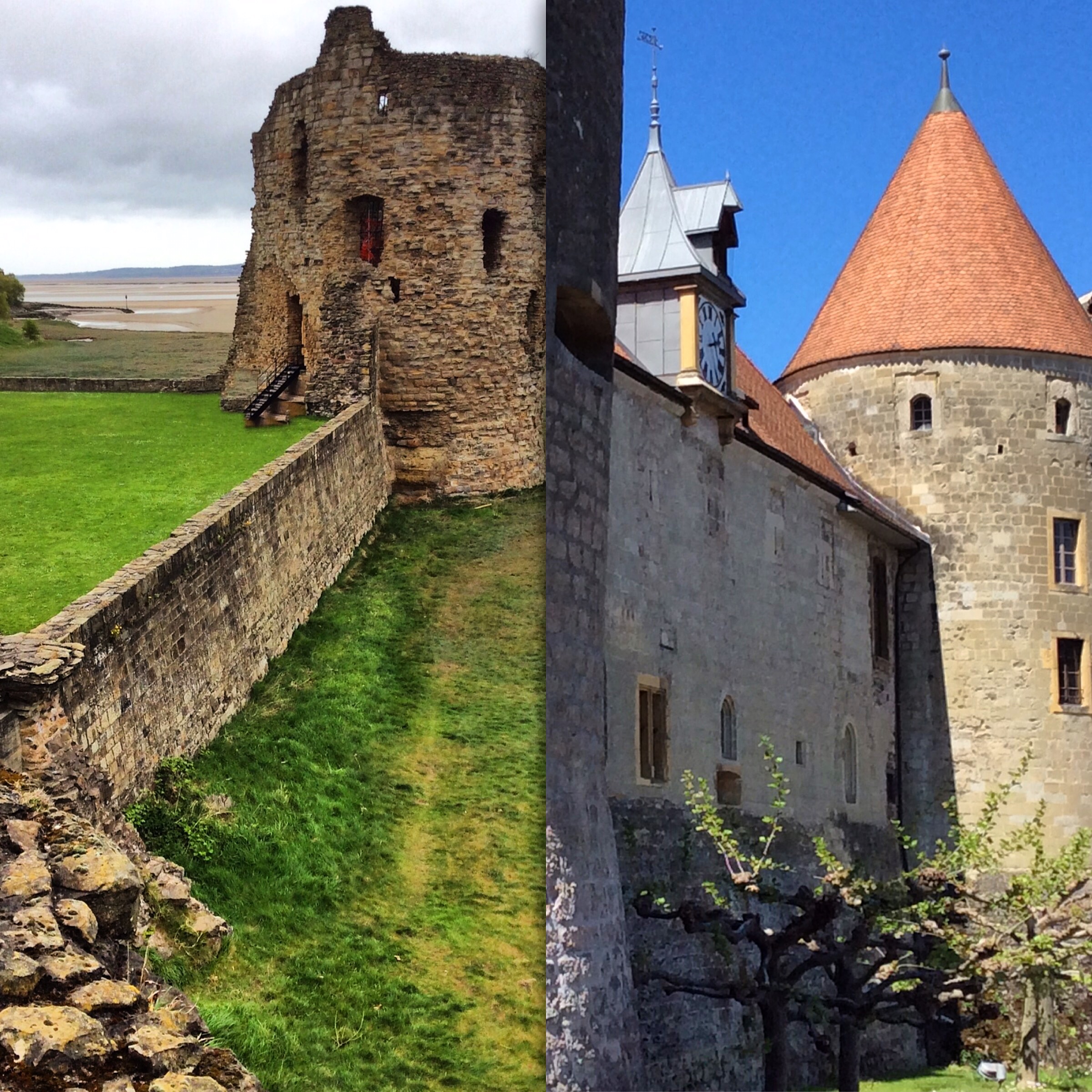
Flint Castle
Shakespeare set the scene at Flint Castle in Richard II, the moment when a king lost his crown. In 1399, Richard II stopped here on his way from Wales, and Henry Bolingbroke was waiting. The king who arrived at Flint as sovereign left as a prisoner, bound for London and eventual death in Pontefract Castle. It is fitting that this drama unfolded at the first link in Edward I's Iron Ring, the chain of fortresses built to subjugate Wales. A castle designed to strip one nation of its independence became the stage for stripping a king of his.
The First Stone
Construction at Flint began almost immediately after Edward I launched the First Welsh War in 1277, making it the earliest of his Welsh castles. The site was chosen with calculated precision: one day's march from Chester, accessible by the River Dee for supply ships, and near a ford across to England usable at low tide. Eighteen thousand laborers and masons built the castle and its earthworks using local Millstone Grit ashlar and sandstone. The Savoyard master mason James of Saint George, who would go on to design many of Edward's greatest fortresses, was assigned to Flint in 1280 and remained for seventeen months, accelerating a construction pace that had started sluggishly. Edward also laid out a new town in front of the castle, a plantation borough for English settlers and merchants, protected by defensive ditches and a timber palisade whose outline is still traceable in the street patterns of modern Flint.
A Design Without Equal
Flint's layout is unique among British castles. Its massive isolated keep, standing detached from the curtain wall at one corner, serves as both corner tower and donjon, a design with no parallel in the British Isles. The arrangement has been compared to the fortresses at Dourdan and Aigues-Mortes in France. Edward I had passed through Aigues-Mortes in 1270 on his way to join the Eighth Crusade, and the influence is plausible. The castle has also been described as a 'classic Carre Savoyard,' closely resembling Yverdon Castle in Switzerland though a third larger in its ground dimensions. The keep itself is formidable: walls seven meters thick at the base and five meters above, with access only by drawbridge into a first-floor entrance chamber. A vaulted passage runs around the entire ground floor interior, and small rooms are built into the massive walls at each level.
Besieged, Burned, and Besieged Again
Welsh resistance to Flint was fierce and sustained. In 1282, forces under Dafydd ap Gruffydd, brother of Llywelyn ap Gruffudd, besieged the castle in an attempted uprising against the English Crown. Twelve years later, during the revolt of Madog ap Llywelyn in 1294, the constable of Flint was forced to set fire to his own fortress to prevent its capture by Welsh forces. The castle was later repaired and partly rebuilt, but the message was clear: the Iron Ring was not unbreakable, and the Welsh would test every link. During the English Civil War, the castle changed hands one final time. Held by Royalists, it was captured by Parliamentarians in 1647 after a three-month siege, then slighted on Cromwell's orders. The ruins are what remain today.
Turner's Castle, Wales's Wound
In 1838, J. M. W. Turner painted a watercolour of Flint Castle, its ruins softened by the artist's atmospheric light into something romantic and elegiac. The reality of the castle's meaning was less picturesque. In 2017, plans for a giant iron ring sculpture in the castle grounds were abandoned after public outcry. The architects said the sculpture represented the 'unstable nature of the crown,' but many in Wales read it as a symbol of subjugation, a memorial to the very oppression the castle had been built to enforce. The controversy captured something essential about Flint: it is a place where English and Welsh readings of history diverge sharply, where architecture meant to project power still provokes the resistance it was designed to crush. Today, Cadw maintains the ruins with free public access, and a spiral staircase installed in the northeast tower in 2017 offers views across the Dee Estuary, the water that once carried Edward's supply ships now carrying light toward a horizon that belongs to no one.
From the Air
Located at 53.252N, 3.130W on the shore of the Dee Estuary in Flintshire, North Wales. The castle's distinctive isolated keep is visible from altitude as a separate circular structure detached from the main curtain wall. The Dee Estuary coastline provides strong visual orientation. Nearest airport is Hawarden (EGNR, 8nm south). Liverpool John Lennon (EGGP) is 15nm northeast across the estuary. Rhuddlan Castle is 8nm west along the coast.