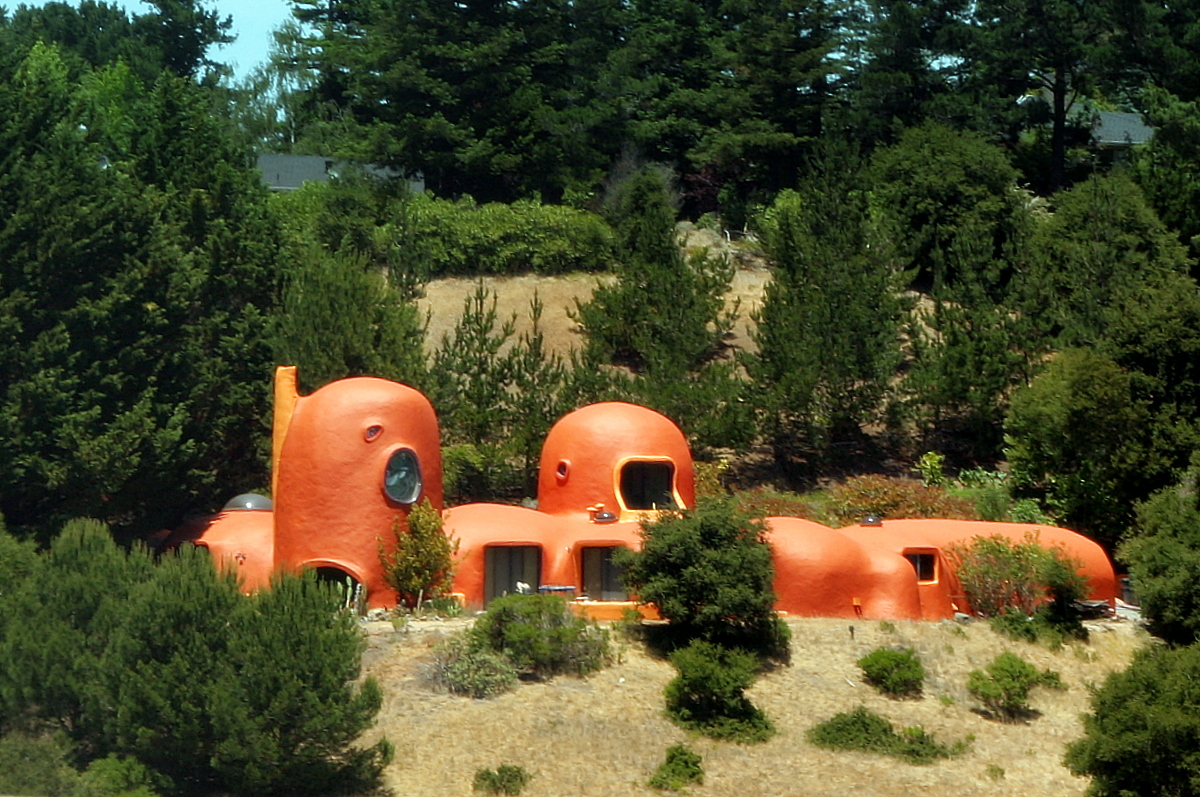
Flintstone House
Every driver on Interstate 280 between San Francisco and San Jose has seen it: a cluster of orange and purple domes perched on a hillside in Hillsborough, looking like something that escaped from a cartoon. The Flintstone House, as it has been universally known since its construction in 1976, was not built to be a joke. Architect William Nicholson designed it as a serious experiment in alternative building materials, inspired by the airframe homes of Wallace Neff. It was constructed by spraying shotcrete onto steel rebar and wire mesh frames draped over inflated aeronautical balloons. The result was a home designed to resist both wildfires and earthquakes. That it also looks like it belongs in Bedrock is a coincidence the world has never let go of.
Built on Bubbles
The construction method was genuinely innovative. Aeronautical balloons were inflated to create the dome shapes, then wire mesh and rebar were arranged over them. Workers sprayed shotcrete over the frames, building up layers of concrete that formed the curved walls and ceilings. Once the concrete cured, the balloons were deflated and removed, leaving behind organic, flowing interior spaces unlike anything produced by conventional construction. The house sits on a concrete slab foundation and contains three bedrooms, two bathrooms, and a two-car garage. One bedroom is accessed via a spiral staircase that narrows as it climbs, inspired by an ice cream cone, until the top of the staircase is the same diameter as the room it enters. It was built by a company called Fame Homes for its first owners, Tyrone and Norma Thompson.
Dinosaurs and the Law
The house changed hands at declining prices -- listed at $4.2 million in 2015, reduced to $3.2 million in 2017, and finally sold for $2.8 million. Its new owner, Florence Fang, installed large oxidized steel sculptures of dinosaurs, a woolly mammoth, a giraffe, and Fred Flintstone himself in the yard. Neighbors were not amused. In March 2019, the town of Hillsborough filed a complaint alleging the modifications were a public nuisance and lacked proper permits. Fang retained the law offices of former San Francisco Mayor Joseph L. Alioto and Angela Alioto to fight the case. The lawsuit was settled in June 2021: the sculptures could stay, and the city paid Fang $125,000. In 2024, Hillsborough blocked plans for a private dining experience at the house, determining that multi-course meals for paying guests constituted commercial use in a residential zone.
Nicknames and Legacy
The house has accumulated aliases over the decades: the Dome House, the Gumby House, the Worm Casting House, the Bubble House. None stuck like Flintstone House, a name that connects it to the Hanna-Barbera cartoon about a Stone Age family that debuted in 1960. The house's influence outlasted its construction method -- no other Fame Homes domes survive or were widely built -- but the building itself has proven surprisingly durable. Foundation damage from water runoff in the mid-1980s required extensive restoration in 1987, and San Francisco architect Eugene Tsui remodeled portions in the 2000s. The house that Nicholson designed as an experiment in resilience has, against expectations and neighborhood opposition alike, persisted. It remains the most photographed residence on the Peninsula, a daily source of delight for the million-plus drivers who pass it on I-280 each year.
From the Air
Located at 37.531°N, 122.359°W in Hillsborough, overlooking I-280 at the Doran Memorial Bridge over San Mateo Creek. The distinctive orange/purple domes are visible from altitude. Nearest airports: San Carlos (KSQL) 3 nm south, SFO (KSFO) 6 nm north. Best viewed from the east at 2,000-3,000 ft AGL along the I-280 corridor.