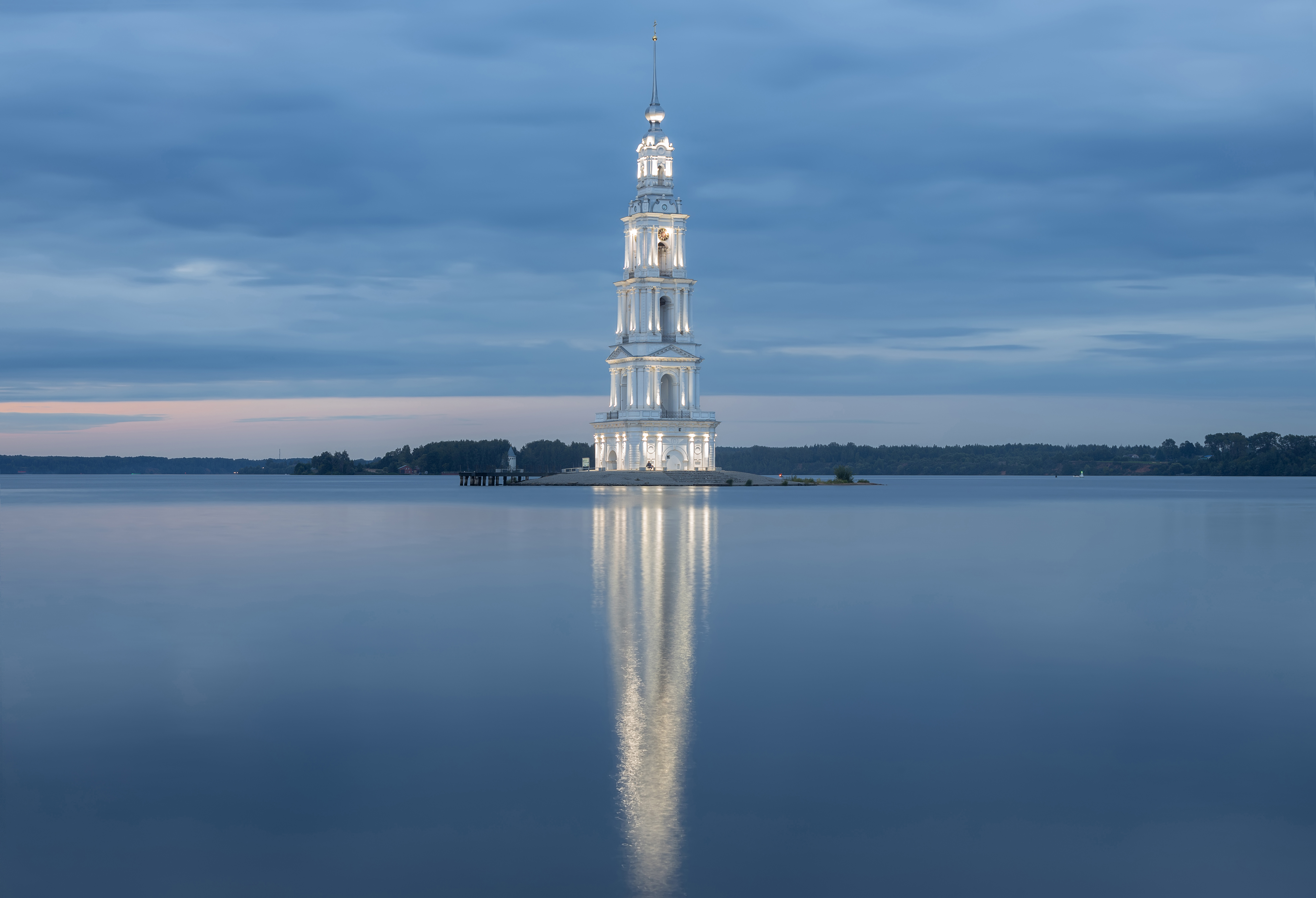
Flooded Belfry
It rises from the water like a prayer that refused to be silenced. The Kalyazin Bell Tower stands 74.5 meters tall in the middle of the Uglich Reservoir, its white Neoclassical spire reflected in the still surface of what was once the Volga River's floodplain. There is no church attached to it, no monastery walls flanking it, no town square at its base. Everything else is gone -- swallowed by the reservoir that Stalin's engineers created in 1939. The belfry alone remains, an accidental monument to everything the water took.
What the Water Took
Before the reservoir, Kalyazin was a prosperous town in Tver Oblast whose spiritual life centered on the Monastery of St. Nicholas. The steepled belfry was built between 1796 and 1800 as part of that monastery complex, which included a pentacupolar katholikon dating from 1694. Twelve bells hung in the tower. The largest, cast in 1895 to commemorate the coronation of Nicholas II, weighed some 17,000 kilograms. When Stalin ordered construction of the Uglich Dam, the old quarters of Kalyazin -- medieval streets, the Saint Nicholas Monastery, the Troitsky Makariev Monastery -- all disappeared beneath the rising waters. The katholikon was dismantled stone by stone. But the belfry was left standing, perhaps because demolishing it would have been more trouble than it was worth, perhaps because even Soviet engineers hesitated to topple something so tall into a reservoir they were trying to fill.
A Steeple Without a Congregation
For decades the tower stood in eerie isolation, its lower floors submerged, its upper stages exposed to wind and ice. The image became iconic -- reproduced on postcards, painted by Russian artists, photographed by every tourist who made the journey to eastern Tver Oblast. What had been a functional piece of monastery architecture became something stranger and more resonant: a symbol of the old Russia that vanished after the Revolution, of entire communities erased in the name of industrial progress. The Uglich Reservoir drowned not just Kalyazin's monasteries but parts of other towns as well. Nearby Mologa and Korcheva suffered similar fates, their populations relocated, their histories submerged. The bell tower, because it refused to sink, became the memorial that the Soviet state never built for any of them.
Pilgrimage by Boat
Today the campanile is the main tourist attraction in eastern Tver Oblast. Engineers shored up the small artificial island beneath it and installed a pier for boats. Visitors arrive by water, stepping onto the concrete platform to look up at the Neoclassical tiers that once rang with twelve bells calling monks to prayer. Several times a year, Orthodox Christians hold Divine Services inside the belfry itself -- worship returning to a building that lost its church, its monastery, and its town but somehow kept its purpose. In winter, when the reservoir freezes, the tower stands in a white expanse of ice, its reflection replaced by silence. In summer, the water shimmers around its base, and the steeple catches the light of long northern evenings. Either way, the Kalyazin Bell Tower remains what it has been since 1939: the last thing standing.
From the Air
Located at 57.24°N, 37.86°E on the Uglich Reservoir along the Volga River in Tver Oblast. The bell tower is strikingly visible from the air as an isolated white spire rising from open water. Best viewed at 2,000-5,000 feet. The town of Kalyazin sits on the opposite shore. Nearest airports: Sheremetyevo (UUEE) and Domodedovo (UUDD) in Moscow, approximately 190 km southwest.