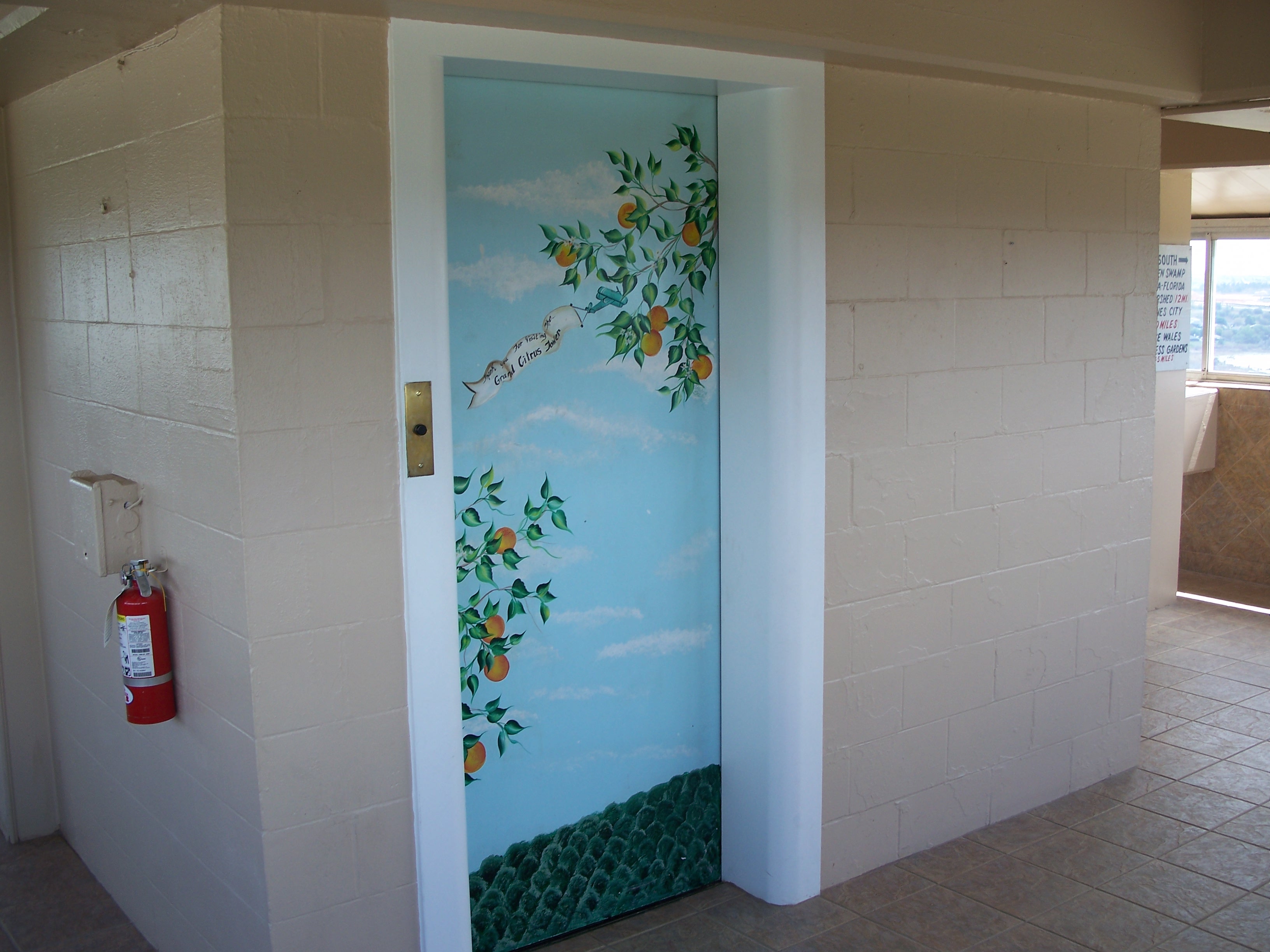
Florida Citrus Tower
Drop a coin into the slot at the top of the Florida Citrus Tower and listen. It falls 226 feet, pinging off the interior walls before hitting bottom with a faint, satisfying clink. That coin drop is the tower's most enduring attraction - outlasting the citrus groves it was built to showcase, the half-million annual visitors who once packed its observation deck, and even the orange-and-white paint scheme that defined its skyline silhouette for decades. Built in 1956 along US Highway 27 in Clermont, the tower rose above what was then a sea of citrus stretching to the horizon in every direction. Today those groves are gone, replaced by subdivisions and strip malls, but the tower still stands - a concrete anachronism that refuses to disappear.
When the Groves Stretched Forever
In the 1950s, Lake County was the heart of Florida's citrus belt. Orange, grapefruit, and tangerine trees carpeted the rolling hills around Clermont, and the sweet smell of blossoms hung in the humid air every spring. The Citrus Tower was conceived as a way to show it all off - a 226-foot observation platform where tourists driving between Cypress Gardens and Silver Springs could stop, ride the elevator up, and gaze out over a patchwork quilt of green groves and blue lakes. It worked spectacularly. During its early years, the tower drew up to 500,000 visitors annually. Postcards proclaimed "Greetings from Citrus Tower," and the striped tower became one of Central Florida's most recognizable roadside landmarks.
Death by Turnpike and Deep Freeze
The tower's decline came in two blows. The first was concrete: in 1964, Florida's Turnpike extended northward, giving travelers a faster route through Central Florida that bypassed US 27 entirely. Overnight, the steady stream of highway tourists thinned to a trickle. The second blow came from the sky. Three brutal freezes in the 1980s - in 1983, 1985, and 1989 - devastated Lake County's citrus industry. Temperatures plunged below 20 degrees Fahrenheit, splitting bark and killing trees to their roots. The groves that had once stretched to the horizon turned brown, then were bulldozed. By the early 1990s, the tower's original purpose was gone. There were no groves to admire. The view from the top now showed the raw red earth of construction sites as Central Florida's suburban sprawl marched westward.
Reinvention After Reinvention
The tower changed hands repeatedly as each new owner tried to find a reason for its existence. In 1988, a tram was built to tour remaining citrus crops - a last attempt to connect the tower to its agricultural roots. In 1995, Greg Homan purchased the property and repainted it white and turquoise, a departure from the original orange-and-white stripes. In April 2015, the tower was restored to its classic color scheme, the bold orange bands once again visible for miles. Then in 2022, the Homan family sold the tower to Simchat Torah Beit Midrash for $3.3 million. The new owners renovated the property and reopened it in May 2023 with the stated goal of bringing it back to what it once was. The lobby now houses ROOM: Valencia, a banquet facility, gift shop, and museum chronicling the tower's history.
Roadside Relic, Unlikely Survivor
The Florida Citrus Tower belongs to a vanishing breed of American roadside attraction - the kind built before interstate highways and theme parks changed how people traveled. Its neighbors in this category are mostly gone. But the tower endures, partly because it is genuinely tall (the highest point in a notably flat county), partly because the view from the top still impresses, and partly through sheer stubbornness. Near the tower stands the Presidents Hall of Fame, featuring wax figures of every US president and a scale model of the White House interior - another roadside curiosity from a different era of tourism. Together, they form a pocket of Old Florida kitsch surviving amid the sprawl. The coin drop still works. Visitors still listen for the clink. And from the top, on a clear day, you can still see lakes and green stretching toward the horizon - just not citrus groves anymore.
From the Air
Located at 28.56N, 81.74W in Clermont, Florida, on the rolling hills west of Orlando. The 226-foot tower is visible from altitude as a slender vertical structure with distinctive orange-and-white banding. The hilly terrain of the Lake Wales Ridge is unusual for Florida - Clermont sits on some of the highest ground in the peninsula. Lake Apopka is visible to the northeast; the chain of lakes characteristic of Lake County dots the landscape. Orlando Executive Airport (KORL) is 25 miles east. Leesburg International Airport (KLEE) is 20 miles north. Orlando International Airport (KMCO) is 35 miles southeast. Walt Disney World's sprawl is visible to the south.