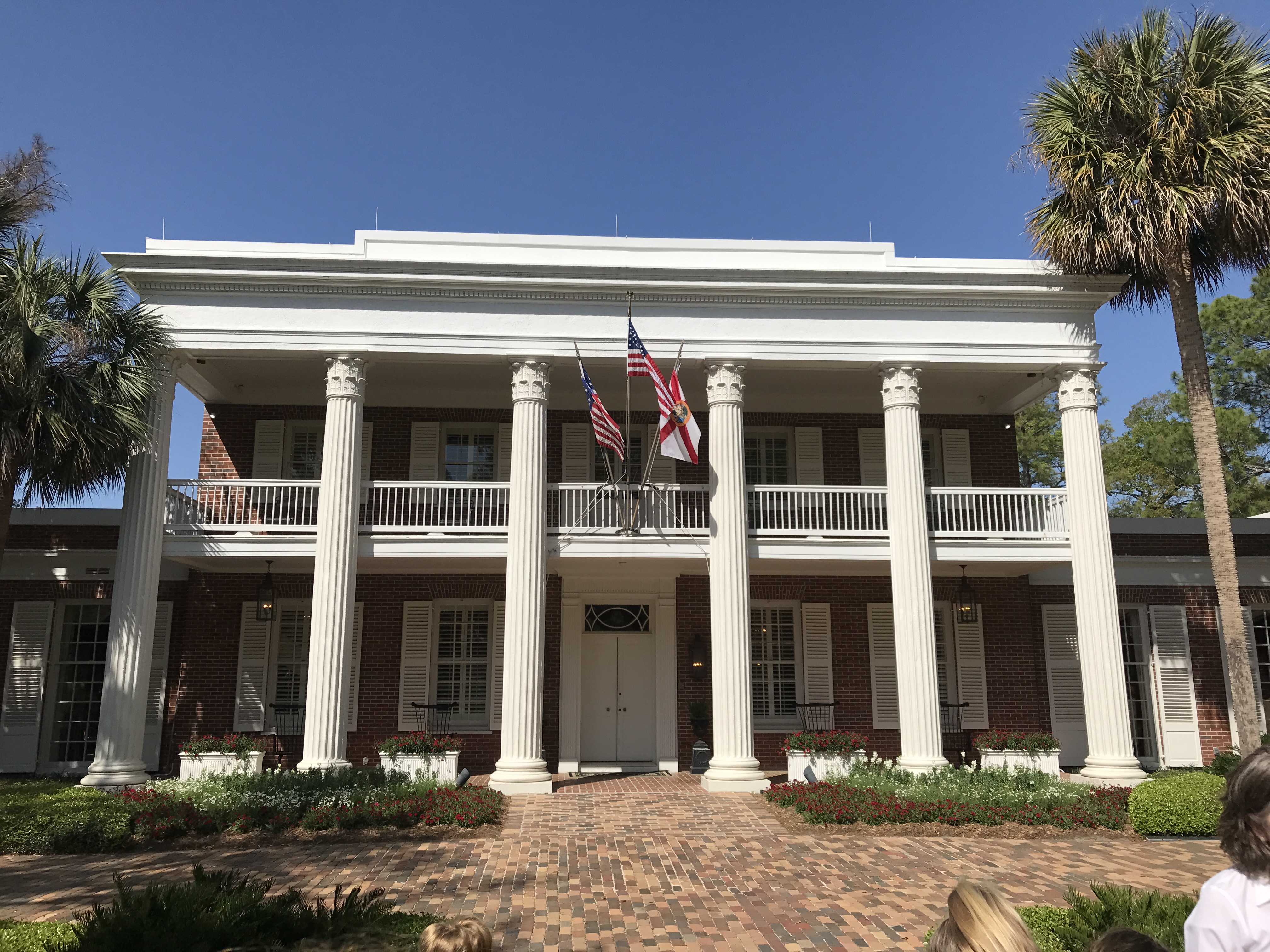
Florida Governor's Mansion
Reverend Sidney J. Catts arrived at the Florida Governor's Mansion as a dinner guest in 1915 and left with a plan. Assigned to stay with Governor and Mrs. Park Trammell during a Baptist convention, the preacher from DeFuniak Springs spent his visit asking pointed questions, inspecting every room from attic to stables. At his final meal, he asked the governor what the rent cost. "It is provided rent-free by the taxpayers of Florida," Trammell replied. Weeks later, Catts announced his candidacy. He won the 1916 election and promptly moved in -- bringing a pig, a milk cow, and chickens to the grounds of Florida's most prestigious address.
Boardinghouse Governors
For more than half a century after Florida joined the Union in 1845, its governors had no official residence. They lived in hotels and boardinghouses around Tallahassee, a circumstance that suited a state government that was, in those early decades, deliberately modest. The situation changed when George Saxon, a local banker, donated four lots for a proper executive residence. Architect Henry John Klutho designed the first mansion, completed in 1907, with a Neoclassical exterior and a 14-room Georgian interior. It served fifteen governors and their families over nearly fifty years, accumulating the kind of genteel wear that comes from decades of official entertaining and the occasional eccentric occupant. By 1955, structural problems and cramped quarters forced the state to build anew. The old mansion's furnishings were auctioned off, raising $7,500 to help outfit its successor.
Jackson's Shadow in Tallahassee
The current mansion, completed in 1957, was designed by Marion Sims Wyeth to evoke Andrew Jackson's Hermitage in Nashville -- a deliberate nod to the president who shaped Florida's early territorial history. The 30-room residence sits on manicured grounds that belie its complicated story. Its furnishings are overseen by an eight-member Governor's Mansion Commission, charged with cataloging every antique, every fixture, every decorative object in the state rooms. The formality reflects the mansion's dual role: it is both a private home and a public trust, known officially as the People's House of Florida. Half-hour tours led by trained volunteer docents run year-round, welcoming school groups and visitors into rooms where policy has been debated over dinner for nearly seven decades.
Bronze Children and Fallen Oaks
Directly across the street from the mansion, a small park holds one of Tallahassee's most charming public sculptures. Florida's Finest, unveiled in April 1998 by Governor Lawton Chiles and his wife, depicts five life-size bronze children and a dog playing Follow the Leader across the logs of a fallen tree. It was dedicated to the children of Florida -- a gesture of optimism frozen in metal. The mansion grounds themselves have not always been so serene. In August 2023, Hurricane Idalia sent a 100-year-old oak crashing onto the property, a reminder that even the governor's residence answers to Florida's weather. The mansion was added to the National Register of Historic Places on July 20, 2006, and celebrated its 50th anniversary in 2005 with a $500,000 expansion that added the Florida Sun Room.
The People's House
The mansion today includes a greenhouse and the Manatee Sculpture Garden, nestled beside a private park. Its evolution mirrors Florida's own transformation -- from a frontier state whose leaders stayed in boardinghouses to a political powerhouse whose governor's residence required a formal commission to manage its antiques. The mansion sits at the heart of Tallahassee's government district, surrounded by the institutional architecture of state power: the Capitol complex, the Supreme Court, the historic buildings that line Adams Street. Yet the mansion retains a domestic scale that sets it apart from the monuments around it. It is, deliberately, a house -- one where governors still live, still entertain, still look out windows onto grounds where a preacher once sized up the stables and decided he wanted the job.
From the Air
Located at 30.45°N, 84.28°W in central Tallahassee, within the government district near the Florida State Capitol. The mansion grounds are visible as a manicured green rectangle amid the urban grid. Tallahassee Regional Airport (KTLH) lies approximately 5nm to the southwest. The Capitol building's distinctive tower -- the tallest structure in Tallahassee -- serves as a nearby visual reference. Tallahassee's terrain is unusually hilly for Florida, with a canopy of live oaks visible across the city.