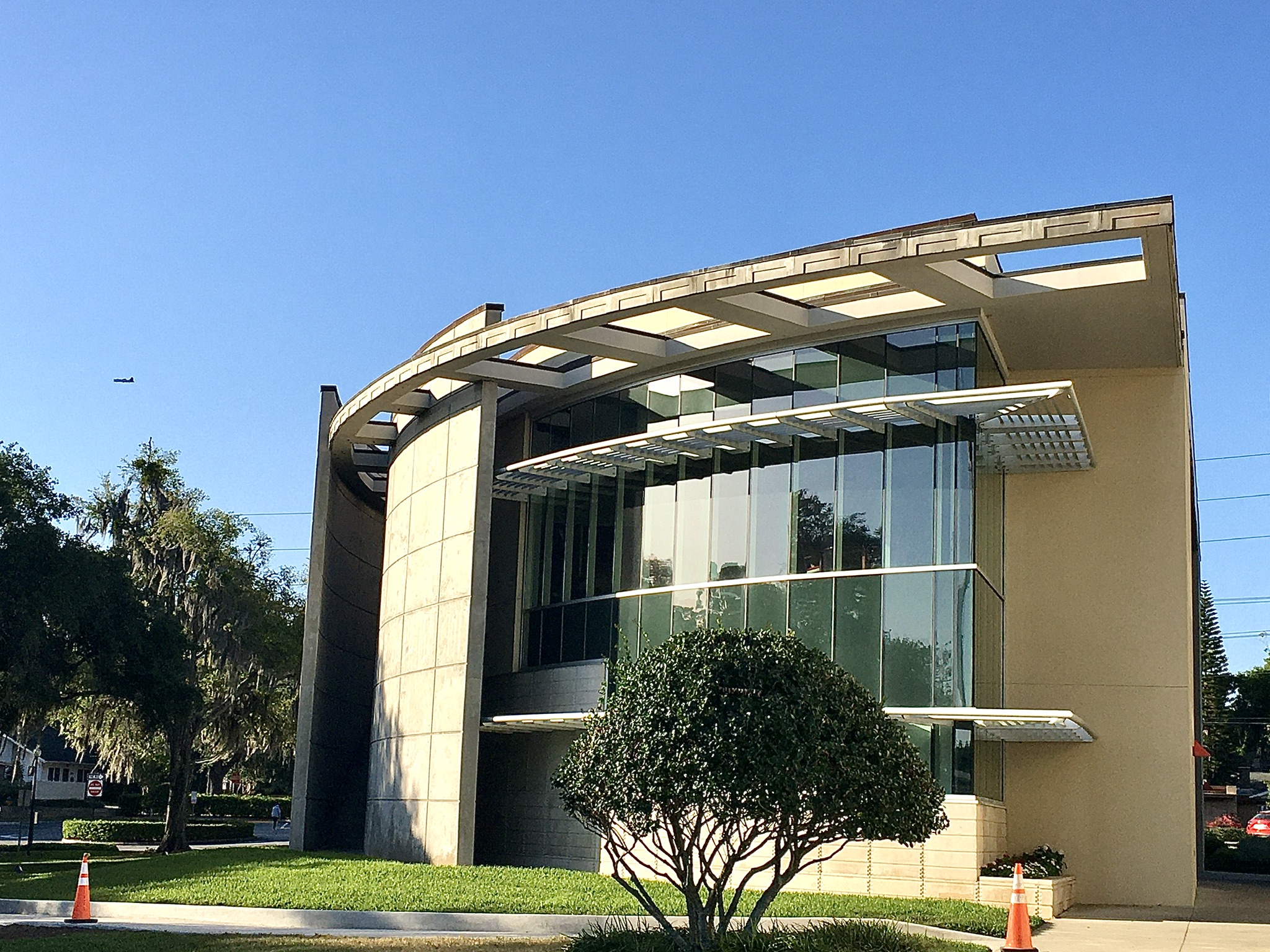
Florida Southern College
Sunlight enters the E.T. Roux Library through small cubes of colored glass embedded in the concrete walls, casting prismatic patterns across the reading room floor. The effect is unmistakably Frank Lloyd Wright -- light not as illumination but as material, shaped and directed by architecture the way a prism shapes a beam. Florida Southern College in Lakeland holds the world's largest single-site collection of Wright buildings, thirteen structures collectively called Child of the Sun, and walking between them is like stepping through a decades-long conversation between one architect and one patch of Florida earth. Wright began the project in 1938 and worked on it until his death in 1959, longer than any other single commission in his career.
Four Cities Before Lakeland
Florida Southern College arrived at its current home only after a series of relocations that reads like a comedy of misfortune. Founded as South Florida Institute in Orlando in 1883, the school moved to nearby Leesburg in 1885, where it was sponsored by the United Methodist Church and renamed Florida Conference College. In 1901, it moved again to Sutherland, now known as Palm Harbor, and changed its name to Southern College in 1906. Then fires struck in the early 1920s, forcing a temporary relocation to Clearwater Beach before the college finally settled in Lakeland in 1922. It was renamed Florida Southern College in 1935. By the time the school found its permanent home on the shores of Lake Hollingsworth, it had been a nomadic institution for four decades -- a college perpetually in search of the right ground to build on.
A President's Bold Invitation
In 1938, Florida Southern's president, Ludd M. Spivey, approached Frank Lloyd Wright with an audacious proposal: transform a hundred-acre lakeside orange grove into a modern campus. Wright was already America's most famous architect, seventy years old and deep into the most productive final act in architectural history. He accepted, and his vision was characteristically radical. He wanted to demolish the existing campus buildings -- he called them uninspired -- and replace them with structures that would, in his words, 'grow out of the ground and into the light, a child of the sun.' Construction on the Annie Pfeiffer Chapel began in 1938, and the building was dedicated in 1941. Over the next two decades, Wright designed and oversaw the construction of eleven more structures, including the Buckner Building, the Danforth Chapel, the Polk County Science Building, the Watson Fine Building, and the Water Dome, a fountain partially completed in 1949 and fully restored to Wright's original plans in 2007.
Concrete, Glass, and Light
Wright's Florida Southern buildings share a vocabulary of materials -- reinforced concrete and concrete blocks -- but each speaks with its own voice. The Annie Pfeiffer Chapel rises in angular tiers, its tower an abstract composition of concrete and colored glass. The E.T. Roux Library, built between 1941 and 1945 for $120,000, features a distinctive multi-tiered circular reading room where long, narrow windows crown the concrete walls and small colorful glass cubes scatter light in prismatic patterns. The Danforth Chapel, begun in 1954, is an intimate space where the concrete feels almost weightless. Connecting many of these buildings are the Esplanades, covered walkways that Wright designed to shelter students from Florida's rain and sun while creating a visual rhythm across the campus. After Nils Schweizer, a protege of Wright, designed the new Roux Library in 1968 in a complementary mid-century modern style, the original library was renamed the Thad Buckner Building and repurposed for lectures and events.
Recognized and Endangered
The campus Wright built has earned extraordinary recognition and faced real peril. The Florida Southern College Architectural District is listed on the National Register of Historic Places, and in 2012, the campus was designated a National Historic Landmark. The Princeton Review selected it as the most beautiful campus in America in both 2011 and 2012. Travel+Leisure listed it among the most beautiful campuses in the United States. But the World Monument Fund also placed the campus on its watch list as an endangered cultural site, acknowledging that the concrete structures Wright designed for a Florida climate require constant maintenance against humidity, storms, and the slow chemistry of time. The college has responded with ongoing restoration, including the full completion of the Water Dome in 2007 and the commissioning of architect Robert A. M. Stern to design new buildings that complement Wright's aesthetic.
More Than an Outdoor Museum
Florida Southern is not a museum campus where students tiptoe past protected landmarks. It is a working college of roughly 2,200 undergraduates who attend classes in Wright-designed buildings, study in Schweizer's mid-century library, and walk the Esplanades between lectures. The Branscomb Memorial Auditorium, designed by Schweizer to complement the Child of the Sun concept and completed in 1963, hosts the Festival of Fine Arts, the longest-running theater and musical performance series in Polk County. The college offers the nation's only bachelor's degree program in citrus science. Its campus has served as a film location for The Marriage-Go-Round in 1961 and The Waterboy in 1998. Alumni include Baseball Hall of Famer-adjacent athletes, U.S. Open golf champions, and a secretary general of OPEC. The architecture is the draw, but it frames a living institution -- one that Frank Lloyd Wright spent the last twenty-one years of his life designing, and that has spent the decades since keeping his vision intact.
From the Air
Located at 28.03N, 81.95W on the southern shore of Lake Hollingsworth in Lakeland, Florida. The campus is visible from the air by its distinctive lakeside setting and the geometric forms of Wright's concrete buildings, particularly the angular tower of the Annie Pfeiffer Chapel. Lake Hollingsworth itself is a strong visual landmark -- a roughly circular lake surrounded by residential neighborhoods. Nearest airports: KLAL (Lakeland Linder International Airport), approximately 4 nm southwest; KGIF (Winter Haven's Gilbert Airport), roughly 10 nm east. The I-4 corridor passes several miles north of the campus and provides a strong east-west reference line between Tampa and Orlando.