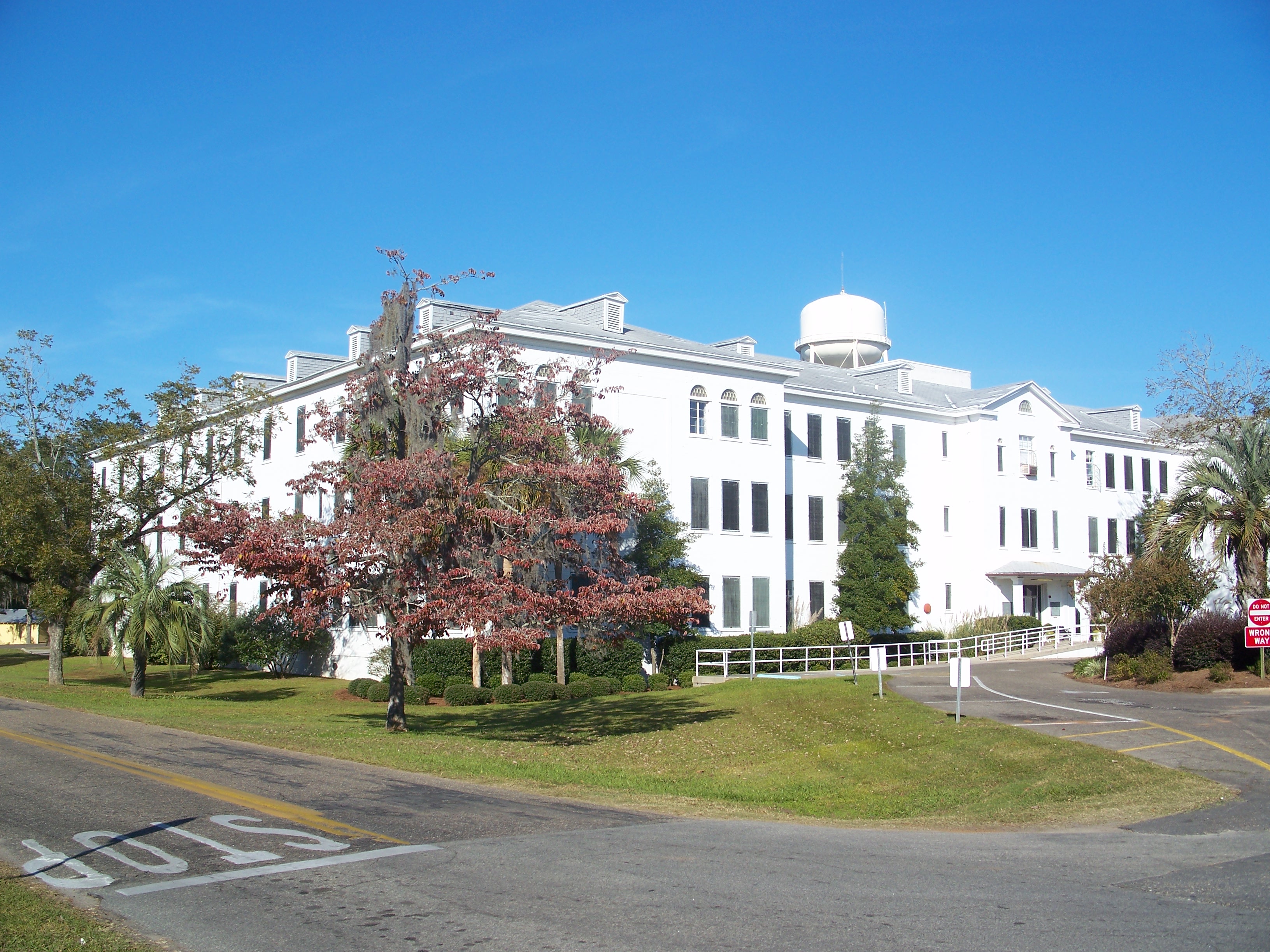
Florida State Hospital
Kenneth Donaldson spent fifteen years locked inside Florida State Hospital against his will. He was not dangerous. He was not incapable of surviving on his own. When his case reached the United States Supreme Court in 1975, the justices ruled that the hospital had illegally confined him - a decision that helped ignite the deinstitutionalization movement and led to the closure of large public psychiatric hospitals across the country. But Donaldson's story is only one chapter in the long, troubled history of this compound in Chattahoochee, Florida, where the same patch of ground beside the Apalachicola River has served as a military arsenal, the state's first prison, and its oldest mental institution.
Arsenal, Prison, Asylum
The campus began as the Apalachicola Arsenal, built in the 1830s and named for the river that curves past it. The arsenal served through the Seminole Wars and the Civil War before Florida Governor Harrison Reed converted the property into the state's first penitentiary in 1868. Florida's first recorded inmate was Calvin Williams, sentenced to one year for larceny that November. By the following year, 42 inmates and 14 guards occupied the former military grounds. Conditions deteriorated quickly. Warden Malachi Martin gained a reputation for cruelty and corruption, using prison labor to build his personal houses and tend his private vineyards. An 1891 book titled The American Siberia portrayed the Chattahoochee prison as a place of relentless barbarity. When the prisoners were relocated to Raiford in 1876, the facility was refurbished as the Florida State Hospital for the Insane - the state's first mental institution, established by the Reconstruction-era legislature.
The Case That Changed the Law
For nearly a century, the hospital operated with broad authority to confine patients. Allegations of mistreatment surfaced periodically as treatment standards evolved, but the institution that truly changed was American law itself. Kenneth Donaldson was committed to Florida State Hospital and held for fifteen years. He sued the hospital and its superintendent, J.B. O'Connor, arguing that his confinement was unconstitutional. In O'Connor v. Donaldson (1975), the Supreme Court agreed. The ruling, as interpreted by the American Civil Liberties Union, established that it is unconstitutional to commit individuals who are not an imminent danger to themselves or others and who can minimally survive on their own. The decision rippled through every state's commitment laws and contributed directly to the nationwide wave of deinstitutionalization that emptied and shuttered many of America's large public psychiatric hospitals.
Competency and the Executioner's Paradox
A second Supreme Court case arose from the hospital's forensic wing. In Ford v. Wainwright (1986), a Florida death row inmate argued that he was not mentally competent to be executed. The Court ruled that the Eighth Amendment prohibits executing an insane prisoner, and that a proper judicial hearing - not merely an executive determination - must be held to evaluate an inmate's competency. The ruling created an ethical dilemma that persists in forensic psychology to this day: clinicians are tasked with treating a patient specifically so that patient can be put to death. Florida State Hospital's forensic psychologists live with that paradox as part of their daily work, evaluating and treating inmates committed under the criminal justice system as incompetent to stand trial or not guilty by reason of insanity.
The Faces Behind the Walls
The hospital's patient rolls read like a catalog of Florida's darkest and strangest chapters. Victor Licata, whose axe murder of his family in 1933 helped fuel the national panic that marijuana causes criminal insanity. Ruby McCollum, an African-American woman convicted of killing a white doctor she said had forced her to bear his child, committed in 1954 and not released until 1974 under the Baker Act. Chris Calhoun, a Korean War veteran with post-traumatic stress disorder whose experiences inside the hospital became the subject of the 1989 film Chattahoochee. John William Clouser, the so-called Florida Fox - a former police detective who escaped the hospital in 1964 and spent ten years on the run before surrendering in 1974. Each story reflects the institution's complicated place at the intersection of justice, illness, and the limits of what society knows how to do with people it cannot easily categorize.
Still Standing, Still Working
Today, Florida State Hospital has a capacity of 1,042 patients, split between 491 civil beds and 646 forensic beds. The Administration Building - adapted from the original Officers' Quarters of the Apalachicola Arsenal - is listed on the National Register of Historic Places, a physical link to the compound's military origins nearly two centuries ago. The hospital's stated goal is recovery: restoring competency to those found incompetent to stand trial, teaching daily living skills to those acquitted by reason of insanity, and transitioning residents back into community life when they are ready. By statute, a patient committed as incompetent to proceed cannot be held for more than five years. Those committed as not guilty by reason of insanity face no such limit. The hospital works on, as it has since 1876, in a small Panhandle town where the weight of the past is never far from the present.
From the Air
Located at 30.707N, 84.837W in Chattahoochee, Florida, on the east bank of the Apalachicola River near the Georgia border. The hospital campus is a large institutional compound visible from the air as a cluster of buildings and cleared grounds adjacent to the town of Chattahoochee. The Apalachicola River and the Jim Woodruff Dam/Lake Seminole are dominant visual landmarks to the north and west. Nearest airports: Tallahassee International (KTLH) approximately 50nm east-southeast, and Dothan Regional (KDHN) approximately 60nm northwest. The terrain is gently rolling Panhandle lowlands. Best viewed at 2,000-4,000 feet AGL in clear conditions.