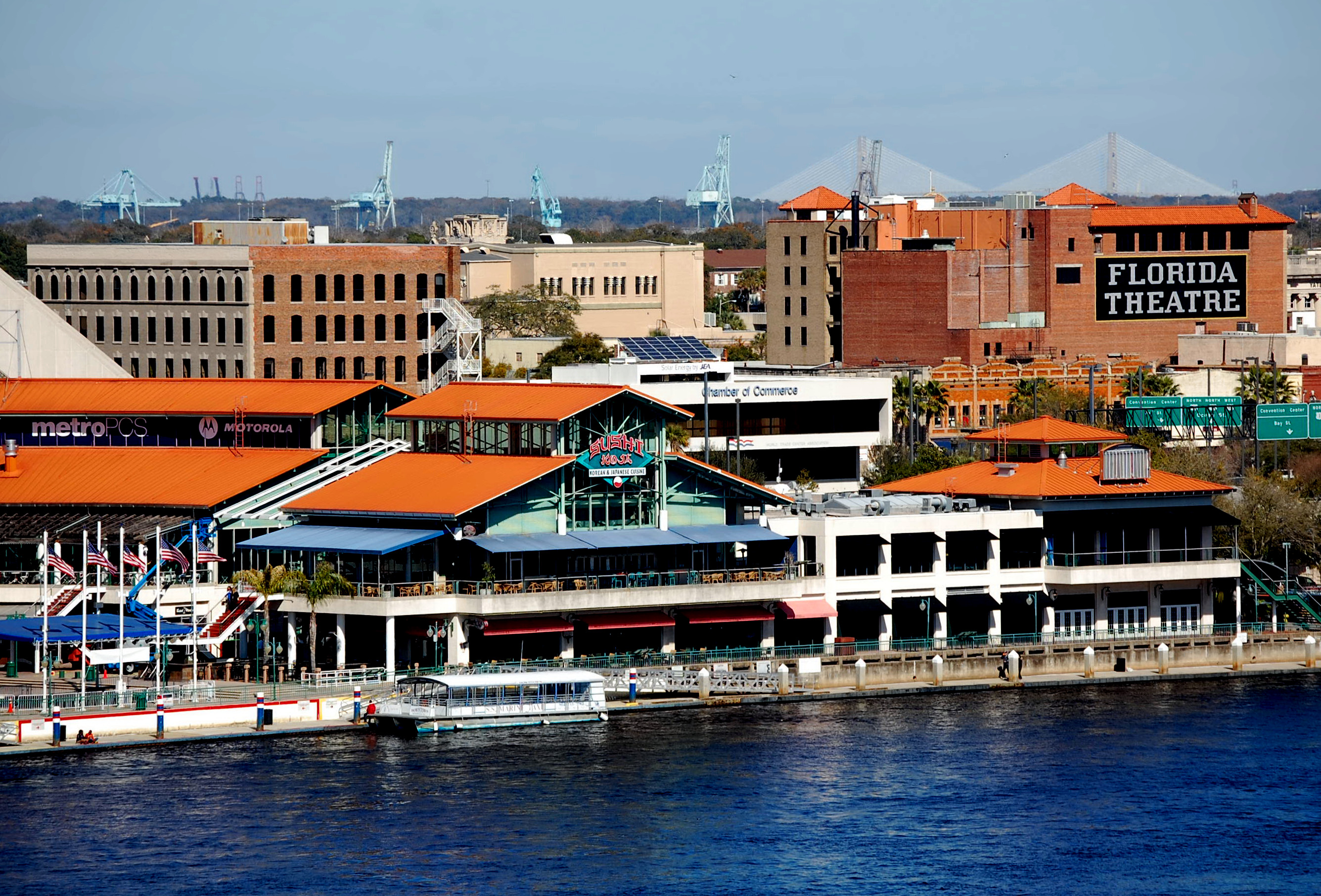
Florida Theatre
Judge Marion Gooding had arrest warrants drawn up and ready to serve. The charge: Elvis Presley's hips. On August 10, 1956, the 21-year-old performer arrived at the Florida Theatre in downtown Jacksonville for two sold-out shows, and the city's leadership decided his bodily movements posed a threat to local youth. Gooding met Presley backstage and delivered an ultimatum: tone it down or go to jail. Elvis played the shows. The police stayed put. The warrants gathered dust. The Florida Theatre, meanwhile, kept doing what it had done since 1927: hosting the collision of spectacle and respectability that defines a great American movie palace.
A Palace on a Jail's Grave
The spot where the Florida Theatre stands at 128 East Forsyth Street once held a police station and jail. Southern Enterprises, Inc. demolished those structures in the summer of 1926 and hired architects R. E. Hall and Roy A. Benjamin to design something grander. What rose in their place was a seven-story, fireproof concrete building in the Mediterranean Revival style, complete with a roof garden overlooking downtown Jacksonville. Construction took just one year. On opening night, April 8, 1927, audiences filed into what was then the largest theatre in all of Florida. The program featured the American Legion Bugle Corps, a live stage show, and the film Let It Rain. For decades the theatre ran from 11 AM to 11 PM, cycling through movies, newsreels, and live performances. The roof garden lasted until 1938, when it was converted to rental office space.
The Last of the Movie Palaces
The Florida Theatre belongs to a vanishing breed. It is one of only five surviving high-style movie palaces built in Florida during the Mediterranean Revival boom of the 1920s. The others are the Olympia Theater in Miami, the Saenger Theatre in Pensacola, the Polk Theatre in Lakeland, and the Tampa Theatre. These buildings were designed as fantasy environments, places where ticket-holders could escape the Florida heat and enter a world of ornamental plasterwork, atmospheric lighting, and architectural excess. The Mediterranean Revival style suited the ambition: arched doorways, clay-tiled accents, wrought-iron details, and a general mood of Iberian grandeur transplanted to the American South. In 2012, the American Institute of Architects' Florida Chapter recognized the Florida Theatre on its list of Florida Architecture: 100 Years, 100 Places.
Dark Curtain, Second Act
By the 1970s, suburban multiplexes and urban decline had hollowed out the Florida Theatre's audience. On May 8, 1980, the doors closed. The building sat empty, its plaster cracking, its future uncertain. What saved it was a coalition of preservationists, public money, and civic pride. A $500,000 grant from the State of Florida, a $350,000 HUD Community Development Block Grant from the City of Jacksonville, and $150,000 in private fundraising provided the initial lifeline. On October 31, 1981, the Arts Assembly of Jacksonville purchased the building for $1 million and launched a $5 million restoration. Workers stripped away decades of neglect, restored the ornamental interiors, and brought the stage back to performance standards. The Florida Theatre was placed on the National Register of Historic Places on December 28, 1982, and reopened to the public on August 26, 1983, less than two years after its purchase.
Still Standing on Forsyth Street
Today the Florida Theatre operates as a performing arts venue hosting concerts, comedy, film screenings, and community events. The restoration preserved the Mediterranean Revival detailing that makes the interior feel less like a building than a courtyard: the ceiling suggests open sky, the walls evoke sun-baked plaster, and the balconies carry the proportions of a Spanish plaza. It is a survivor in every sense. Jacksonville's downtown has reinvented itself multiple times since 1927, and the theatre has watched each transformation from the same block of Forsyth Street. Where a jail once stood, the city now preserves a place built for collective wonder, a reminder that the impulse to gather in the dark and watch something spectacular is as durable as concrete and Mediterranean tile.
From the Air
The Florida Theatre is located at 30.326N, 81.656W in downtown Jacksonville, Florida, on East Forsyth Street. From the air, downtown Jacksonville's grid sits along the north bank of the St. Johns River, with the theatre a few blocks inland from the waterfront. Nearest airports include Jacksonville Executive at Craig Airport (KCRG) approximately 10 nm east, and Jacksonville International Airport (KJAX) about 15 nm north. The St. Johns River provides a strong visual reference for orientation. Best viewed below 3,000 ft AGL to pick out the downtown blocks, though the building itself is not individually distinguishable from cruising altitude.