Florissant Fossil Beds National Monument
Someone tried to saw the Big Stump into pieces to ship to the 1893 World's Fair in Chicago. The broken saw blades still sit where they snapped. That failed attempt captures something essential about Florissant Fossil Beds: this place resists extraction. For 34 million years, the stone stumps of ancient redwoods have held their ground at 8,500 feet in the Colorado Rockies, monuments to a world that vanished when volcanoes buried a lush subtropical forest under fifteen feet of mud. The name itself is French -- "florissant" means "flowering" -- and the irony is deliberate. What flowers here now are not living things but the impossibly detailed impressions of an entire ecosystem, pressed into paper-thin shale like flowers in a book no one meant to write.
A Forest Drowned in Mud
Thirty-four million years ago, during the late Eocene, this valley looked nothing like the high-altitude grassland it is today. Redwood trees towered sixty meters above a forest floor crowded with hardwoods, palms, and ferns. The climate averaged nine degrees Celsius warmer than the present. Then the Guffey volcanic center erupted, and massive mudflows called lahars -- volcanic ash mixed with heavy rainfall into a fast-moving slurry -- swept down the valley and buried the forest under five meters of debris. The lahars also dammed the streams, creating Lake Florissant. As volcanic ash settled into the lake, it triggered blooms of diatoms, microscopic algae that drifted to the bottom carrying anything that had recently died: insects, leaves, seeds, entire fish. Layer by layer, these diatom falls built the paper shales that would preserve over 1,700 fossil species with extraordinary detail.
Stumps That Turned to Stone
The monument's most dramatic features are its petrified redwood stumps, among the largest in the world by diameter. An estimated thirty stumps survive, most identified as Sequoia affinis, a close relative of the modern coast redwood. The Big Stump has a circumference of nearly twelve meters and supported a tree between 500 and 1,000 years old before the lahar buried it. Nearby stands the Redwood Trio, the only known fossil occurrence of a redwood "family circle" -- a cluster of sprouts that grew from the base of a parent tree, a reproductive strategy that coast redwoods still use today. The petrification process was painstakingly slow: groundwater seeped through the lahar, dissolved silica from volcanic glass, and deposited it crystal by crystal into individual tree cells, turning wood to stone one cell at a time. Tree-ring analysis of the petrified wood reveals that these ancient redwoods grew in conditions even more favorable than those enjoyed by modern redwoods in central California.
An Eocene Time Capsule
Florissant preserves far more than trees. Over 130 years of scientific study have cataloged more than 1,700 species in over 300 publications, making it one of the richest paleontological sites on Earth. The fossils span an astonishing range: millions of pollen grains, microscopic diatoms, delicate insect wings with veins still visible, imprints of twigs and seeds in shale, and vertebrate remains. Geologists of the Hayden Survey first visited in the early 1870s. Fossil plants were described by Leo Lesquereux, insects by Samuel Hubbard Scudder, and vertebrate fossils by Edward Drinker Cope. Charles Whitman Cross formally named the deposits the Florissant Lake Beds in 1894. Together, these fossils provide one of the most detailed snapshots of the Eocene-Oligocene transition, the moment when Earth's climate shifted from warm and subtropical to cooler and more temperate -- a transformation that reshaped ecosystems worldwide.
Saved from the Bulldozer
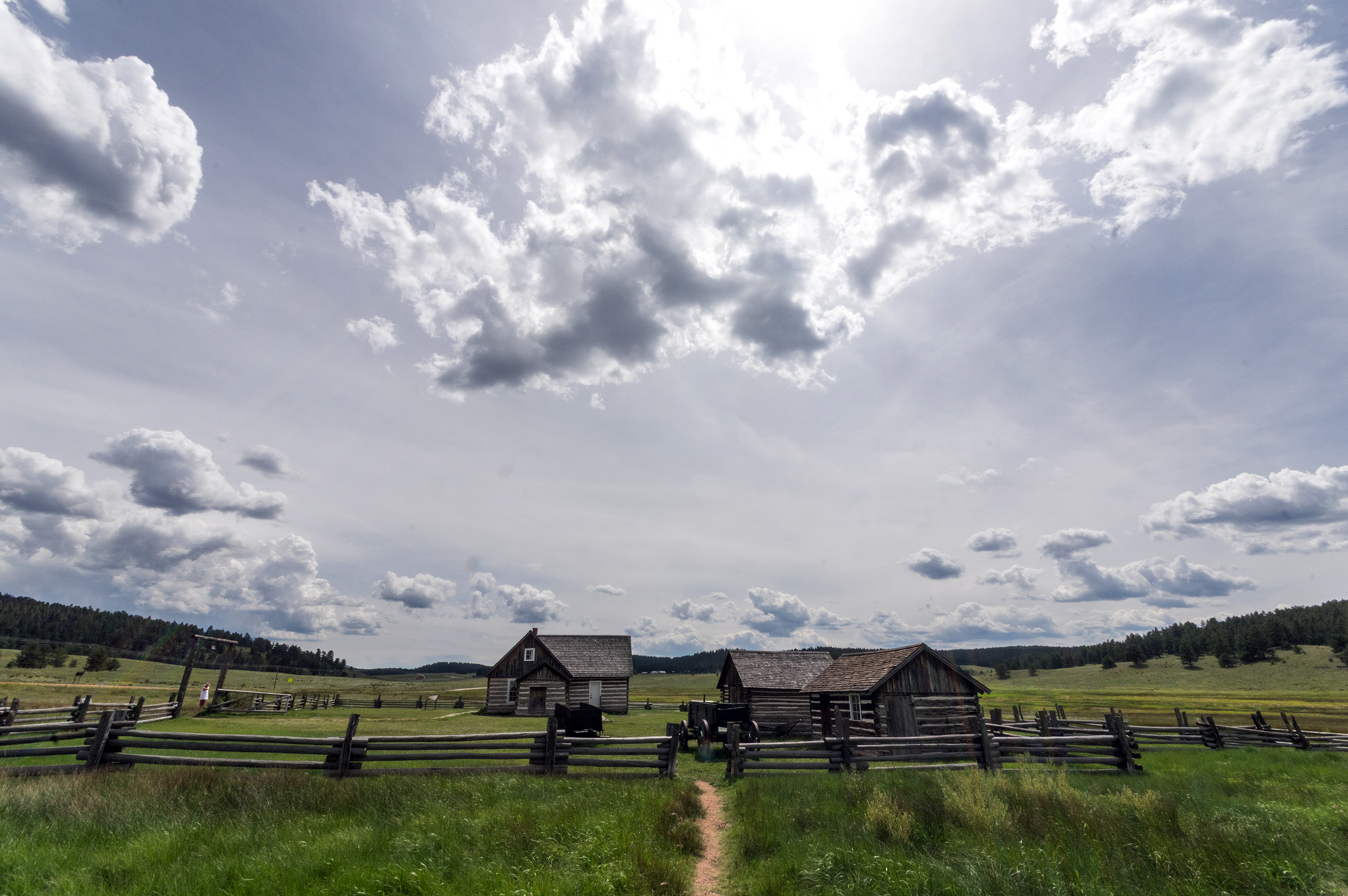
The path to protection was not smooth. For decades, the fossils were vulnerable to collectors, developers, and souvenir hunters. Dynamite was used to better expose the petrified stumps for tourists. The monument was finally established on August 20, 1969, after a hard-fought legal battle between local landowners and the federal government. Today the park encompasses fifteen miles of hiking trails through high-altitude meadow and forest. In 2021, Florissant earned designation as an International Dark Sky Park, and the Hornbek Homestead parking area stays open around the clock for stargazing. On clear nights, visitors from Colorado Springs bring telescopes to observe the sky free of light pollution, looking up at the same stars that once shone over a redwood forest that no longer exists anywhere on Earth at this elevation.
From the Air
Located at 38.914N, 105.286W in Teller County, Colorado, at approximately 8,500 feet elevation. The monument sits along Teller County Road 1, which runs through the middle of the park, approximately 35 miles west of Colorado Springs. Nearest airport is Colorado Springs Municipal Airport (KCOS). The petrified stumps are not visible from typical cruising altitude but the park's meadows contrast with surrounding forest. Pikes Peak (14,115 ft) is a prominent landmark to the east. Cripple Creek lies 18 miles to the south along County Road 1.