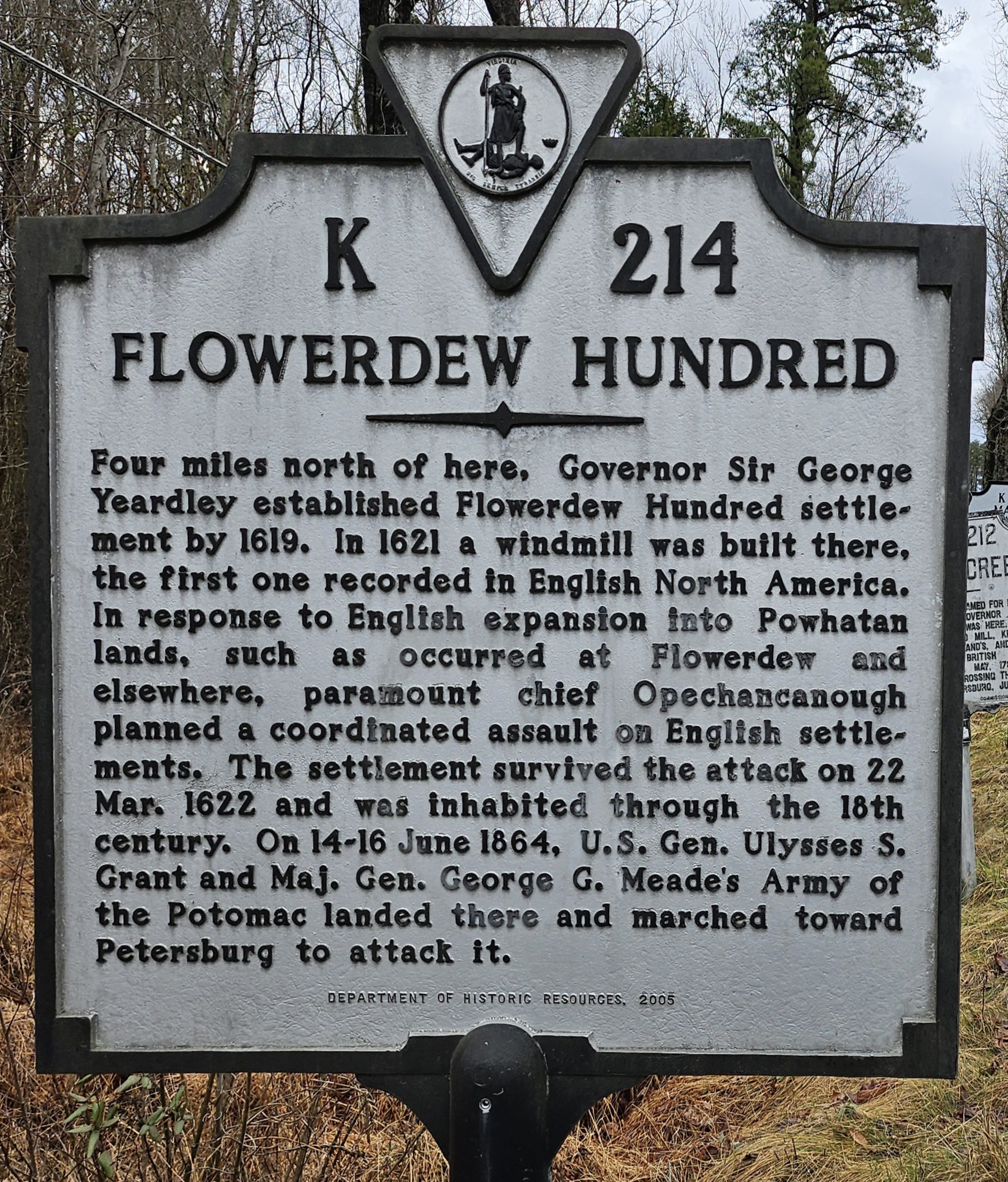
Flowerdew Hundred Plantation
Sir George Yeardley named it after his father-in-law's money, not his affection. When the Governor and Captain General of Virginia patented land on the south side of the James River in 1618, he called it Flowerdew Hundred after Anthony Flowerdew, the wealthy Norfolk gentleman whose daughter Temperance had married him. A "hundred" was an old English division of a county, and this one would prove tougher than most. While neighboring settlements like Henricus and Martin's Hundred were abandoned after the devastating Indian massacre of 1622, Flowerdew survived with only six deaths, its residents fortified and defiant on the riverbank. With about 30 people producing thousands of pounds of tobacco alongside corn, fish, and livestock, the plantation was an economic engine of early colonial Virginia - and home to the first windmill ever erected in British America, built by 1621.
Firsts Along the James
Flowerdew Hundred accumulated firsts the way other plantations accumulated debts. The English post mill that rose on its grounds by 1621 was the first windmill in English North America, its wooden sails catching the river breeze to grind grain. When Abraham Piersey, Cape Merchant of the Virginia Company, purchased the plantation in 1624, he renamed it Piersey's Hundred and built Piersey's Stone House - the first home with a permanent foundation in the colony. The 1624 Muster counted approximately sixty occupants at the settlement, including some of the first Africans in Virginia. Throughout the seventeenth century, the Hundred continued to prosper. A secondary settlement was established, and in 1683, Flowerdew Towne was formed downriver under the king's Advancement of Trade Act, though it never thrived in the James River planter economy. After 1720, a ferry began running across the stretch of the James known as Three Mile Reach, with a tavern built at the landing for the convenience of passengers.
Shelled, Burned, and Rebuilt
The plantation passed through the Poythress family for generations, each heir seemingly named Joshua. In 1781, Benedict Arnold's campaign brought violence to Flowerdew when he ordered Lieutenant Colonel Simcoe and Queen's Rangers to spike the guns near Hood's fort on the property's eastern edge before continuing upriver to set Richmond ablaze. A Petersburg merchant named John Vaughn Willcox later reassembled the scattered plantation, marrying the last Poythress heiress and buying up surrounding tracts that had been sold off during the eighteenth century. In 1804, they built a new farmhouse on the high ridge overlooking the fertile bottomlands along the James. The name itself shifted across centuries - Fleur de, Flowerdieu, Flower de, Flourdy Hundred - along with owners' names: Piersey's, Selden's, Hood's, Bellevue. But the land along the river remained.
The Longest Bridge
In June 1864, Ulysses S. Grant needed to outflank Robert E. Lee and capture Petersburg's vital rail hub. His solution was audacious: order the Corps of Engineers to throw a pontoon bridge across the James River at Flowerdew, then known as Wilcox Landing. In a single evening, the engineers accomplished what was then the longest floating bridge ever built, stretching from Weyanoke to the plantation's shore. Three corps of the Army of the Potomac and a supply train crossed in about three days, heading for City Point to begin the Siege of Petersburg. That record for the longest pontoon bridge stood until World War II. The crossing's exact location was lost to time until 1986, when Eugene Prince and Taft Kiser found it again using a remarkably simple method: a 35mm camera, a cypress tree on the riverbank, and an 1864 photograph by Andrew Joseph Russell. A dead limb visible in the wartime image was still present on the same bald cypress 122 years later, confirming the site.
Buried and Unearthed
Beneath the plantation's 1,000-acre land grant lie more than 60 archaeological sites spanning from archaic Native American encampments to twentieth-century homesteads. Archaeological investigations began in the late 1960s and continued through 1995, when James Deetz led the final excavation within the original fortified area. The work yielded more than 500,000 artifacts, now housed at the University of Virginia. Among the most notable finds is a Prince of Orange medallion minted in 1615 - only three others are known to exist, including one at Historic Jamestowne, one in a Native American grave at Burr's Hill, Rhode Island, and one held by the British Museum. In 1975, then-owner David A. Harrison III created the Flowerdew Hundred Foundation, which operated a museum and conducted tours until closing in 2007. A commemorative windmill of English post design, built on the farm in 1978 by English millwright Derrick Ogden, was eventually donated to the American Wind Center and Museum in Lubbock, Texas. The old Willcox house was torn down in 1955, though a magnolia planted in 1840 still survives. And that bald cypress that anchored the great pontoon bridge still stands along the river.
From the Air
Located at 37.296°N, 77.104°W on the south bank of the James River in Prince George County, Virginia. The plantation sits along a distinctive bend in the James, visible as cleared agricultural land with a large mansion on a ridge above the river bottomlands. Part of the James River Plantations corridor along Route 5. Best viewed at 1,500-3,000 ft AGL. Richmond International Airport (KRIC) is approximately 25nm northwest. Newport News/Williamsburg International Airport (KPHF) is about 30nm southeast. The James River provides an excellent navigation reference. Watch for restricted airspace near military installations in the greater Hampton Roads area.