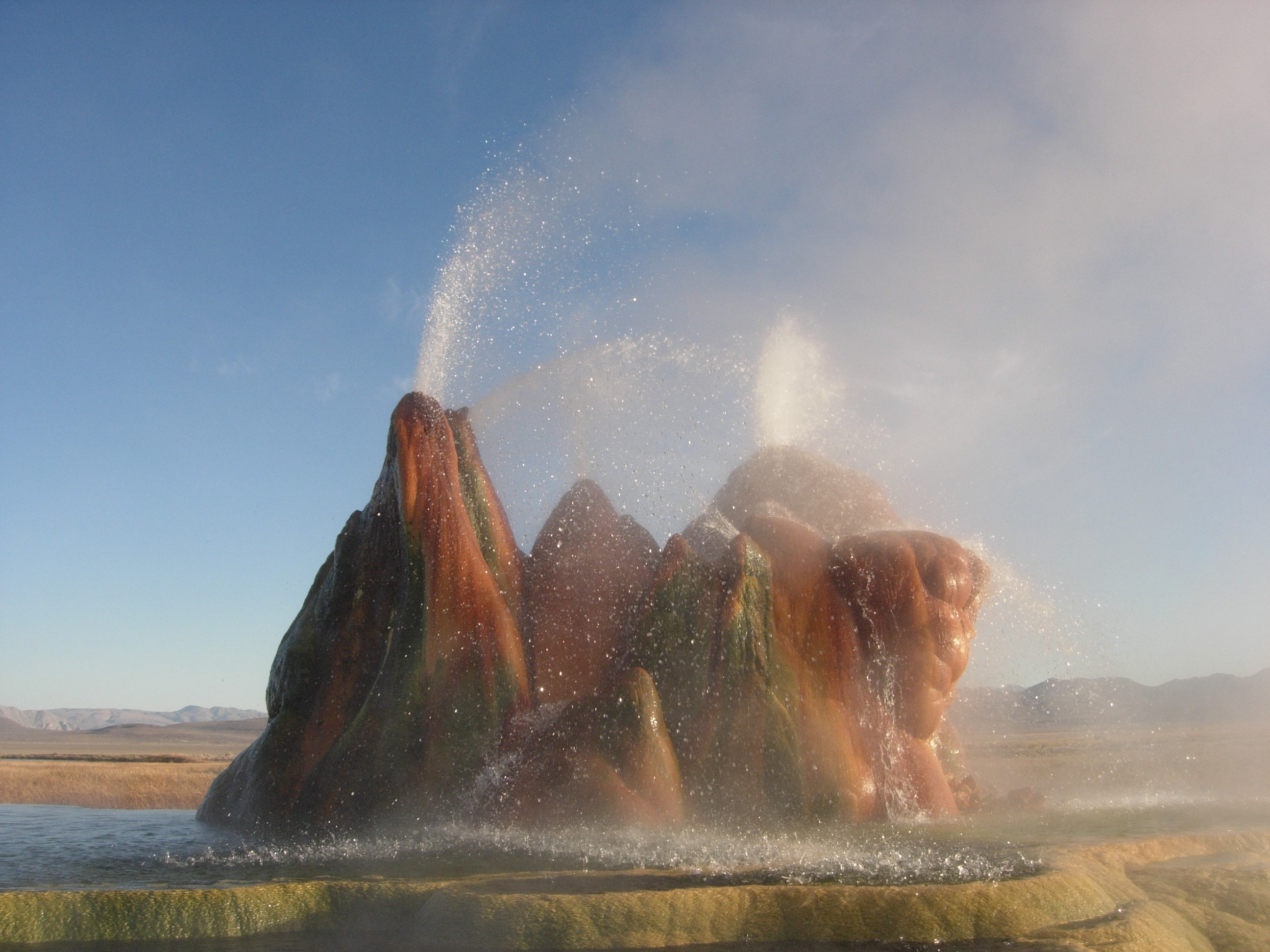
Fly Geyser
Nobody meant to make it. In 1964, a geothermal energy company drilled a test well in the Hualapai Flat of northern Nevada, hoping to tap underground heat for power generation. When they found the water temperature was not quite hot enough for their purposes, they capped the well and moved on. The cap failed. What emerged over the following decades is one of the most otherworldly landscapes in North America: a constantly erupting fountain depositing vivid mineral cones that grow several inches each year, painted in streaks of brilliant green and red by thermophilic bacteria thriving in the scalding water. This is Fly Geyser, an accident that became a destination, now watched over by the same organization that brings 70,000 people to the Nevada desert each August for Burning Man.
Two Wells, Two Geysers
The story actually begins earlier. In 1916, ranchers drilled a well on Fly Ranch seeking irrigation water. Instead of cool groundwater, they struck geothermal water near boiling temperature. They abandoned the attempt, but over time a calcium carbonate cone formed around that first failed well. Nearly fifty years later, the 1964 drilling created a second, more spectacular geyser nearby. Dissolved minerals in the superheated water, including calcium carbonate and silica, began accumulating around the new opening, building the terraced travertine pools and multicolored cones that define the site today. The 1916 geyser went dormant when its younger sibling began releasing water, as if the earth chose which artwork to display.
Colors of Extremophile Life
The psychedelic palette of Fly Geyser comes not from the minerals alone but from life itself. Thermophilic algae and bacteria flourish in the moist, scalding environment where water exits the geyser at temperatures exceeding 200 degrees Fahrenheit. These extremophiles, organisms that thrive in conditions lethal to most life, color the rocks in brilliant hues of green and red. The effect changes with the seasons, the angle of light, and the shifting microbial communities. What looks like painted rock is actually a living skin, constantly growing, constantly changing. Scientists studying the geyser have found remarkably high silica content in the water, a chemistry that is producing quartz inside the geyser at extraordinary speed. Quartz typically takes up to 10,000 years to form in geothermal systems. Here, it is happening in human timescales.
From Private Mystery to Burning Man Stewardship
For decades, Fly Geyser remained hidden on private ranchland, visible only as a distant curiosity from the highway or in photographs taken by trespassers. The Fly Ranch property encompassed 3,800 acres of remote high desert, and its owners preferred solitude. That changed in June 2016 when the nonprofit Burning Man Project purchased the entire ranch, including the geyser, for $6.5 million. The acquisition aligned with Burning Man's interest in experimental communities and desert stewardship. In May 2018, the organization began offering limited public access through guided nature walks. Tours are managed by the Friends of Black Rock-High Rock, and ticket payments function as donations supporting the property's conservation.
A Landscape Still Being Built
Unlike natural geysers in places like Yellowstone that erupt periodically, Fly Geyser is a continuously flowing feature, a perpetual fountain building its own monument. The mound of accumulated minerals now stands several feet high and continues growing. The travertine pools surrounding it expand outward, creating an ever-larger footprint on the flat desert floor. Carolina Munoz Saez, a geologist hired by Burning Man to study the geyser, described finding conditions that challenge assumptions about how geological features form. The geyser is not a relic but an ongoing process, a place where you can watch the Earth remake itself in real time. The scalding water, the extremophile life, the mineral deposits, and the constant growth make Fly Geyser less a static landmark than a geological organism.
The Black Rock Connection
Fly Ranch sits at the edge of the Black Rock Desert, the same playa that hosts the Burning Man festival each year. Gerlach, the nearest town, lies a few miles to the south, a community of a few hundred souls that swells dramatically each August when festival-goers pass through. The Hualapai Flat where the geyser sits is part of a larger geothermal zone, evidence of the tectonic rifting and faulting that characterize this region. Deep beneath the surface, hot rock heats groundwater to temperatures that would be lethal to most life but perfect for the extremophiles that paint these formations. State Route 34 passes nearby, but the geyser remains deliberately difficult to reach, its isolation part of its protection. What was once an industrial accident is now a strange temple to unintended consequences, where human intervention released forces that built something no engineer would have designed.
From the Air
Located at 40.86N, 119.33W in Washoe County, Nevada, approximately 20 miles north of Gerlach. The geyser appears as a small but brightly colored formation on the otherwise tan-brown Hualapai Flat. Best spotted from 2,000-4,000 feet AGL; the vibrant greens and reds contrast sharply with the desert floor. Nearest airports: Reno-Stead (KRTS) 75nm south, Reno-Tahoe International (KRNO) 90nm south. The Black Rock Desert playa is visible to the east. Site of Burning Man festival annually in late August.