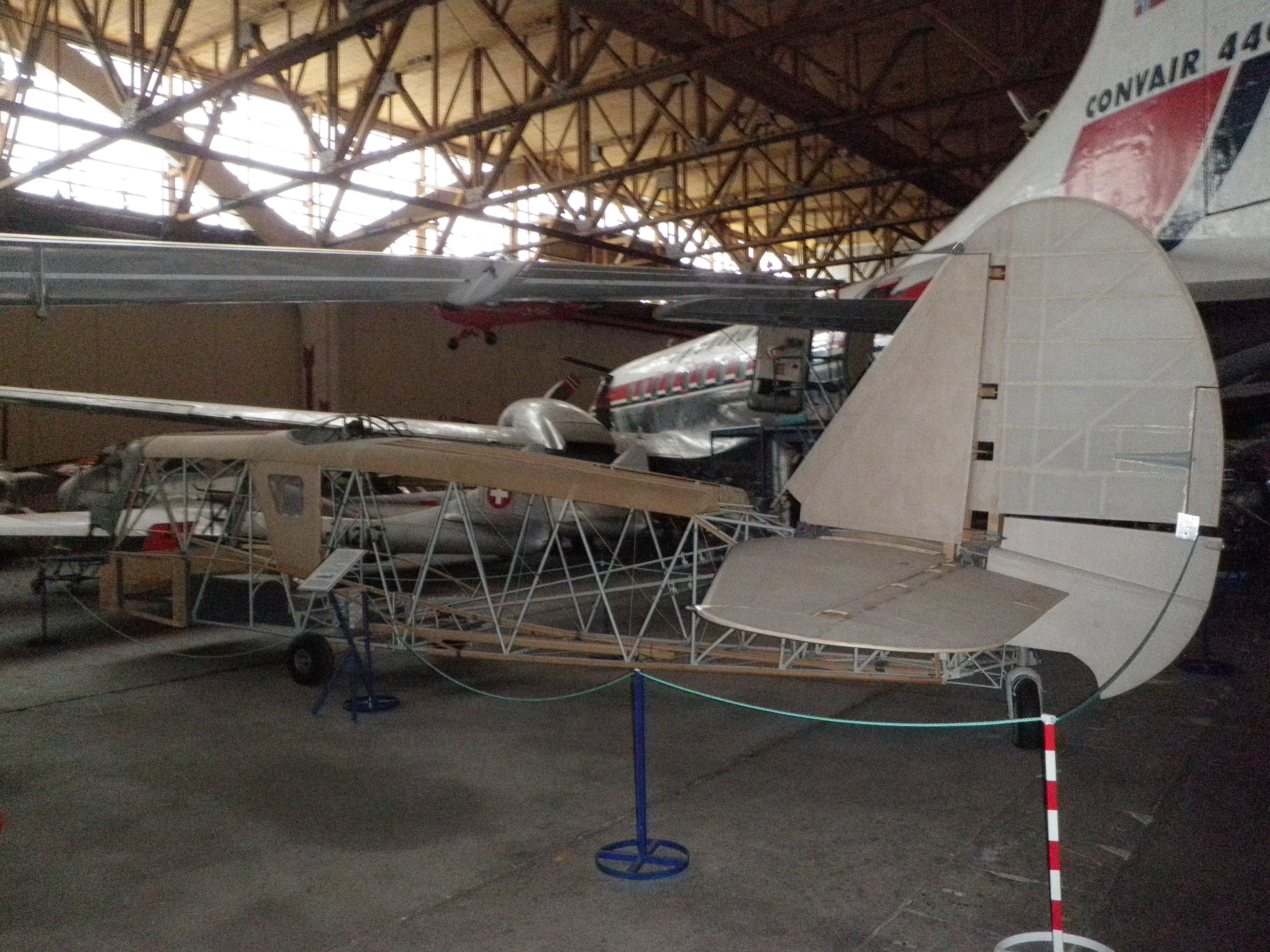
Flyhistorisk Museum, Sola
The hangar was built by German forced labor during World War II, designed to shelter seaplanes at what was then a Luftwaffe base on Norway's southwest coast. Today it houses something the occupiers never intended: a museum dedicated to preserving the full arc of aviation at Stavanger Airport, Sola, from wartime to the present. Founded in 1984 and run entirely by volunteers, Flyhistorisk Museum Sola is one of those small, passionate institutions where you can watch restorers hunched over an eighty-year-old airframe in one room and drink coffee in a cafe built from a decommissioned fighter squadron bar in the next.
Relics of the Occupation
The Luftwaffe collection is the museum's most historically significant. Among the aircraft is an Arado Ar 196 -- or rather its airframe, pulled from the wreck of the German heavy cruiser Blucher, sunk in the Oslofjord during the German invasion of Norway in April 1940. The Blucher went down with most of her crew in a surprise attack by Norwegian coastal fortress guns, and the floatplane that sat on her catapult went with her. Also in the collection is what is believed to be the only surviving, or at least the most complete, Arado Ar 96 trainer anywhere. A Messerschmitt Bf 109 was rolled out after restoration in June 2020. In the workshop, volunteers continue painstaking work on a Heinkel He 115 seaplane and a Caproni Ca.310 bomber. A Junkers Ju 52 sits in storage awaiting its turn.
Every Jet Norway Ever Flew
Stavanger Airport served as a Royal Norwegian Air Force base throughout the Cold War, and the museum's collection reflects that history with an example of every post-war jet type operated by the Norwegian military -- with the notable exception of the F-16. A Republic F-84G Thunderjet sits alongside a North American F-86F Sabre, a Northrop F-5A Freedom Fighter, a Canadair CF-104 Starfighter, and a Lockheed T-33 trainer. A de Havilland Vampire rounds out the jet collection with Swiss markings. For helicopter enthusiasts, a Bell UH-1B and a Westland Sea King represent the rotary-wing side of Norwegian military aviation. The collection tells a Cold War story specific to Norway's position on NATO's northern flank, where the proximity of Soviet naval and air bases made air defense a constant preoccupation.
Propellers and Peacetime
The civilian side of the museum captures the golden age of Scandinavian commercial aviation. A Douglas DC-6 once operated by Braathens S.A.F.E -- the airline that made Sola its maintenance hub -- anchors the collection. A Fokker F.27 Friendship, a Convair CV-440 Metropolitan in Norsk Metropolitan Klubb colors, and a De Havilland Heron represent the propeller-driven airliners that connected Norway's coastal cities before jets took over the routes. Smaller aircraft fill the gaps: a Grumman Widgeon floatplane, a Noorduyn Norseman bush plane, a Piper J-3 Cub, and a Bell 47 helicopter in Helikopter Service livery. The engine collection includes a Rolls-Royce Merlin, a Wright R-3350 Duplex-Cyclone, and a Pratt and Whitney JT8D -- powerplants spanning four decades of aviation technology.
A Hangar with a Second Life
What makes Flyhistorisk Museum Sola distinctive is not just its collection but its setting. The wartime seaplane hangar is an artifact in its own right, a concrete shell that has outlived its builders' intentions by eight decades. The museum operates on a volunteer basis, opening Sundays from May through November and daily during the school summer holiday. Since 2012 it has cooperated with Jaermuseet, the regional museum network, but its character remains grassroots -- driven by enthusiasts who spend their weekends with rivet guns and restoration manuals. The aircraft on display and in storage represent nearly every chapter of Norwegian aviation, from the grim utility of wartime to the optimism of postwar commercial flight to the disciplined readiness of NATO's northern air defenses.
From the Air
Located at 58.90N, 5.63E at Stavanger Airport, Sola (ENZV). The museum is in a WWII-era seaplane hangar on the airport grounds. Pilots arriving at or departing from ENZV can spot the hangar on the airfield's north side. The museum is accessible from the airport. Fly over at circuit altitude for views of the historic hangar amid the modern airport infrastructure.