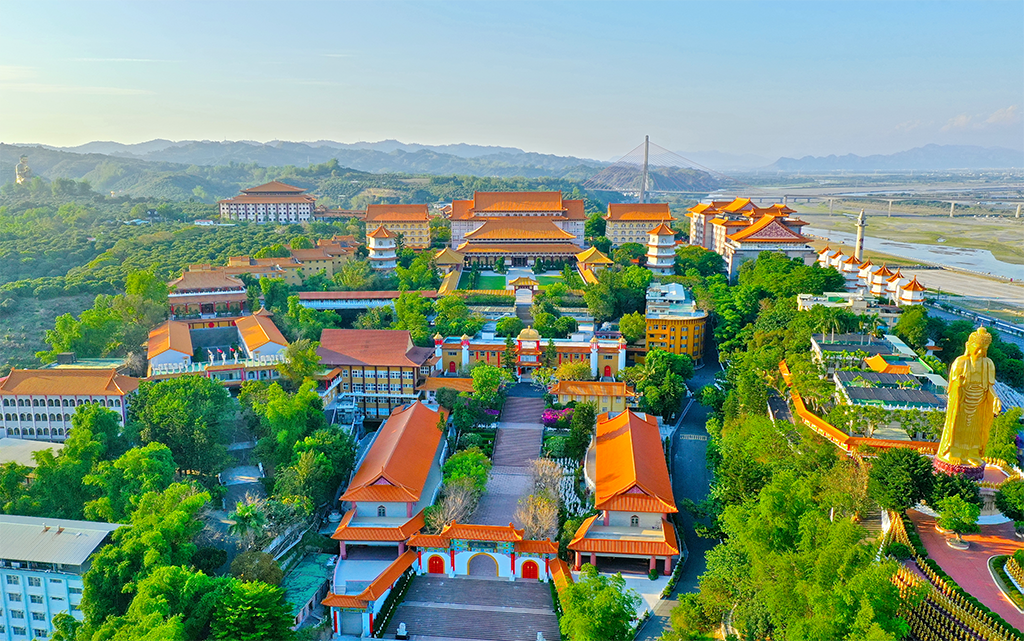
Fo Guang Shan Monastery
In 1997, the monastery's founder closed the gates. Hsing Yun, the monk who had purchased 30 hectares of hillside in Dashu Township in 1967 and spent three decades building Taiwan's largest Buddhist monastery upon it, announced that Fo Guang Shan would shut its mountain gate to the general public. Monastics needed quiet for their practice, he explained. For three years, the gates stayed closed. Then President Chen Shui-bian visited at the turn of the millennium, carrying a request from constituents who wanted the monastery reopened. Fo Guang Shan relented, partially -- opening the grounds enough for visitors to practice Pure Land Buddhism while preserving space for monastic contemplation. It was a characteristic compromise from an institution that has spent its entire existence balancing tradition with accessibility.
Thirty Hectares and a Vision
Hsing Yun broke ground on May 16, 1967, on a hillside in what was then rural Kaohsiung County. The land was remote, undeveloped, and affordable -- qualities that made it unattractive to most but ideal for a Buddhist monastery that would need room to grow. Grow it did. Over the following decades, Fo Guang Shan undertook a continuous stream of construction projects: university buildings, shrines, a retirement home, a cemetery. In 1975, a 36-meter-tall statue of Amitabha Buddha was consecrated -- at the time the tallest standing Buddha in Southeast Asia. The Great Hero Hall was completed in 1981. Meanwhile, the order was establishing temples beyond the mother monastery, building a network that would eventually span the globe. The main shrine alone covers 3,570 square meters, rises 30 meters high, and can accommodate a thousand people. Three Buddha statues, each 7.8 meters tall, preside over the interior.
Where 14,800 Buddhas Watch
The Great Buddha, standing 36 meters on the monastery's eastern side beside the Great Wisdom Shrine, is surrounded by one of the most striking interior spaces in Taiwanese religious architecture. Its four interior walls are lined with Dunhuang-style stone niches, each holding a small statue of Sakyamuni Buddha -- 14,800 in total. The effect is overwhelming: tier upon tier of identical figures ascending toward the ceiling, creating a sense of infinite repetition that mirrors the Buddhist concept of countless enlightened beings across countless lifetimes. Nearby, the Great Compassion Shrine houses a 6-meter statue of Guan Yin, the bodhisattva of mercy. The Patriarch Shrine, which serves as a memorial hall for Hsing Yun and the final resting place for his relics after his death in February 2023, also functions as the Sutra Repository, housing over 50 copies of the Tripitaka -- the complete canonical collection of Buddhist scriptures.
Democracy in Saffron
Fo Guang Shan's governance breaks sharply from traditional Mahayana Buddhist practice, where an abbot typically selects his own successor. Here, the abbot is elected by all monastic members through public vote, serving a six-year term with the possibility of one reappointment. Upon election, the new abbot adopts an "inner name" beginning with the character Hsin, meaning heart. The inauguration involves a dharma transmission ceremony: the receiving of robe and bowl, the ancient symbols of Buddhist authority. Hsing Yun himself served as abbot from the founding in 1967 until 1985 and was the only leader not elected by the membership. After his designated successor Hsin Ping died of sudden illness in 1995, vice director Hsin Ting was elevated to complete the term. Since then, the democratic process has held. Retired abbots remain within the order as elder teachers, continuing to give Dharma talks worldwide.
A Mountain of Light from the Air
Fo Guang Shan -- the name means "Buddha's Light Mountain" -- occupies a hillside that is visible from considerable distance. The monastery's buildings cascade down the slope in a series of terraces, their rooflines rising among the tropical vegetation. The adjacent Fo Guang Shan Buddha Museum, opened in 2011, extends the complex northward with its avenue of eight pagodas and the massive 108-meter seated Big Buddha. Together, the monastery and museum form one of the largest religious complexes in East Asia. In October 2018, Fo Guang Shan hosted the First International Dialogue for Buddhist and Christian Nuns, bringing together 70 nuns from both traditions. It was an event that captured something essential about the institution: a monastery rooted in centuries of Chinese Buddhist practice that has consistently reached outward, embracing interfaith dialogue, democratic governance, and modern technology in ways that would have been unimaginable to the tradition's founders.
From the Air
Located at 22.757N, 120.441E in the hills of Dashu District, northeast of central Kaohsiung. The monastery complex cascades down a hillside, with the 36-meter Amitabha Buddha statue visible from distance. The adjacent Buddha Museum's 108-meter Big Buddha is the most prominent aerial landmark. Nearby airports: RCKH (Kaohsiung International Airport, 25 km southwest). Best viewed at 3,000-6,000 ft AGL. The terraced monastery buildings amid tropical hillside vegetation are distinctive.