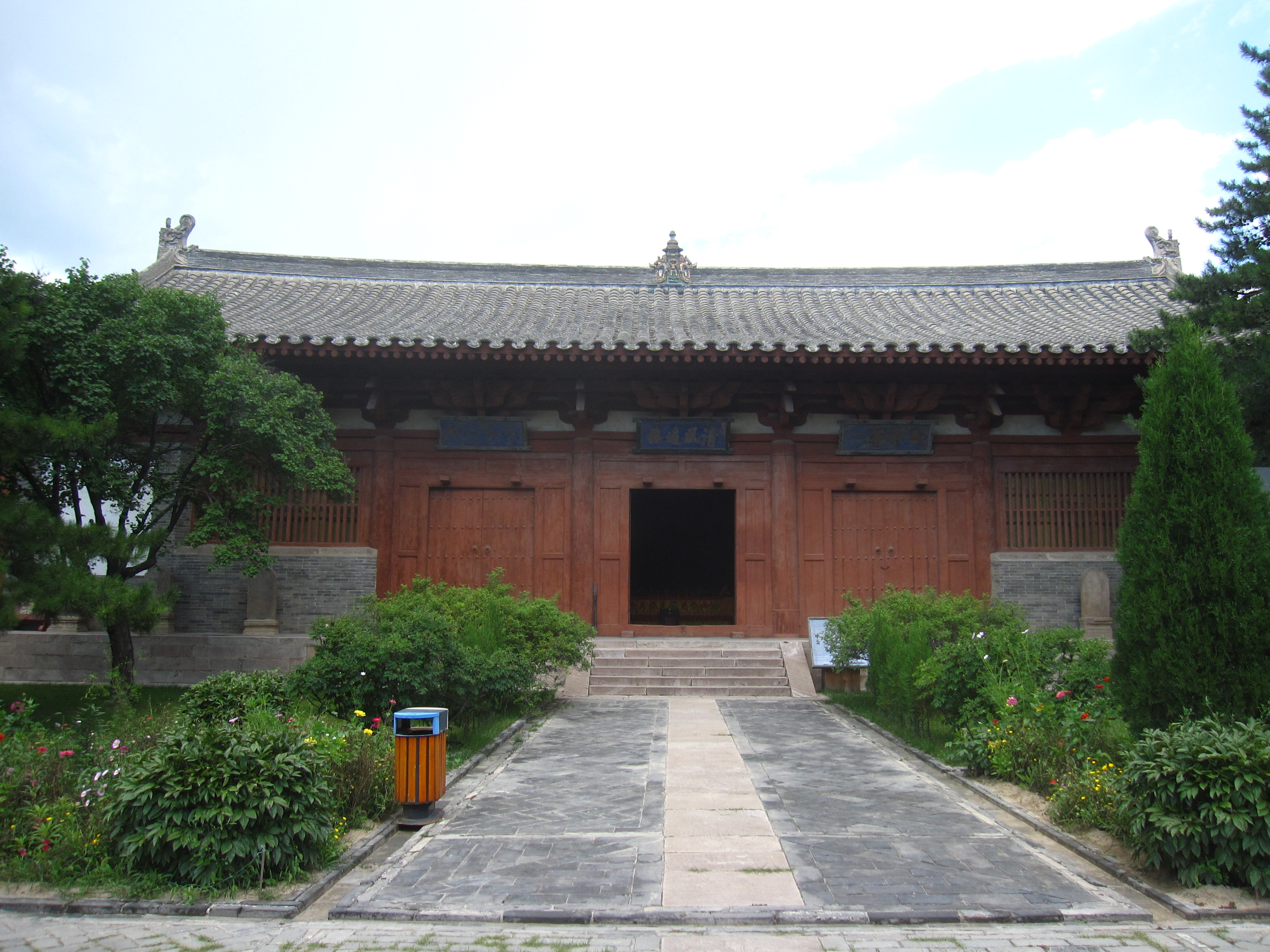
Foguang Temple
In 1937, the architectural historian Liang Sicheng and his wife Lin Huiyin were searching for something that many Chinese scholars believed no longer existed: a building from the Tang dynasty. Seven years of methodical surveying across rural China had yielded nothing. Then, in the mountains of Wutai County in Shanxi Province, they found Foguang Temple, and Lin Huiyin deciphered ink writing on a beam identifying the donor, then confirmed the date 857 AD from an inscription on a stone dharani pillar in the courtyard. The Tang dynasty, which had seemed architecturally extinct, suddenly had a survivor. The discovery would reshape the understanding of Chinese architectural history.
Burned, Then Reborn
Foguang Temple was originally established in the fifth century during the Northern Wei dynasty. By the early ninth century, it had grown to include a three-level, 32-meter-tall pavilion. Then, in 845 AD, Emperor Wuzong of Tang launched the Great Anti-Buddhist Persecution, ordering the destruction of temples and monasteries across the empire. Foguang Temple was burned to the ground. Only a small hexagonal funerary pagoda -- the Zushi Pagoda, possibly dating from the Northern Wei or Northern Qi dynasty -- survived the flames. Twelve years later, in 857, a woman named Ning Gongyu provided the funds to rebuild the temple, and a monk named Yuancheng supervised the construction of the Dongda Hall on the site of the destroyed pavilion. That a layperson, and a woman, bankrolled the resurrection of a Tang dynasty masterpiece is a detail that history nearly lost.
A Hall That Faces the Wrong Way
Most Chinese temples orient along a south-north axis. Foguang Temple faces east-west, a departure explained by its feng shui: mountains rise on three sides, and placing the buildings with mountains behind them was considered auspicious. The Dongda Hall, the temple's largest structure, sits atop a stone platform at the complex's eastern end. It measures seven bays by four -- 34 by 17.7 meters -- and contains some of the most sophisticated bracket work surviving from the Tang dynasty. Seven different bracket types, each one-half as tall as the supporting column, create an interlocking system of stunning complexity. A lattice ceiling conceals the roof frame, and the hipped roof profile testifies to the hall's high status in the Tang architectural hierarchy.
Thirty-Six Figures in Eternal Assembly
Inside the Dongda Hall, thirty-six sculptures and Tang dynasty murals create an interior that has changed little in nearly 1,200 years. Three large Buddhas -- Sakyamuni, Amitabha, and Maitreya -- sit on lotus thrones at the center, each flanked by attendant bodhisattvas. Manjushri rides a lion, Samantabhadra sits on an elephant, and two heavenly kings guard the dais. In the back of the hall, two statues represent the people who made this possible: Ning Gongyu, the donor, and Yuancheng, the monk who oversaw the work. Their presence among the Buddhas and bodhisattvas is a rare humanizing touch in a sacred space. Murals of arhats painted in 1429 during the Ming dynasty line the walls, adding a later artistic layer to the Tang-era core.
Painted in a Cave a Thousand Miles Away
In the tenth century, artists at the Mogao Grottoes near Dunhuang -- over a thousand kilometers to the west -- painted a depiction of Foguang Temple in Cave 61. The painting shows a two-storied white building with a green-glazed roof, nothing like the actual red-and-white Dongda Hall. The artists had almost certainly never visited the temple, but they knew of its fame. That Foguang Temple appeared in the Mogao murals confirms its importance as a destination on the Buddhist pilgrimage circuit. By 2009, the temple had earned a different kind of recognition: it was inscribed as part of the Mount Wutai UNESCO World Heritage Site, ensuring that the building Liang Sicheng and Lin Huiyin pulled from obscurity will remain in the world's consciousness.
The Patriarch's Pagoda
South of the Dongda Hall stands the Zushi Pagoda, a small white hexagonal tower roughly six meters tall that may contain the tomb of Foguang Temple's founder. Built during either the Northern Wei or Northern Qi dynasty, it is the second oldest surviving pagoda in China, after the Songyue Pagoda. The first story contains a hexagonal chamber, while the second is purely decorative, adorned with lotus petals. Two Tang dynasty funerary pillars also stand on the temple grounds, the older of which records the construction of the Dongda Hall in 857. These pillars are the same physical evidence that helped Liang Sicheng confirm the age of the building his wife had identified by its rafter inscription -- a detective story in which architecture, epigraphy, and love of country converged.
From the Air
Located at 38.87N, 113.39E in Wutai County, Shanxi Province, approximately 5 km from Doucun. Part of the Mount Wutai UNESCO World Heritage Site. Nearest airport is Xinzhou Wutaishan Airport (ZBXZ). The temple complex is oriented east-west in a mountain valley. The nearby Nanchan Temple, China's oldest timber building, is approximately 20 km to the southwest. Standard mountain flying precautions; terrain rises significantly to the east.