The Powerhouse That Beat Niagara Falls
On September 9, 1895, Sacramento threw itself a party. Thousands of electric light bulbs decorated the state capitol building for a "Grand Electric Carnival" celebrating the 45th anniversary of California statehood. But the real celebration was the light itself. For the first time, Sacramento was running on electricity generated 22 miles away at Folsom, transmitted over one of the longest power lines in the United States. The generators at the Folsom Powerhouse had been operating for less than two months, and already the world was watching. The Niagara Falls Adams Power Plant would not send its first alternating current to Buffalo, New York, until 1897. A building on the American River, powered by rushing water and equipped with machines too large to ship by rail, had quietly changed how civilization would power itself.
A Sawmill That Became a Revolution
Horatio Gates Livermore originally wanted to build a sawmill. In the early 1890s, he directed the construction of a diversion dam across the American River -- 650 feet long, 89 feet tall -- and a 2.5-mile canal called the East Canal to carry water alongside the river at a gentler slope. The canal was 50 feet wide and 8 feet deep, moving 85,000 cubic feet of water per minute. By the time the dam and canal were completed in 1893, the ambition had grown far beyond lumber. The geometry of the site gave the powerhouse a hydraulic head of about 85 feet -- the vertical drop between the canal's forebay and the river below. Livermore used contracted labor from nearby Folsom State Prison to build the infrastructure. The falling water would not drive saws. It would drive generators.
Machines That Sailed Around the World
The four alternating current generators were among the most powerful rotating armature three-phase machines ever built. Designed by Elihu Thomson and manufactured at General Electric's newly incorporated plant in Schenectady, New York, each weighed nearly 30 tons. They were so large that no railroad car could carry them. Instead, they traveled 19,000 miles by ship around Cape Horn to reach the American River. Each 750-kilowatt generator was connected directly to a water turbine built by S. Morgan Smith Works of York, Pennsylvania -- also among the largest turbines of their time. Centrifugal governors controlled the water flow to hold each turbine at exactly 300 revolutions per minute, the speed required to produce a steady 60-cycle alternating current. On July 13, 1895, with only two of the four generators operational, the powerhouse sent its first electricity to Sacramento.
Eleven Thousand Volts on Cedar Poles
The breakthrough was not just generation but transmission. Before Folsom, nearly all power stations used direct current, which could not be economically sent more than a few miles. Thomas Edison's Pearl Street Station in Manhattan, the nation's first central power plant, had started in 1882 serving 85 customers within a two-mile radius. Alternating current changed the equation. At the Folsom Powerhouse, twelve air-cooled transformers designed by William Stanley Jr. boosted the generated 800 volts to 11,000 volts for transmission. Twelve bare copper wires strung on ceramic insulators ran along two rows of 40-foot cedar poles, planted 105 feet apart, stretching 22 miles to Sacramento. Telephone lines hung beneath the power cables. In Sacramento, transformers stepped the voltage back down for local use -- the same basic architecture that powers electrical grids worldwide today. By 1900, improved oil-cooled transformers had replaced the originals, and a second powerhouse was built in 1897 to meet growing demand.
Fifty-Seven Years of Continuous Service
The Folsom Powerhouse operated without interruption from 1895 to 1952 -- 57 years of continuous power generation. It survived the transition from Sacramento's streetcar era to the automobile age, from gas lamps to household refrigerators. Pacific Gas and Electric bought the facility in 1902, retooled it in 1906, and ran it until the original diversion dam had to be destroyed to make way for the much larger Folsom Dam. When the new dam and its modern hydroelectric plant were built, PG&E donated the old powerhouse and most of its equipment to the State of California. The 35-acre historic park was established in 1956. The powerhouse was designated California Historical Landmark Number 633, and in 1981 it earned the distinction of U.S. National Historic Landmark -- recognition that this building on the American River had helped launch the electrical age.
Standing Inside the Future's Workshop
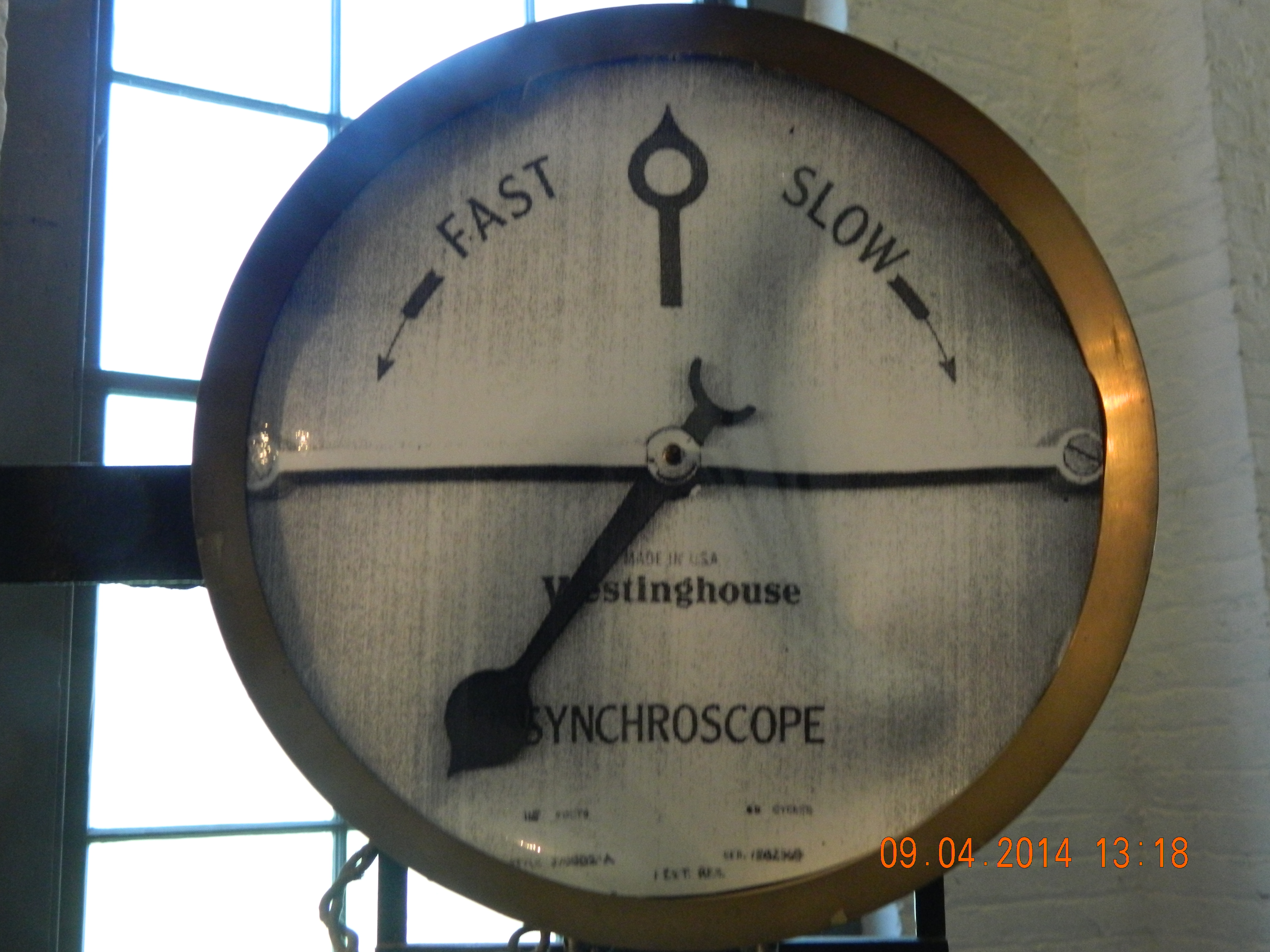
Walk into the powerhouse today and the scale of the machinery stops you. The four generators sit on the floor like industrial monuments, each 8.5 feet across, their rotating armatures containing 216 radial slots with paired inductive bars wound in flattened spirals -- three phases, six branch circuits, an engineering solution so elegant it still generates the same 60-cycle current used throughout the United States. The penstocks that fed the turbines, the switchboard with its frequency indicator added to regulate electric clocks, the synchroscope that allowed operators to synchronize generators to the grid -- all of it remains. Larger hydroelectric plants on the Yuba, Feather, and Tuolumne Rivers eventually surpassed Folsom's capacity, as Sacramento's appetite for electricity outgrew what three megawatts could satisfy. But those later plants followed the path the Folsom Powerhouse cut. The future of electrical power was prototyped here, 23 miles up the American River, in a building that a man built because he wanted a sawmill.
From the Air
Located at 38.68N, 121.18W on the north bank of the American River in the city of Folsom, about 23nm east of Sacramento. The powerhouse sits below the site of the original 1890s diversion dam, downstream from the modern Folsom Dam. The East Canal trace is visible from lower altitudes as a linear feature paralleling the river. Sacramento Mather Airport (KMHR) lies 12nm southwest; Sacramento Executive (KSAC) is 20nm west. The historic park is best spotted by following the American River upstream from its confluence with the Sacramento River. The powerhouse building and its immediate grounds are small but distinctive along the river corridor.