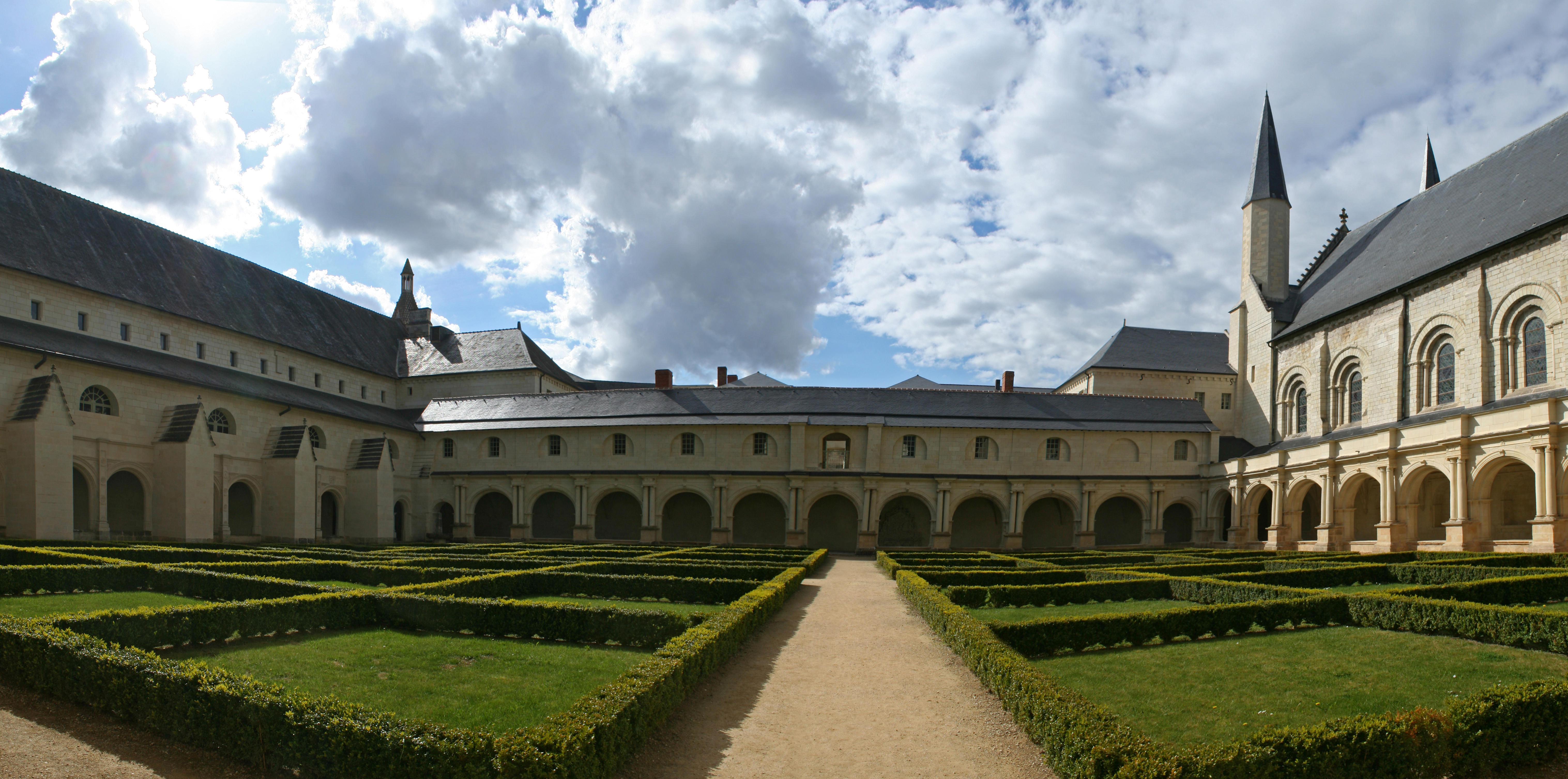
Fontevraud Abbey
Three of the most powerful people in twelfth-century Europe lie side by side in a single nave. Henry II of England, his wife Eleanor of Aquitaine, and their son Richard the Lionheart — painted stone effigies atop their tombs, faces serene in a peace they rarely knew in life. Fontevraud Abbey, tucked into the Loire Valley near Chinon, holds these royal dead. But the abbey's story begins not with kings but with a wandering preacher who had a radical idea: men and women would live in the same monastic community, and a woman would lead them all.
The Preacher in the Valley
Robert of Arbrissel had been Archpriest of the Diocese of Rennes before hostile clergy drove him out in 1095. He retreated to the forest of Craon, where his austere asceticism attracted followers. In 1096, he founded a monastery of canons regular at La Roë, but when the resident canons objected to the lower social standing of incoming candidates, Robert resigned and left. Around 1100, he and his growing band of followers settled in a valley called Fons Ebraldi. Here Robert established something remarkable: a double monastery where monks and nuns lived in the same community, with the monks serving under the nuns' authority. Pope Urban II had already appointed Robert an apostolic missionary, authorizing him to preach anywhere, and his eloquence drew crowds that included men, women, and even lepers.
An Abbess Over All
The community was recognized in 1106 by both the Bishop of Angers and Pope Paschal II. Robert appointed Hersende of Champagne to lead, and her assistant Petronilla of Chemillé became the first abbess in 1115. Robert's Rule of Life, based on the Rule of St. Benedict, insisted on simplicity in all things and included an unusual directive: the abbess should never be chosen from among those raised at Fontevraud but should be someone with experience of the world. This injunction was observed only for the first two abbesses before Pope Innocent III canceled it in 1201. By Robert's death in 1117, about 3,000 nuns lived in the community. The order eventually consisted of four separate communities within the abbey, all managed by a single abbess — a structure of female authority that persisted through thirty-six abbesses over nearly seven centuries.
Resting Place of the Plantagenets
The first permanent structures rose between 1110 and 1119, during the era of the Angevin Empire that stretched from the Scottish border to the Pyrenees. Fontevraud became the chosen burial site for the Plantagenet dynasty. When Henry II died at the Château de Chinon in 1189, betrayed by his sons and defeated by Philip II of France, his body was carried here. Richard the Lionheart joined his father after his death in 1199, and Eleanor of Aquitaine — who had outlived her husband by fifteen years, survived imprisonment, and governed as regent — was buried here in 1204. Their painted tomb effigies, known as gisants, remain among the most striking medieval sculptures in France. Eleanor is depicted reading a book, a detail that speaks to her reputation as one of the most educated women of her era.
From Cloister to Cell Block
The French Revolution seized the abbey and dissolved its monastic community. What followed was an astonishing transformation: in 1804, Napoleon converted the sprawling complex into a prison. For 159 years, the cloisters where nuns had chanted became cell blocks, and the halls where abbesses had governed held inmates. Jean Genet set his semi-autobiographical novel Miracle de la Rose in a Fontevraud prison, though there is no evidence he was ever incarcerated there himself. The prison finally closed in 1963, and since 1975 the abbey has operated as a cultural center. Today it sits within the Loire-Anjou-Touraine Regional Nature Park, part of the Loire Valley UNESCO World Heritage Site — a building that has been monastery, royal mausoleum, prison, and cultural institution across nine centuries.
From the Air
Located at 47.18°N, 0.05°E in the village of Fontevraud-l'Abbaye, near Chinon. The abbey's large Romanesque church and surrounding monastic buildings are visible from the air as a substantial complex. Nearest airport: Tours Val de Loire (LFOT), approximately 55 km northeast, or Saumur (LFOD). Part of the UNESCO World Heritage Loire Valley. Best viewed at 2,000–3,000 ft AGL.