Football at the 1928 Summer Olympics
On 26 May 1928, the day before football kicked off at the Amsterdam Olympics, FIFA's congress met in the same city and voted to do something it had been edging toward for years. A new tournament would be created. It would be called the World Cup. It would be open to professionals as well as amateurs, which the Olympics still refused to allow. The first edition would be held in 1930. Uruguay, Italy, Spain, Sweden, and the Netherlands all immediately offered to host it. The men in the room knew, even before the first whistle blew at the Olympic Stadium the next afternoon, that they were attending the last great football tournament the Olympics would ever stage. Two hundred and fifty thousand ticket requests had already arrived from across Europe. Most would not be filled.
The Amateurism Problem
The Olympic charter required amateur athletes. Football had been professional in most of Europe for thirty years. FIFA had tried to bridge the gap with what it called broken time payments - reimbursing players for wages lost while their clubs released them for international duty. The four British associations refused to accept the dodge. On 17 February 1928, the FA, the Scottish FA, the Welsh FA, and the Irish FA voted unanimously to withdraw from FIFA, declaring themselves free to run their own affairs as their long experience has shown them to be desirable. The British absence opened up half a bracket. Seventeen nations made the trip to the Netherlands anyway, ten of them European. Among them were squads that would shape football for the next decade: an Italian team whose forward line of Baloncieri, Levratto, and Schiavio would soon be world champions; an Argentine side whose Domingo Tarasconi would score eleven Olympic goals; and a Uruguay defending the gold medal it had won in Paris four years earlier.
The Tournament Itself
Uruguay opened by beating the host Dutch 2-0 in front of forty thousand people at the Olympic Stadium, a match notable for what it was not - the previous Olympic encounter between the same teams had ended in chaos and missiles thrown at Uruguayan defender Jose Leandro Andrade. This time the Belgian referee Jean Langenus kept order. Argentina ran riot against the United States, 11-2. Egypt knocked Portugal out 2-1 in the quarterfinals, becoming the only African team to reach a football semifinal at an Olympics until the 1990s. Italy met Spain in a quarterfinal that ended level and had to be replayed three days later; the Azzurri won the rematch 7-1. The semifinals produced the bracket FIFA had quietly wanted: Italy versus Uruguay on one side, Argentina versus Egypt on the other. Argentina dispatched Egypt 6-0. Uruguay beat Italy 3-2 on goals from Jose Pedro Cea and Hector Scarone, the Italian goal coming from Levratto in consolation.
Two Finals to Settle One
Argentina and Uruguay had been trading wins against each other since the 1924 Olympics. They were the two best teams in the world by any honest reckoning, and the final reflected it. The first match, on 10 June at the Olympic Stadium, finished 1-1. Pedro Petrone put Uruguay ahead. Manuel Ferreira leveled for Argentina. Under tournament rules the tie required a replay. Three days later, on 13 June, the two teams returned. Uruguay struck first through Roberto Figueroa. Argentina equalized through Luis Monti, and in the second half Hector Scarone scored the goal that won the Olympic gold medal 2-1. The Celestes, as Uruguay's national team is called, had now won two consecutive Olympic football tournaments. FIFA's regulations from the era counted those titles, along with the 1924 gold, as equivalent to World Cup championships. Uruguay has worn four stars on its shirt ever since.
Why Uruguay Got the 1930 World Cup
The decision was almost a formality. Uruguay had won the last two Olympic football tournaments. Uruguay was celebrating its centenary of independence in 1930. Uruguay offered to pay every visiting team's travel and accommodation costs and to build a stadium specifically for the event. The other candidates - Italy, Spain, Sweden, the Netherlands - could match none of those arguments. The Estadio Centenario went up in Montevideo in just over eight months and was finished, barely, in time for the opening match. Most European football associations still refused to make the long boat crossing; only four European teams ultimately competed. Uruguay won the final against Argentina, again, 4-2 - the third consecutive global football championship for a country of fewer than two million people. The Olympic football tournament continued after 1928, but its prestige collapsed almost overnight. The World Cup was the world championship now. The Olympics became a tournament for under-23 sides and amateur leagues, a status that did not change for sixty years.
The Stadium That Remains
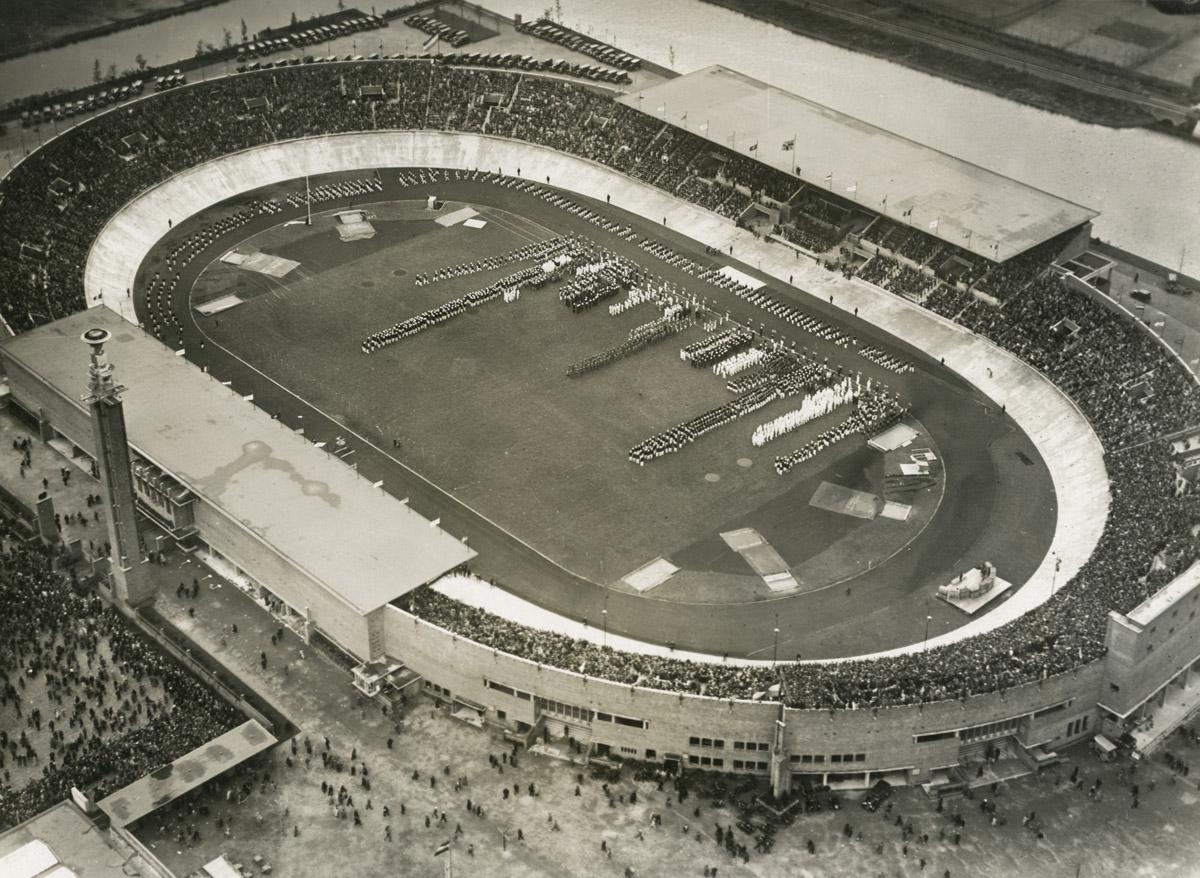
The Olympische Stadion still stands in Amsterdam's south, on Stadionplein, about three kilometers south of the city center. Jan Wils designed it for the 1928 Games, a brick and glass amphitheater in the Amsterdam School style of the period. The marathon tower at the south end held the Olympic flame, and was relit briefly each year for ceremonial purposes. The capacity has been reduced from the original 31,600, the running track has come and gone and been restored, and the stadium now mostly hosts athletics, concerts, and the occasional historical match. Walk inside on a quiet afternoon and the geometry of the place is still legible - the curve of the stand, the angle of the tower, the line of the pitch where Hector Scarone scored the goal that confirmed Uruguay as the best football nation on Earth.
From the Air
The Olympisch Stadion sits at Olympisch Stadion 1 in Amsterdam, coordinates 52.343 N, 4.854 E, approximately 3 km south of central Amsterdam. From the air, the stadium is identifiable as an oval enclosure with a distinctive square brick marathon tower at one end, set in a residential neighborhood between the Amstelveenseweg and Stadionkade canal. Nearest airport: Schiphol (EHAM), 9 km southwest. Class A airspace; the stadium often lies under arriving traffic from the north on the Polderbaan. Best viewing altitude 1,500-2,500 feet on a clear afternoon.