Forbidden City (nightclub)
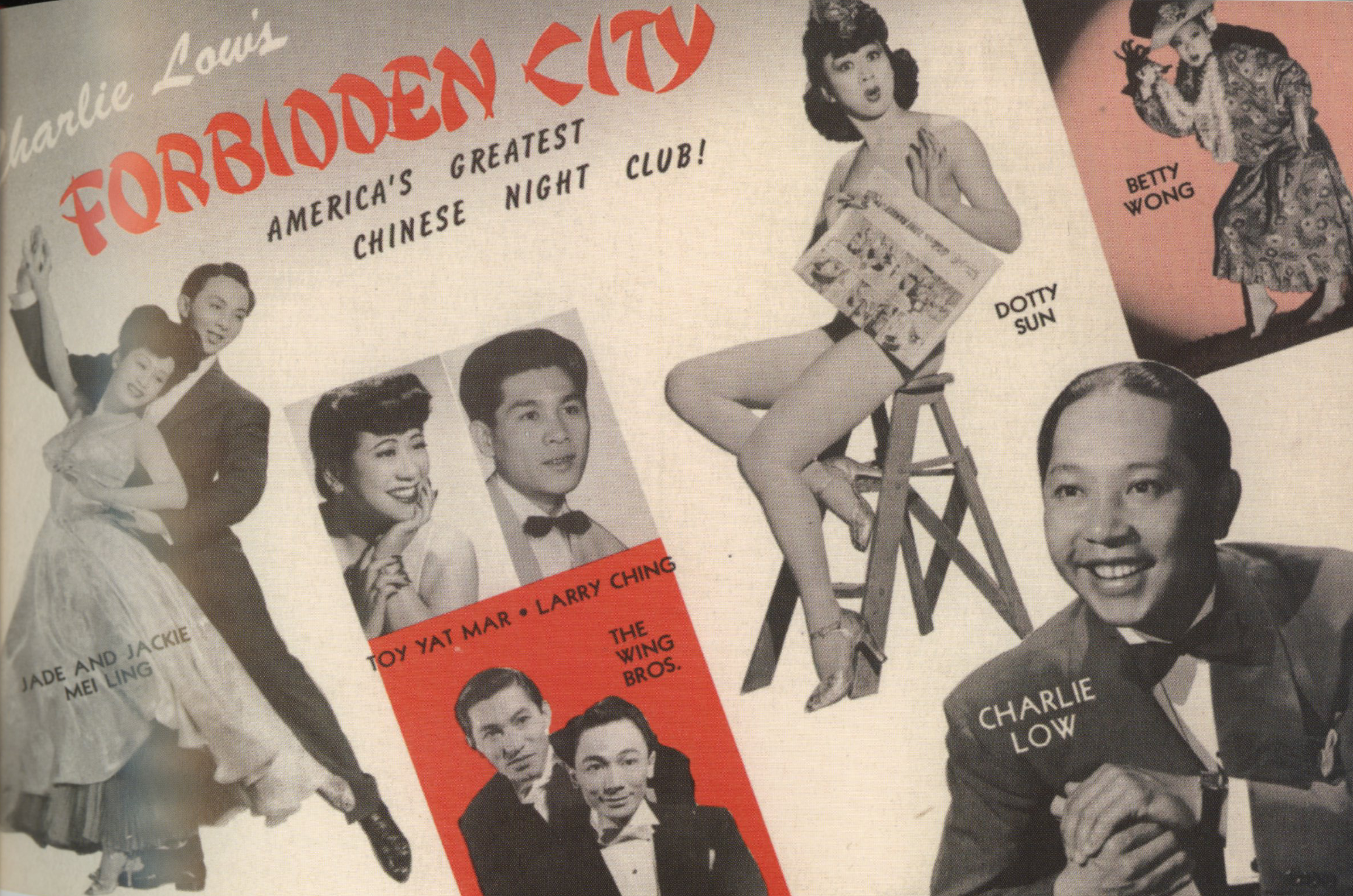
In a city where Chinatown was largely a tourist curiosity -- a place white San Franciscans visited for chop suey and exoticized atmosphere -- the Forbidden City nightclub did something radical: it put Chinese American performers on stage as headliners. From the late 1930s through the postwar decades, the club at 363 Sutter Street -- on the edge of Chinatown and Union Square -- offered floor shows featuring Chinese American singers, dancers, and comedians performing in a nightclub format that mainstream America associated exclusively with white entertainers. The club inspired C.Y. Lee's novel The Flower Drum Song, which became a Rodgers and Hammerstein musical in 1958 and a Hollywood film in 1961.
Breaking the Bamboo Ceiling
The Forbidden City emerged from a Chinatown nightlife scene that had been building since at least 1913, when Dai Wah Low's Shanghai Low opened on Grant Avenue. By the 1920s, Chinese restaurant-nightclubs with harmonized music and dancing featured elaborate stage shows. The Forbidden City took this tradition further, presenting Chinese American performers in a format indistinguishable from the mainstream supper clubs of the era -- singers doing standards, dancers in sequined costumes, comedians working the crowd. The performers were billed with stage names that emphasized their novelty: Frances Quan Chun was the "Chinese Frances Langford." The framing was a product of its era, but the talent was real.
More Than Novelty
For the performers, the Forbidden City was both an opportunity and a constraint. It offered Chinese American entertainers a stage when almost no other venue would book them. But it also confined them to a space defined by their ethnicity -- they performed as Chinese Americans, for audiences who came partly because the act was "exotic." Frances Quan Chun acknowledged this tension in later interviews, noting that the novelty of Chinese performers doing Western-style entertainment was part of the draw. The performers navigated this dynamic with professionalism, building careers in an industry that offered them almost no other options.
Legacy in Film and Memory
Arthur Dong's 1989 documentary Forbidden City, U.S.A. brought the club's story to a wider audience, interviewing surviving performers and documenting a chapter of Chinese American cultural history that had been largely forgotten. The film revealed lives lived at the intersection of entertainment and discrimination -- performers who had been stars within Chinatown but invisible to the mainstream industry. The club's influence on The Flower Drum Song ensured that its spirit, if not its specific story, reached millions through stage and screen. The Forbidden City is gone, but its legacy endures in the broader history of Asian Americans fighting for visibility in American popular culture.
From the Air
Located at 37.7893°N, 122.4063°W at 363 Sutter Street, on the edge of Chinatown and Union Square in San Francisco. The former nightclub site is in the dense urban grid of Chinatown, north of the Financial District. Best viewed at 2,000-3,000 feet AGL. Nearest airports: KSFO (11 nm south), KOAK (10 nm east). Chinatown is identifiable by its dense building pattern and pagoda-style rooftops north of the Financial District.