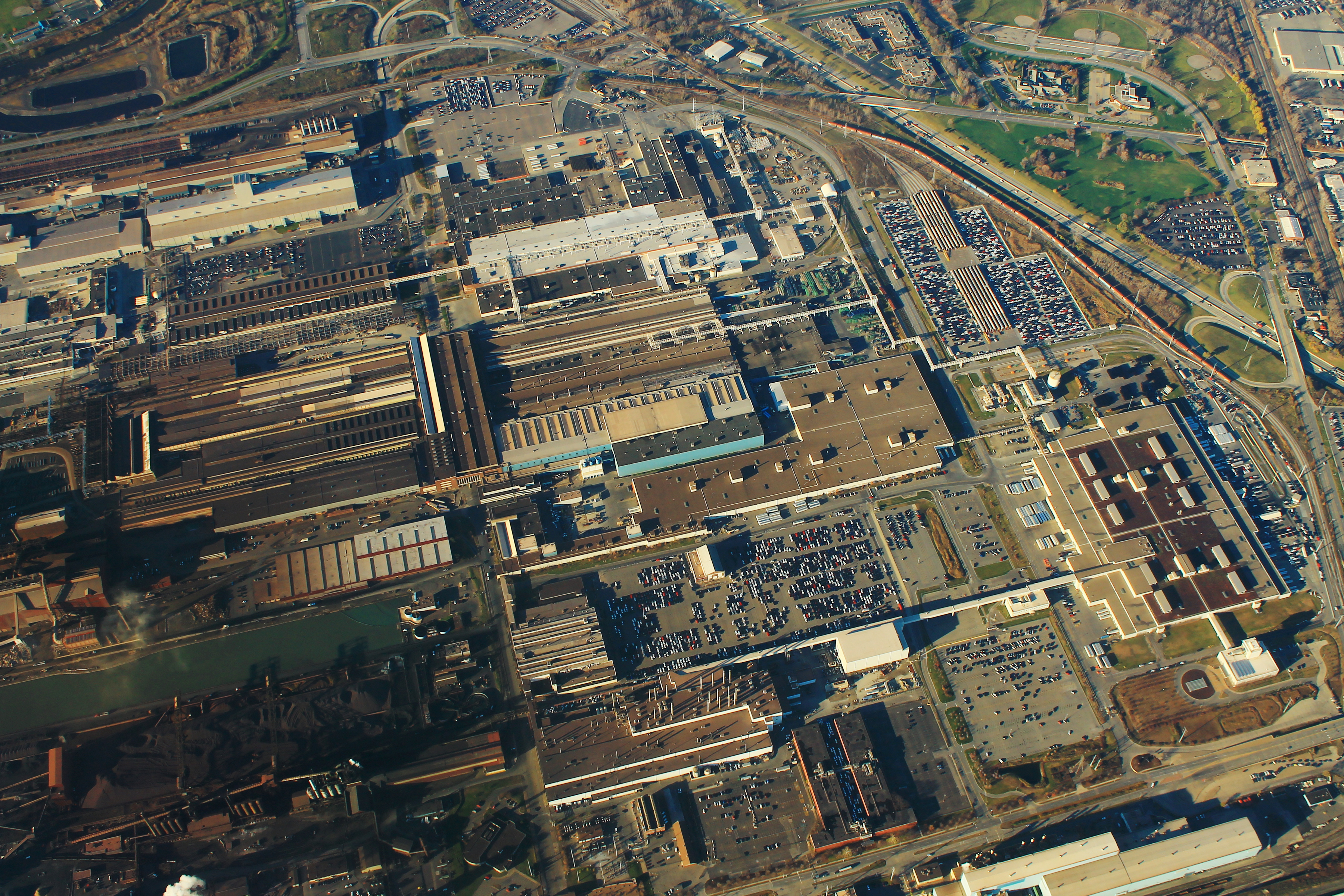
Ford River Rouge Complex: The Factory That Swallowed a River
Henry Ford purchased the land along the Rouge River in 1915 with plans for a bird sanctuary. What he built instead was a colossus: 93 buildings spread across a complex so vast it had its own docks on the dredged Rouge River, its own railroad network, its own power plant, and its own integrated steel mill. Raw iron ore arrived by lake freighter at one end; finished automobiles rolled out the other. Charlie Chaplin studied the Rouge's relentless machinery for his 1936 film Modern Times. Completed in 1928 and designated a National Historic Landmark in 1978, the Rouge remains the oldest automobile plant still in operation, and its influence stretches from Renault's factories in France to Volkswagen's Wolfsburg plant in Germany to Hyundai's complex in South Korea.
From Warships to Model T's
The Rouge's first products were not cars but warships. During World War I, the plant produced Eagle-class patrol craft for the United States Navy, vessels that were never deployed before the armistice. Building those ships required widening the Rouge River, and the dredging had a lasting consequence: lake freighters could now navigate directly to the plant. Ford pivoted to tractors from 1921 to 1927, then shut down for five months before launching production of the Model A. The plant manufactured most of the components of Ford vehicles starting with the Model T, compiling many into "knock-down kits" shipped by rail to branch assembly plants across the country. This was vertical integration on a scale the world had never seen -- raw materials to running vehicles within a single complex.
Architecture as Industry
Architect Albert Kahn designed key buildings at the Rouge, including the tire plant completed on January 30, 1938, measuring 802 feet long and 240 feet wide with a butterfly roof and massive glass panels. Kahn's industrial architecture proved as influential as the manufacturing it housed. The Rouge inspired factory complexes worldwide: Renault's Ile Seguin factory in 1920, GAZ's plant in the Soviet Union in the 1930s, Volkswagen's Wolfsburg factory in 1938, and FIAT's Mirafiori factory in Italy in 1939. Ford even participated directly in developing an automobile production complex in Nizhny Novgorod during the early stages of Soviet industrialization. The Rouge was designated a National Historic Landmark District in 1978 for both its architecture and its historical importance to the American economy.
Blood on the Overpass
The Rouge's labor history is written in confrontation. On May 26, 1937, members of the United Auto Workers planned to hand out union leaflets near the plant. Ford's security men attacked them in what became known as the Battle of the Overpass, one of the most notorious incidents in American labor history. The UAW was not officially recognized at the Rouge until June 20, 1941, after a ten-day sit-down strike by 40,000 workers forced Henry Ford's hand. By 1947, the plant's union was led by Communist Party USA official James E. Jackson. African American workers, who made up roughly 25% of employees, formed a caucus in 1949 to protect their interests, though their demands were denied through red-baiting. By 1960, 65% of the plant's workforce was African American, though only 3.5% held skilled positions.
Explosion and Reinvention
On February 1, 1999, the Rouge's power plant exploded, killing six workers and critically injuring fourteen others. Ford was fined $1.5 million; the explosion was attributed to the company's disregard of safety regulations. Bronze plaques honor the six who died. That same year, architect William McDonough began redesigning the complex, covering the Dearborn truck assembly plant's roof with sedum groundcover that retains and cleanses rainwater while moderating the building's temperature. The green roof became one of the largest in the world, a striking reinvention for a factory that had once epitomized heavy industry's environmental footprint.
A Century and Counting
The Rouge celebrated its centennial in 2019, making it the oldest automobile plant still in operation. Ford marked the occasion by debuting the 700-horsepower Mustang Shelby GT500. In September 2020, Ford announced the $700 million Rouge Electric Vehicle Center for production of the F-150 Lightning. In May 2021, President Joe Biden toured the plant and drove an F-150 Lightning, endorsing electric vehicles in a speech from the factory floor. The Rouge has hosted public tours since 1924, drawing roughly a million visitors per year at their peak. From above, the complex stretches along the Rouge River upstream from its confluence with the Detroit River at Zug Island, a landscape of industrial buildings, rail yards, and docks -- a factory that reshaped the world and, a century later, is still building trucks.
From the Air
Located at 42.31°N, 83.17°W in Dearborn, Michigan, along the Rouge River upstream from its confluence with the Detroit River at Zug Island. The complex is unmistakable from altitude -- 93 buildings spread across more than 1,000 acres with its own docks on the Rouge River. The green roof of the truck assembly plant is visible as a distinctive patch of vegetation amid the industrial landscape. Nearest airport is Detroit Metropolitan Wayne County Airport (KDTW), approximately 7 miles southwest. Coleman A. Young International Airport (KDET) lies 8 miles northeast.