Forks, Washington
Stephenie Meyer had never been to Forks when she chose it. She searched Google for the rainiest place in the contiguous United States and found this small town on the western Olympic Peninsula, population 3,335, where it rains more than 100 inches a year and measurable precipitation falls on more than 200 days. She set her vampire romance novels here, and everything changed. In December 2005, 74 visitors signed the guest book at the Forks Visitor Center. By December 2009, after the Twilight books and films had reached global audiences, that number was 2,540. In July of that year, it hit 16,186.
Where Three Rivers Meet
The town's name is literal. Forks sits on a prairie just east of where the Calawah River joins the Bogachiel River, near the point where these waterways and the Sol Duc converge to form the Quillayute River. The Quileute people inhabited this land long before settlers arrived, and the name Forks Prairie comes from their language, a translation of the phrase meaning "prairie upstream." In 1889, a reservation was created nearby for the Quileute, and that same year settler Daniel Pullen burned the existing village. A road passable for automobiles opened from Lake Crescent to Forks in 1927, and the Olympic Loop Highway replaced it in 1931, connecting this isolated community to the wider world. For most of the twentieth century, the connection mattered primarily for one thing: timber.
From Timber to Tourism
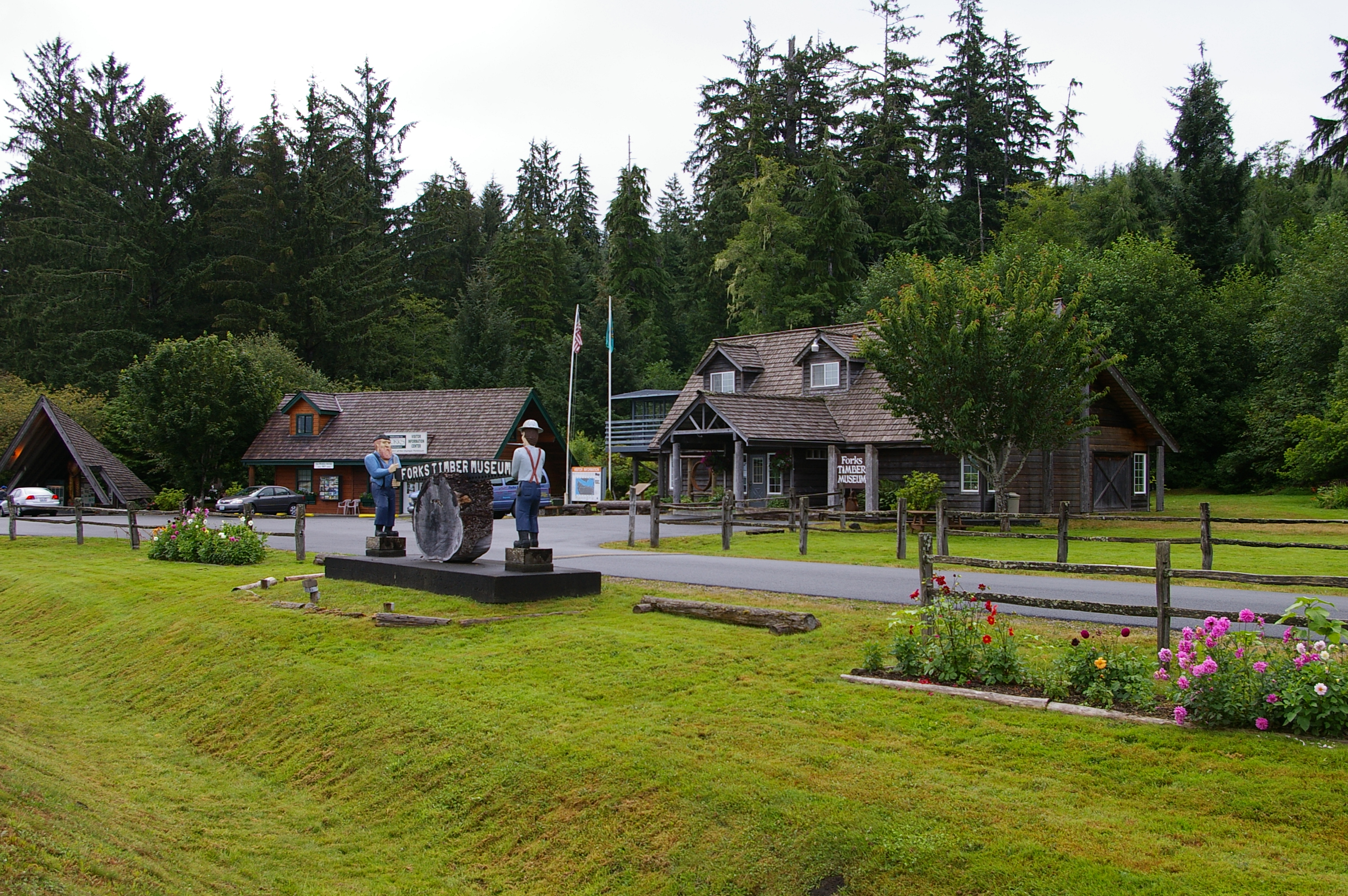
Logging built Forks. The surrounding Olympic rainforest provided massive Sitka spruce, western hemlock, and Douglas fir, and the town grew around the mills that processed them. The Forks Timber Museum, constructed in 1989 by the Forks High School carpentry class, tells this story through exhibits dating to the 1870s. But by 2003, an economic development official was already noting that Forks was "going through a transition from a logging community to a tourist community." The rivers that once floated logs now draw anglers. Winter steelhead fishing on the Quillayute river system is renowned, and the Hoh, Sol Duc, Bogachiel, and Calawah rivers all offer excellent runs. Forks became a base camp for visitors to the Hoh Rainforest, the Pacific beaches, and Olympic National Park's wilderness trails.
The Twilight Effect
Then came Bella Swan. Meyer's Twilight series, published between 2005 and 2008, and the film adaptations that followed from 2008 to 2012, transformed Forks into a destination for an entirely different kind of visitor. The Forks City Council passed a resolution in 2007 declaring September 13 as Stephenie Meyer Day, timed to the fictional birthday of the series' protagonist. Tourism numbers peaked around 2010, then settled to roughly 50 percent above pre-Twilight levels, a permanent bump for a town that needed one. Stephenie Meyer Day eventually evolved into the Forever Twilight in Forks Festival, held annually around September 13, complete with a movie marathon, a blood drive, and dance lessons. The weekly Forks Forum, billed as "the farthest west newspaper in the contiguous United States," covered the phenomenon as it unfolded in its own backyard.
Small Town, Deep Roots
Forks remains a place where community events run on tradition rather than trends. Rainfest, a spring arts celebration, fills April. The Quillayute Valley Scholarship Auction has awarded over one million dollars to local students since the first scholarship went to Robert Henry in 1964. July brings an Old Fashioned Fourth celebration with a demolition derby, while Quileute Days at nearby La Push features a traditional salmon bake, bone games, canoe races, and a street fair. In October, Heritage Days culminates in the Old Timers Round Table, a moderated conversation broadcast live on local radio, where longtime residents share stories of the region's past. The town's airport, Forks Municipal, has a single 2,400-foot runway, six based aircraft, and visual approaches only. It is a fitting measure of the place: functional, unpretentious, and just enough to get the job done.
From the Air
Located at 47.95N, 124.39W on the western Olympic Peninsula. Forks Municipal Airport (S18) has a single runway (4-22), 2,400 ft long, 75 ft wide, asphalt surface, medium intensity runway lighting, visual approaches only. The town is visible along US-101 surrounded by dense rainforest. William R. Fairchild International Airport (KCLM) in Port Angeles is about 55 miles northeast. Best viewed at 2,000-3,000 ft AGL to see the town, river confluences, and surrounding forest.