Former Shawinigan Aluminium Plant
On October 20, 1901, a molten stream of metal poured from a crucible in Shawinigan, Quebec, and cooled into Canada's first aluminium ingot. The event was quiet, industrial, and utterly transformative. The plant that produced it, built on a plateau overlooking the Saint-Maurice River where 50-meter falls generated the enormous electrical power that aluminium smelting demands, would operate for 85 years, change names three times, survive two world wars and a depression, and ultimately outlast the industry that created it. Today its 12 brick buildings stand not as ruins but as Espace Shawinigan, a restored National Historic Site where the overhead cranes still hang in the old cell halls.
The Falls That Made Metal
The story begins with water, not metal. In 1899, the Shawinigan Water and Power Company was looking for industries hungry enough for electricity to justify its hydroelectric ambitions on the Saint-Maurice River. The Pittsburgh Reduction Company, later known as Alcoa, was exactly such a customer. Aluminium production through the Hall-Héroult electrolysis process, invented by Charles Martin Hall in 1886, consumed staggering amounts of power. The company had already built a smelter at Niagara Falls for the same reason. The plateau above Shawinigan Bay offered a flat building site, a natural dike channeling the river over the falls, and proximity to the hydroelectric source. Construction began in spring 1900 under engineer Edwin Stanton Fickes. By 1901, the foundry and first potroom were complete. The first ingot was shipped to New Glasgow, Nova Scotia.
Booms, Busts, and Söderberg Cells
The plant's history mirrors the turbulence of the 20th century. Production surged from 1,175 tonnes in 1905 to 2,686 tonnes by 1907. By the end of World War I, over 700 workers were employed. The 1921 post-war recession slashed the workforce to 187 and left only 70 electrolytic cells running. The Great Depression hit harder still; by 1933, Canadian aluminium exports had fallen to one-third of their 1930 level, and the Shawinigan plant suspended operations entirely. Revival came in 1936, and with it, technological innovation. Norwegian engineers from Elektrokemisk introduced the Söderberg cell, which used a single continuous electrode rather than individual carbon anodes. Two experimental cells were installed in 1936, and by 1938, Shawinigan was producing 16,800 tonnes annually using three different cell technologies simultaneously. In 1925, the company had been renamed Aluminium Company of Canada Limited, known as Alcan.
From Potrooms to Power Lines
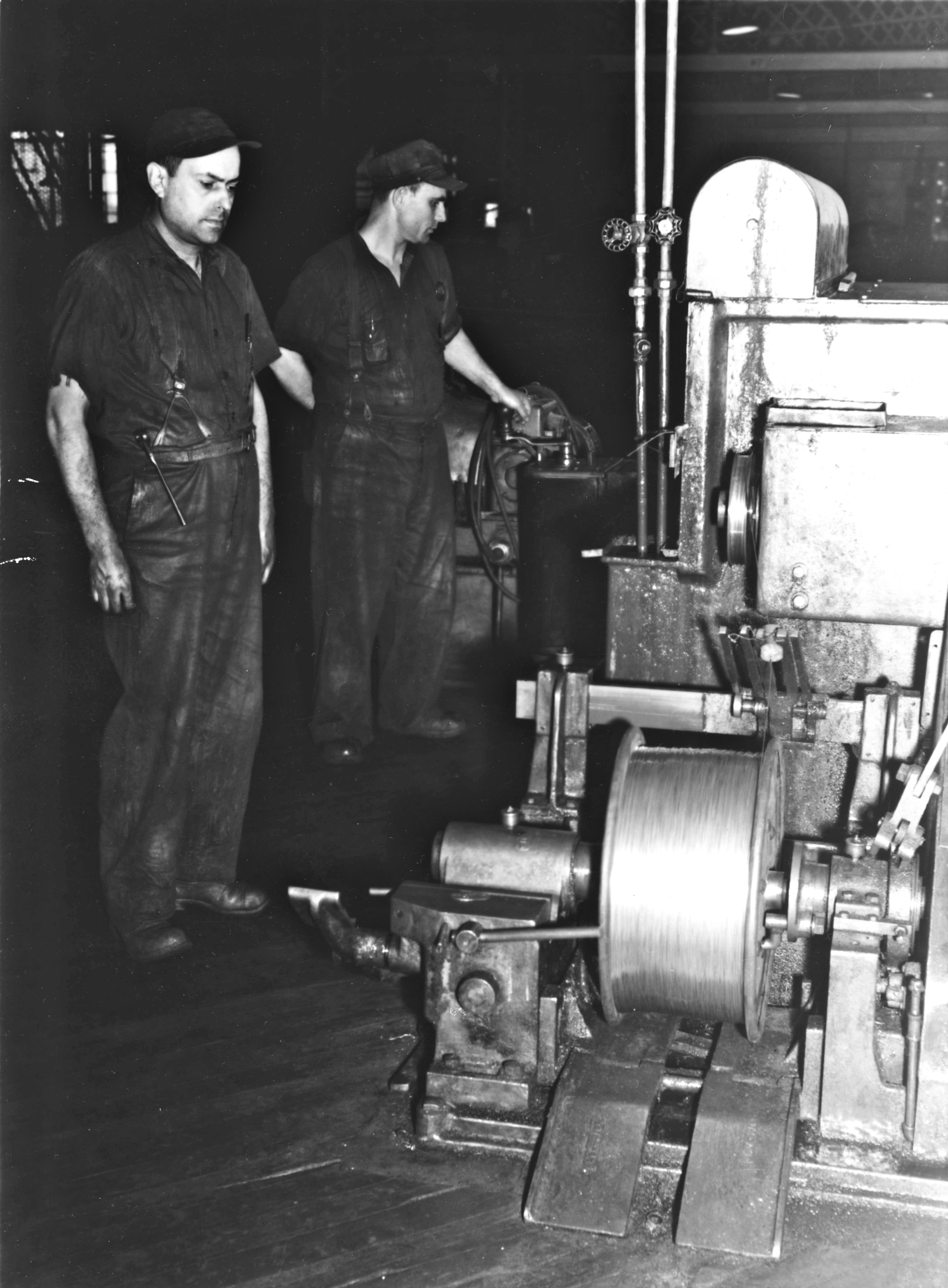
Primary aluminium production ended in 1944 when a new, purpose-built plant opened nearby. But the old Shawinigan complex found a second life. Post-war Quebec was electrifying its countryside and building hydroelectric stations on the Saint-Maurice, Betsiamites, Outardes, and Manicouagan rivers. Every dam and every kilometer of rural power line needed conductor cables, and the Shawinigan plant became a major cable manufacturer. The wire-drawing and cable workshop, building AL-3, which had produced Canada's first aluminium conductor cables back in 1902, now ran at full capacity. Production of aluminium strips for protective wire sheaths diversified the output further. Cable manufacturing peaked in the 1960s during the dam-building era, then declined as the great hydro projects wound down. The plant closed in 1986.
Brick and Memory
Closure might have meant demolition, but Shawinigan's industrial heritage proved too significant to bulldoze. In 2001, Alcan transferred the remaining buildings to the Cité de l'énergie, a museum dedicated to the region's industrial past. The complex was designated a National Historic Site of Canada on July 18, 2002. A consortium of architects restored the buildings between 2001 and 2003, and the site reopened as Espace Shawinigan, hosting exhibitions, fairs, and cultural events. In 2013, the Quebec Ministry of Culture designated the entire complex a heritage property. The 12 surviving buildings, clad in American-bond brick with understated classical ornamentation, pilasters, corbelled cornices, and segmental arches, present a remarkably cohesive streetscape. The administrative building's main entrance still bears a stone frieze reading 'ALUMINIUM COMPANY OF CANADA, LIMITED.' Inside the old cell halls, the original overhead cranes remain suspended from the steel trusses, silent witnesses to the century when falling water became flying metal.
From the Air
Located at 46.54°N, 72.76°W on a plateau above the Saint-Maurice River in Shawinigan, Quebec. The industrial complex is visible as a cluster of brick buildings near Shawinigan Falls, which has a 50-meter drop. Nearest airport is Trois-Rivières (CYRQ), approximately 35 km southeast. Québec City Jean Lesage International (CYQB) is about 130 km northeast. The Cité de l'énergie museum complex and the falls are prominent landmarks. Best viewed at 2,000-3,000 feet AGL to appreciate the relationship between the falls, the plateau, and the plant layout.