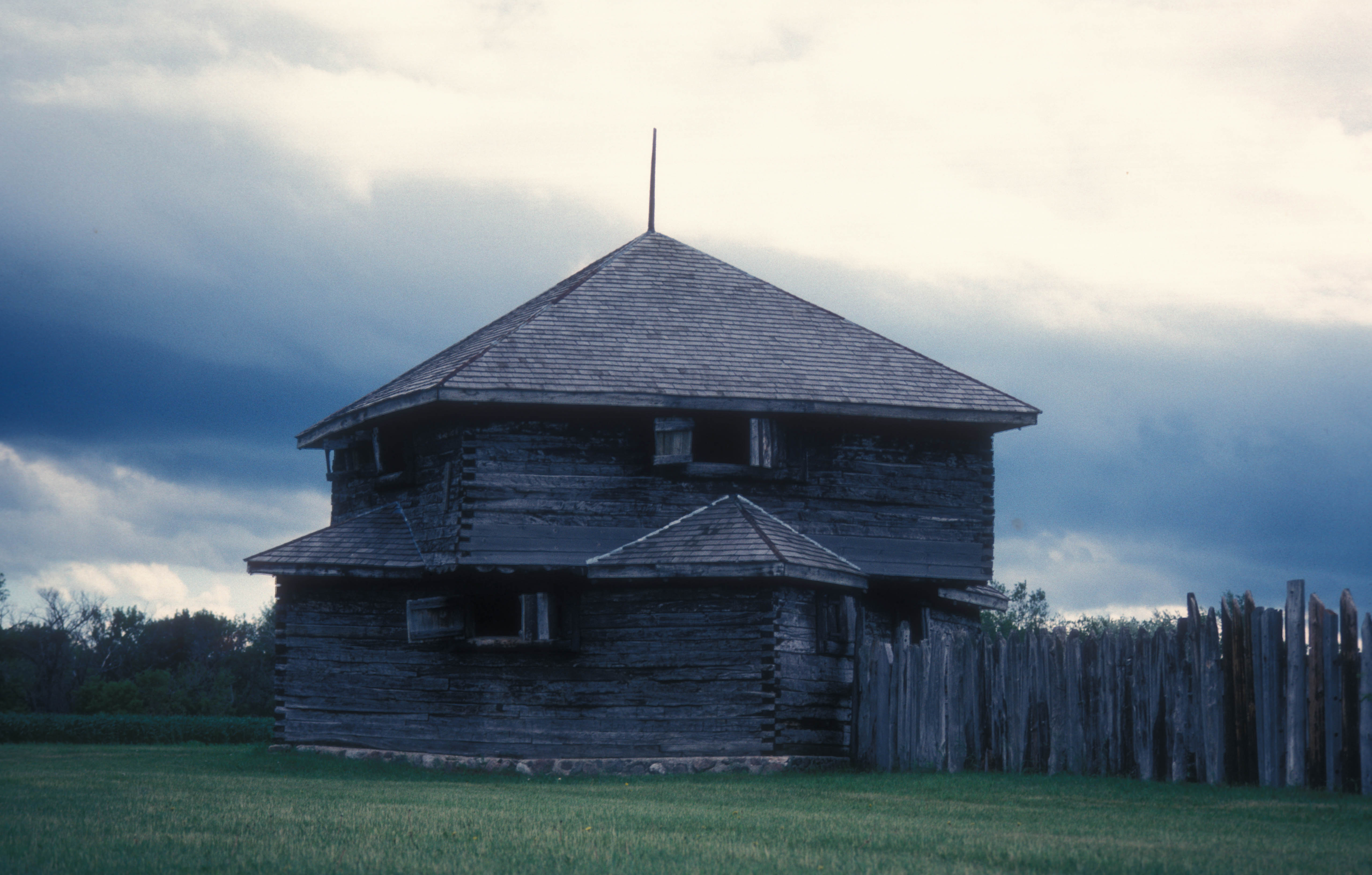
Fort Abercrombie
When darkness fell on September 3, 1862, Pierre Bottineau crawled out of Fort Abercrombie, through the Sioux siege lines, and began an 80-mile trek to Sauk Centre to beg for reinforcements. Behind him, the garrison held two howitzers, a collection of shotguns pulled from Chippewa treaty goods, and the desperate determination of soldiers and settlers who had been under attack since late August. Bottineau's midnight escape was just one chapter in a six-week ordeal that tested this lonely outpost on the Red River of the North -- the first permanent military installation in what would become North Dakota, and a post that earned the title 'The Gateway to the Dakotas' long before anyone knew how fiercely that gateway would have to be defended.
A Fort That Learned to Move
Congress authorized Fort Abercrombie on March 3, 1857, allocating twenty-five square miles of land along the Red River of the North in Dakota Territory. Lieutenant Colonel John J. Abercrombie -- the fort's namesake -- selected a site right on the river and began construction in 1858. It was a poor choice. Spring flooding drove the Army away, and the post sat abandoned until 1860, when troops returned and rebuilt on higher ground north of the original location. The new fort served as a critical transportation hub, guarding the Red River Trails used by ox cart trains hauling fur trade goods, military supply wagons, stagecoach routes, and steamboat traffic plying the Red River. In this flat, wind-scoured country where the tallgrass prairie rolled unbroken to every horizon, the fort was the lone outpost of federal authority for hundreds of miles.
Six Weeks Under Siege
The Dakota War of 1862 erupted across the Minnesota frontier that August, and Fort Abercrombie found itself squarely in the path of the upper agency Sisseton warriors. When word of the uprising reached the garrison, Company D of the 5th Minnesota Infantry Regiment, commanded by Captain John Vander Horck, was preparing to escort Chippewa treaty provisions. Settlers streamed into the fort seeking protection. On August 25, Vander Horck mustered a militia company from among them, appointing quartermaster Captain T. D. Smith as their commander. Among those sheltering at the fort were Pierre Bottineau, Indian Commissioner Dole, and the Chippewa treaty commission -- which included John Nicolay, President Lincoln's private secretary. The Sioux first struck by raiding over 300 animals, including 200 cattle earmarked as treaty payment to the Red Lake and Pembina Chippewa. Then came three direct attacks on the fort itself. Howitzer fire kept the garrison from being overrun, and the defenders built earthen breastworks around the surviving structures. A 500-man militia force finally broke the siege, but not before five defenders were killed and several more severely wounded.
A Peace That Held
Eight years after the siege, Fort Abercrombie witnessed a different kind of history. On August 14, 1870, Sioux and Chippewa leaders gathered at the fort to sign a peace agreement, brought together by the Catholic priest Father Genin. Intertribal hostilities had flared again in 1868 after the deaths of two Sioux at the Leech Lake Reservation, and Chief Flatmouth II had been accused of involvement. The 1870 treaty brought a lasting resolution -- a peace between the two nations that has never been broken. The fort itself was less enduring. The Army abandoned it in 1877, and the original buildings were either destroyed or sold at public auction. The town of Abercrombie, North Dakota, was founded a half mile to the west in 1884, its very existence a testament to the security the fort once provided.
Blockhouses on the Prairie
What stands today at the Fort Abercrombie State Historic Site is largely a product of the Works Progress Administration, which between 1939 and 1940 reconstructed three blockhouses and the stockade and returned the original military guardhouse to the site. More recent renovations salvaged materials from the southeast blockhouse to renovate the two remaining blockhouses and the guardhouse. A new stockade marks the fort's perimeter, and native grasses are allowed to grow where buildings once stood, giving visitors a sense of the structures' footprint against the open prairie. A visitor center was built in 2007, and a modern museum and pavilion now anchor the town of Abercrombie, while the fort itself sits a quarter mile to the east. Stand on the reconstructed stockade and look east toward the Red River, and you can still sense why this spot mattered -- a slender thread of federal authority stretched across a vast and contested landscape.
From the Air
Located at 46.4447°N, 96.7186°W at approximately 960 feet MSL on the western bank of the Red River of the North in southeastern North Dakota. The terrain is flat Red River Valley farmland -- the fort site is subtle from altitude but sits near the town of Abercrombie along ND Highway 1. Hector International Airport (KFAR) in Fargo is approximately 35 nm north-northeast. Wahpeton Municipal Airport (KBWP) is about 20 nm south. The Red River of the North, marking the Minnesota-North Dakota border, is the primary visual landmark and runs immediately east of the fort site. Best viewed at 2,000-4,000 feet AGL where the relationship between the river, the fort, and the surrounding prairie is visible.