Fort Astoria
John Jacob Astor never saw the fort that bore his name. From his offices in New York, America's wealthiest man dispatched two expeditions in 1810 -- one by sea aboard the Tonquin, the other overland from St. Louis -- to build a fur trading empire at the mouth of the Columbia River. By the end of May 1811, his employees had hacked a clearing from forests of trees measuring fifty feet in girth and erected a stockade of bark-covered logs with cannons mounted for defense. Fort Astoria became the first American-owned settlement on the Pacific coast. Within two years, it would be sold to the British. Within four decades, it would help redraw the map of North America.
A Company of Strangers
The people who built and operated Fort Astoria came from nearly every corner of the Atlantic world. Americans and Scots held the top positions as fur trading partners. Below them worked French Canadian voyageurs, Native Hawaiian Kanakas, Iroquois trappers from Eastern Canada, and various Indigenous peoples of the Pacific Northwest. The fort's corporate hierarchy was strict -- partners, clerks, craftsmen, hunters, laborers, in descending order -- but its cultural mix was extraordinary for 1811. By June 1812, the garrison had been reduced to 11 Hawaiians and 39 men of European descent. They ate fish and vegetables, found the diet monotonous, and traded beaver, sea otter, squirrel, and red fox pelts with the surrounding Chinookan peoples. Life at the edge of the continent was tedious, uncomfortable, and occasionally dangerous.
The Tonquin Disaster
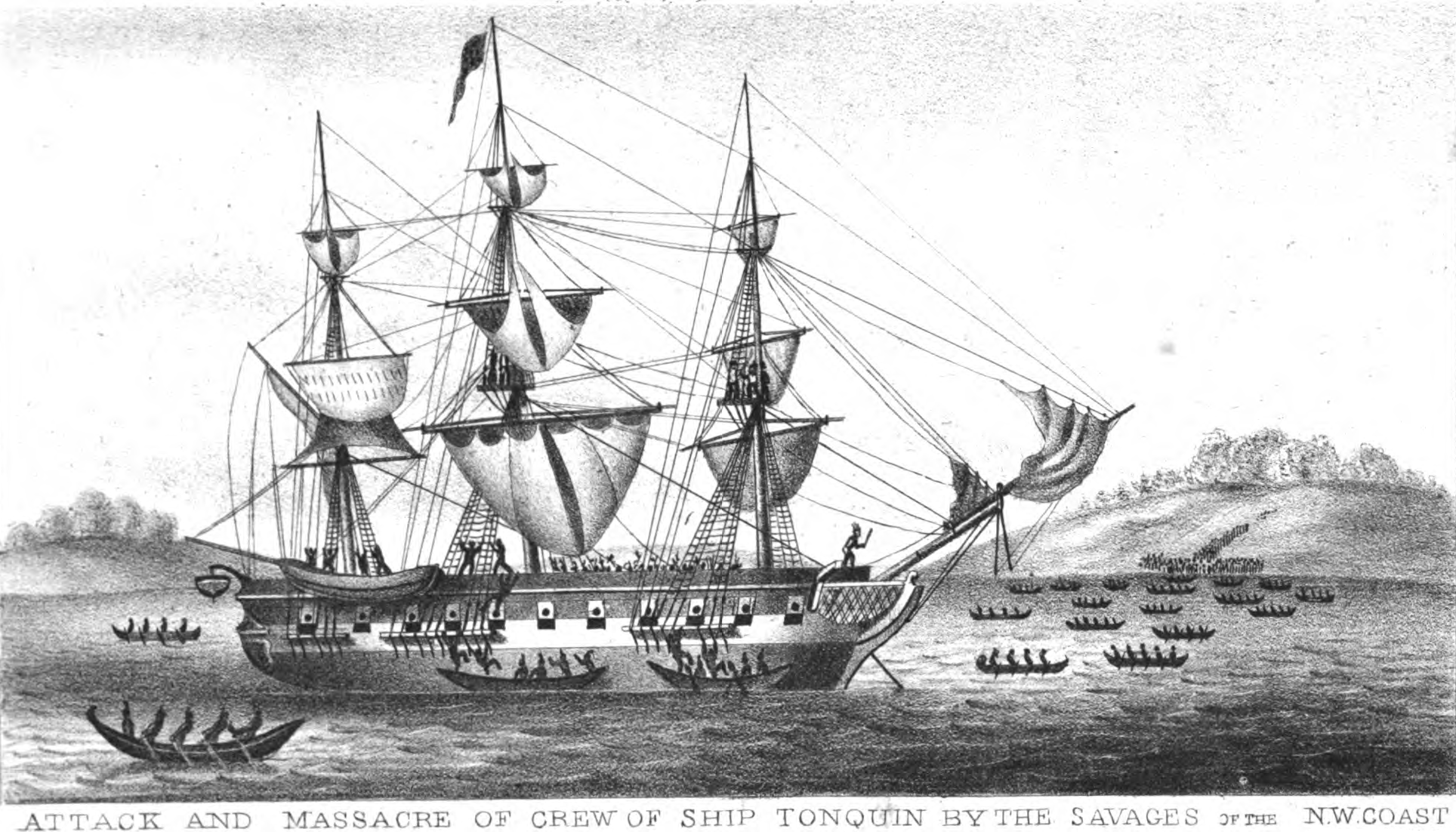
The catastrophe that nearly destroyed Astor's Pacific venture began with an insult. Captain Jonathan Thorn, commanding the supply ship Tonquin, sailed north from Fort Astoria in June 1811 to trade along Vancouver Island. At Clayoquot Sound, he grew impatient with the prices demanded by the Tla-o-qui-aht people and struck an elder with a pelt. The offense was profound. A Quinault interpreter named Joseachal warned Thorn of the danger, but the captain refused to leave. When the Tla-o-qui-aht returned to trade, they attacked. The Tonquin was destroyed and its crew killed. Joseachal alone survived, eventually making his way back to Fort Astoria with the news. The ship had carried the bulk of the company's trade goods and provisions, plunging the fort into hardship that lasted until a resupply vessel arrived in 1812.
Sold Before the Guns Arrived
The War of 1812 sealed Fort Astoria's fate as an American outpost. Too isolated to expect military protection from Washington, the Pacific Fur Company's partners faced a grim calculation: hold the fort and risk seizure by the British Royal Navy, or sell on their own terms. They chose to sell. In 1813, the Montreal-based North West Company purchased the fort's assets, renamed it Fort George, and made it the headquarters of their westernmost operations. The Hudson's Bay Company absorbed Fort George in 1821 along with the rest of the North West Company. When Fort Vancouver opened upriver in 1825, Fort George was briefly abandoned -- but the arrival of American traders on the Columbia forced the Hudson's Bay Company to reopen it, staffing it with as few as four men: an English clerk, a Scottish field manager from Stromness, and two Hawaiians.
The Oregon Question
Fort Astoria's brief American ownership cast a long diplomatic shadow. In 1817, the USS Ontario sailed to the Columbia to reassert the American claim, though under orders to avoid armed confrontation. The ceremony was symbolic: the British formally returned possession, but the North West Company continued operating as before. The Treaty of 1818 established joint Anglo-American occupancy of the Pacific Northwest, a compromise that satisfied neither side but postponed conflict for nearly three decades. Fort Astoria remained a bargaining chip. When diplomats finally resolved the Oregon boundary dispute with the Oregon Treaty of 1846, Great Britain ceded its claims south of the 49th parallel. The Hudson's Bay Company, unwilling to operate under American jurisdiction, sold off its southern holdings -- including the post that had started it all.
What Remains
Today, a reconstructed blockhouse marks the spot where Astor's employees once cleared old-growth forest and mounted cannons against threats that came from every direction -- from the Chinookan peoples they distrusted, from the British rivals they feared, from the wilderness itself. The Fort Astoria Site was designated a National Historic Landmark on November 5, 1961, recognizing a place whose significance far exceeded its modest physical footprint. What happened here between 1811 and 1846 helped determine which nation would control the Pacific Northwest. Astoria, the city that grew around the fort, still sits where the Columbia meets the Pacific, its name the only surviving monument to the fur magnate who bet on the West and lost his fort but helped win the territory.
From the Air
Located at 46.19°N, 123.83°W in downtown Astoria, Oregon, at the mouth of the Columbia River. From the air, the fort site is in the heart of Astoria's historic district, near the waterfront where the Columbia widens dramatically before meeting the Pacific. The Astoria-Megler Bridge (4.1 miles) crosses to Washington. The Columbia Bar -- the notoriously dangerous river entrance -- is visible to the west. Nearest airport is Astoria Regional Airport (KAST). Best viewed at 1,500-2,500 feet for historic district detail. At higher altitude, the strategic importance of the location becomes clear: this is where the Columbia, draining 259,000 square miles of the interior, funnels to the sea.