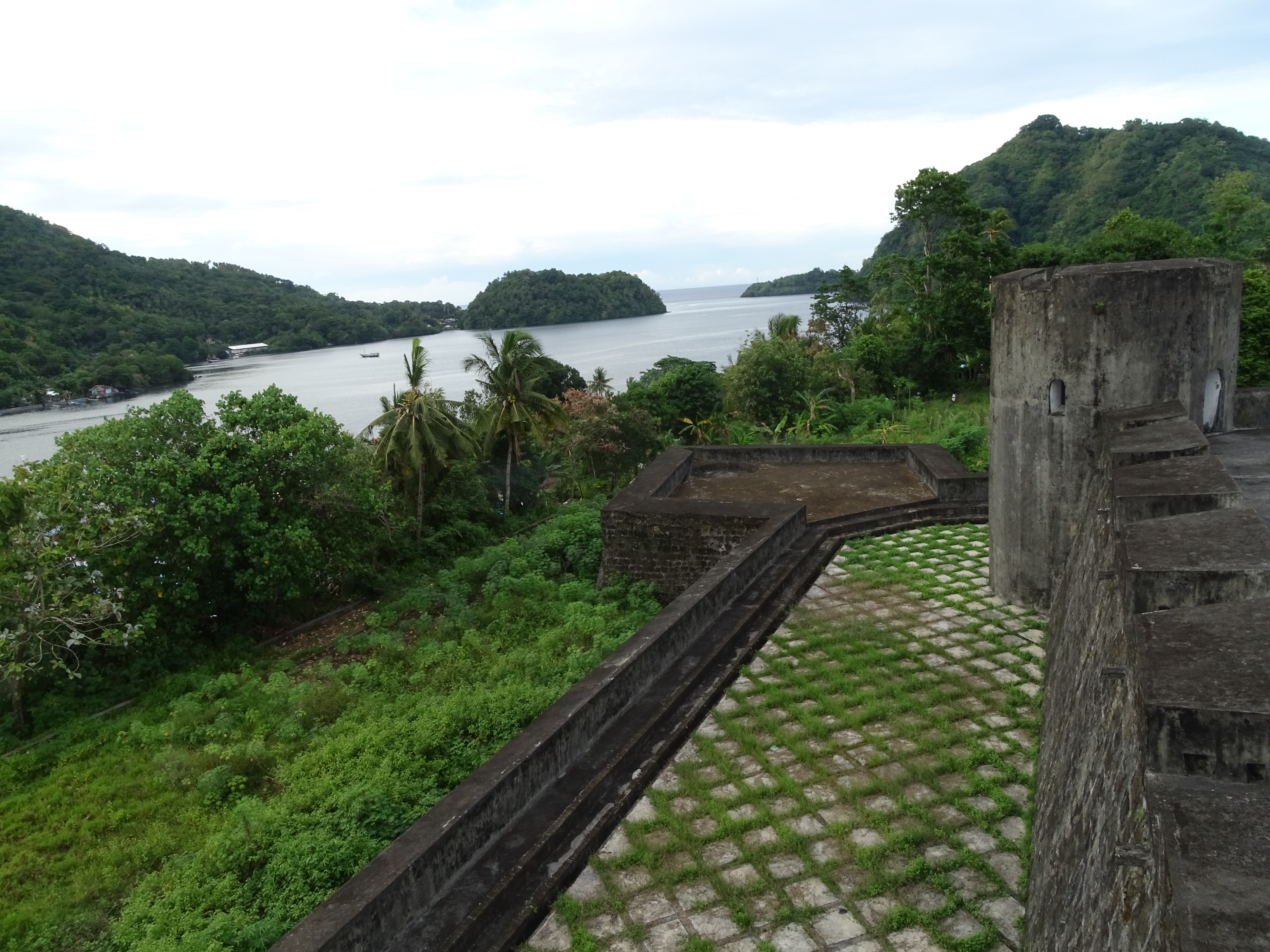
The Nutmeg Fortress
For most of recorded history, every pinch of nutmeg in every European kitchen came from one place: a scattering of volcanic islands in the Banda Sea so small that a pilot could overshoot all of them in a single blink. The Banda Islands held a monopoly granted not by kings but by geology, and the fort that crowns the hilltop of Banda Neira exists because European powers were willing to wage war, build empires, and depopulate entire islands for the right to control that monopoly. Fort Belgica, with its distinctive pentagon-within-a-pentagon silhouette, is one of the best-preserved colonial fortifications in Southeast Asia. It is also a monument to obsession.
Foundations on Contested Ground
The Portuguese arrived first. In 1529, they began laying foundations for a fort on Banda Neira, but the Bandanese people drove them off before the walls could rise. Eighty years later, the Dutch East India Company, or VOC, picked up where the Portuguese had failed. On April 25, 1609, Admiral Pieter Willemsz Verhoeff sent 750 soldiers ashore to build a fort on the same abandoned Portuguese foundations. The Bandanese saw what was coming: not trade but monopoly, not commerce but conquest. They lured Verhoeff and his officers into the woods under the pretense of negotiation and killed them, along with 40 of his men. The Dutch finished the fort anyway. Fort Nassau, a four-bastioned quadrilateral at the base of the hill, became their principal military base in the Bandas. But the hill above it remained exposed, and whoever held the high ground controlled the island.
A Pentagon Rises
On September 4, 1611, Pieter Both, the first Governor-General of the Dutch East Indies, ordered a new fort to dominate the hilltop above Fort Nassau. It was to be named either Belgica or Nederland, and Belgica won. The original structure was modest, a square redoubt large enough for perhaps 40 men. By mid-century, earthquakes, monsoon rains, and shoddy construction had turned it into a ruin. In 1667, Governor Cornelis Speelman sent engineer Adriaan de Leeuw to start over. The result, completed between 1672 and 1673, was something entirely new: a low outer pentagon with five angled bastions, each topped with a bartizan, enclosing a higher inner pentagon with five circular towers. Stone was shipped to the island for the reconstruction. The bastions bore names that still survive: Galge punt, Moorsche punt, Leugenaar punt, Metaale punt, and Klokke punt. The design was unique among all the fortifications in the Banda Islands, a geometric statement of power visible from every approach by sea.
The Fort That Surrendered Twice
The VOC spent over 300,000 guilders on the modifications, mounted 50 guns along its walls, and garrisoned it with 400 men. None of it mattered when a British fleet appeared in 1796. Fort Belgica surrendered without a single shot fired. The Dutch regained control in 1803 under the Treaty of Amiens, but in 1810 the British returned with a more dramatic approach. Captain Christopher Cole led a nighttime assault with fewer than 200 sailors, marines, and soldiers. Their boats grounded on a coral reef a hundred yards from shore, directly opposite a battery of ten 18-pounders. The men leapt into the water, scrambled ashore, and scaled the walls with ladders under musket fire. The garrison fled within fifteen minutes, leaving their commandant dead. For this audacious action, Cole was knighted and awarded an honorary doctorate by the University of Oxford.
The Price of Nutmeg
The fort's story cannot be separated from the spice it was built to protect. Under Governor-General Jan Pieterszoon Coen, the VOC's pursuit of a nutmeg monopoly turned genocidal. In 1621, Coen landed on the Banda Islands with over 1,600 soldiers and 250 Japanese mercenaries. The campaign killed more than 90 percent of the Bandanese population through massacre, forced deportation, starvation, and disease. Survivors were enslaved and sold. The VOC then imported enslaved laborers from Java to work the nutmeg plantations, and the annual profits reached six million guilders. Fort Belgica stood watch over this system for generations. Its walls, elegant in their geometry, enclosed a view of plantations worked by people who had no choice in the matter. The fort's architecture speaks of engineering ambition; its history speaks of the human cost of empire.
Standing Again
Partially demolished in 1904 and incompletely rebuilt in 1919, Fort Belgica spent much of the twentieth century as a ruin. In 1991, Indonesian General Benny Moerdani, then Minister of Defense and Security, ordered a thorough restoration. Today the fort is the most prominent landmark on Banda Neira, its pentagonal walls and circular towers restored to their seventeenth-century proportions. In January 2015, it was added to the UNESCO World Heritage Tentative List as part of the Historic and Marine Landscape of the Banda Islands. From its hilltop, visitors look down over Fort Nassau's crumbling bastions, across the channel to Banda Besar, and out toward the volcanic cone of Gunung Api. The view has not changed in three centuries. What has changed is who tells the story of why these walls were built.
From the Air
Fort Belgica sits at 4.527°S, 129.899°E on the small island of Banda Neira in the Banda Sea, eastern Indonesia. The pentagonal fort is visible from altitude on the hilltop above the harbor. The nearest significant airport is Banda Neira Airport (WAPB). The Banda Islands are a remote volcanic archipelago; the volcanic cone of Gunung Api on the neighboring island provides a dramatic visual landmark. Approach from the west for the best view of both Fort Belgica and Fort Nassau below it. Best viewed at 3,000-5,000 feet for the fort's geometry against the turquoise sea.