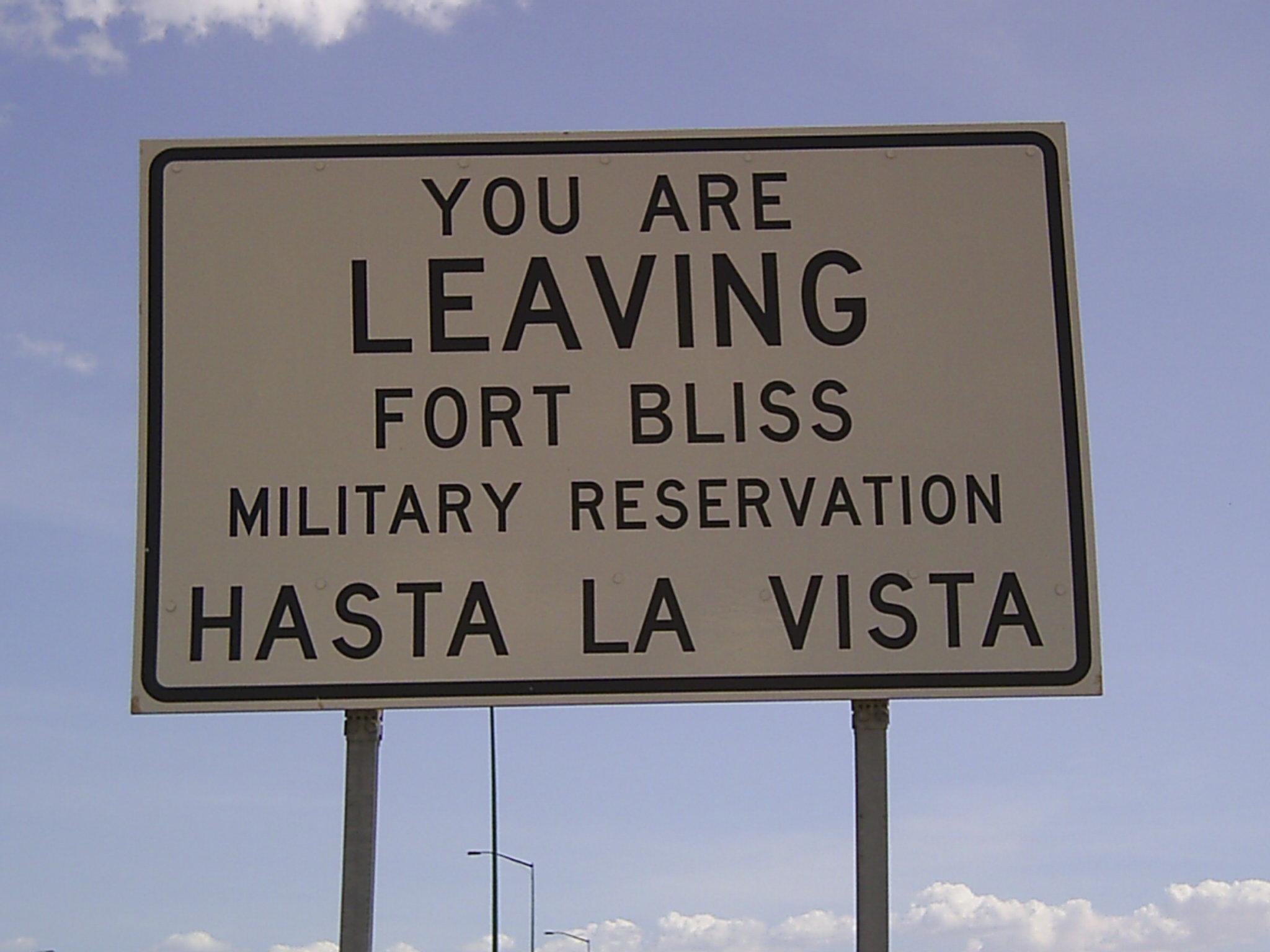
Fort Bliss
Fort Bliss sprawls across 1.12 million acres of Chihuahuan Desert, making it the largest military installation in the United States by land area. But this vast training ground began in 1849 as a handful of adobe buildings called 'The Post opposite El Paso,' established to protect travelers heading west during the California Gold Rush. The fort has moved four times, survived Confederate occupation, housed German rocket scientists after World War II, and evolved into the Army's premier air defense artillery training center. Its story parallels the transformation of the American Southwest from contested frontier to modern military-industrial complex.
Guardian of the Pass
The need for a military presence at El Paso became clear during the Mexican-American War, when the strategic mountain pass proved vital for moving troops and supplies. In 1849, the Army established a post on the north bank of the Rio Grande, directly across from the Mexican settlement of El Paso del Norte. The garrison protected mail coaches, travelers on the San Antonio-El Paso Road, and the future route of the transcontinental railroad. The post was named Fort Bliss in 1854, honoring Lieutenant Colonel William Wallace Smith Bliss, a Mexican-American War hero who had served as chief of staff to President Zachary Taylor. Bliss was renowned as a brilliant linguist and tactician who could compose orders in multiple languages simultaneously. He died of yellow fever in 1853, never knowing his name would endure on the desert frontier.
Four Forts in One
Fort Bliss has occupied four distinct locations over its history, each reflecting the changing needs of the Army and the growing city around it. The original post sat on Coons' Rancho near present-day downtown El Paso. In 1854, the garrison moved to Magoffinsville, where the replica museum now preserves the adobe architecture of that era. The Civil War brought chaos: Texas seceded, Confederate forces briefly held the post, and Union troops from the California Column recaptured El Paso in 1862. After the war, the fort relocated to Hart's Mill before finally settling at its present location in 1893. Each move brought improvements: from adobe to brick, from frontier outpost to permanent installation. The Main Post Historic District, listed on the National Register in 1998, preserves 343 contributing buildings from this evolution.
Pershing's Punitive Expedition
Fort Bliss gained national attention in 1916 when Pancho Villa's forces raided Columbus, New Mexico, killing 18 Americans. President Woodrow Wilson ordered Brigadier General John J. Pershing to pursue Villa into Mexico. Fort Bliss became the staging ground for the Punitive Expedition, with thousands of troops, horses, mules, and early aircraft assembling in the desert. The eleven-month campaign never captured Villa but transformed both the Army and Pershing himself. The expedition tested new technologies including trucks, airplanes, and radio communications. Pershing's performance earned him command of American forces in World War I. The pursuit across Chihuahua marked the last major U.S. cavalry operation and the beginning of modern mechanized warfare.
Rockets and Cold War
After World War II, Fort Bliss entered the Space Age. Operation Paperclip brought German rocket scientists to the post, including Wernher von Braun, who had developed the V-2 rocket for Nazi Germany. The Army established guided missile training programs at Fort Bliss, launching captured V-2 rockets at the adjacent White Sands Missile Range. This work laid the foundation for America's ballistic missile and space programs. A V-2 rocket still stands in the outdoor museum display. During the Cold War, Fort Bliss became the Army's primary air defense artillery training center, a role it maintains today. The German Air Force has trained at Fort Bliss since the 1960s under NATO agreements, operating their own Luftwaffe Air Defense Center on post.
The Largest Post
Today's Fort Bliss encompasses land in Texas and New Mexico, with McGregor Range extending 75 miles north into the desert. The installation serves as headquarters for the 1st Armored Division, returned to Fort Bliss in 2011 after decades in Germany. Over 11,000 people live on post, with thousands more military and civilian personnel commuting daily. The economic impact on El Paso exceeds $6 billion annually. Museums preserve the fort's history: the Replica Museum recreates the Magoffinsville-era post with authentic adobe construction, while the Fort Bliss and Ironsides Museums display artifacts from General Pershing's Dodge command car to captured Iraqi T-72 tanks from the Gulf War. From Apache raids to satellite-guided missiles, Fort Bliss has defended the pass for 175 years.
From the Air
Fort Bliss lies northeast of downtown El Paso at approximately 31.80N, 106.42W, elevation 3,900 feet MSL. Biggs Army Airfield (KBIF) occupies the southern portion of the installation with parallel runways oriented 03/21. The base extends north into the desert toward McGregor Range. From altitude, look for the gridded streets of the main cantonment area, the Noel Parade Field, and the distinctive tan-colored desert terrain contrasting with the green irrigated areas along the Rio Grande to the south. The Franklin Mountains rise to the west.