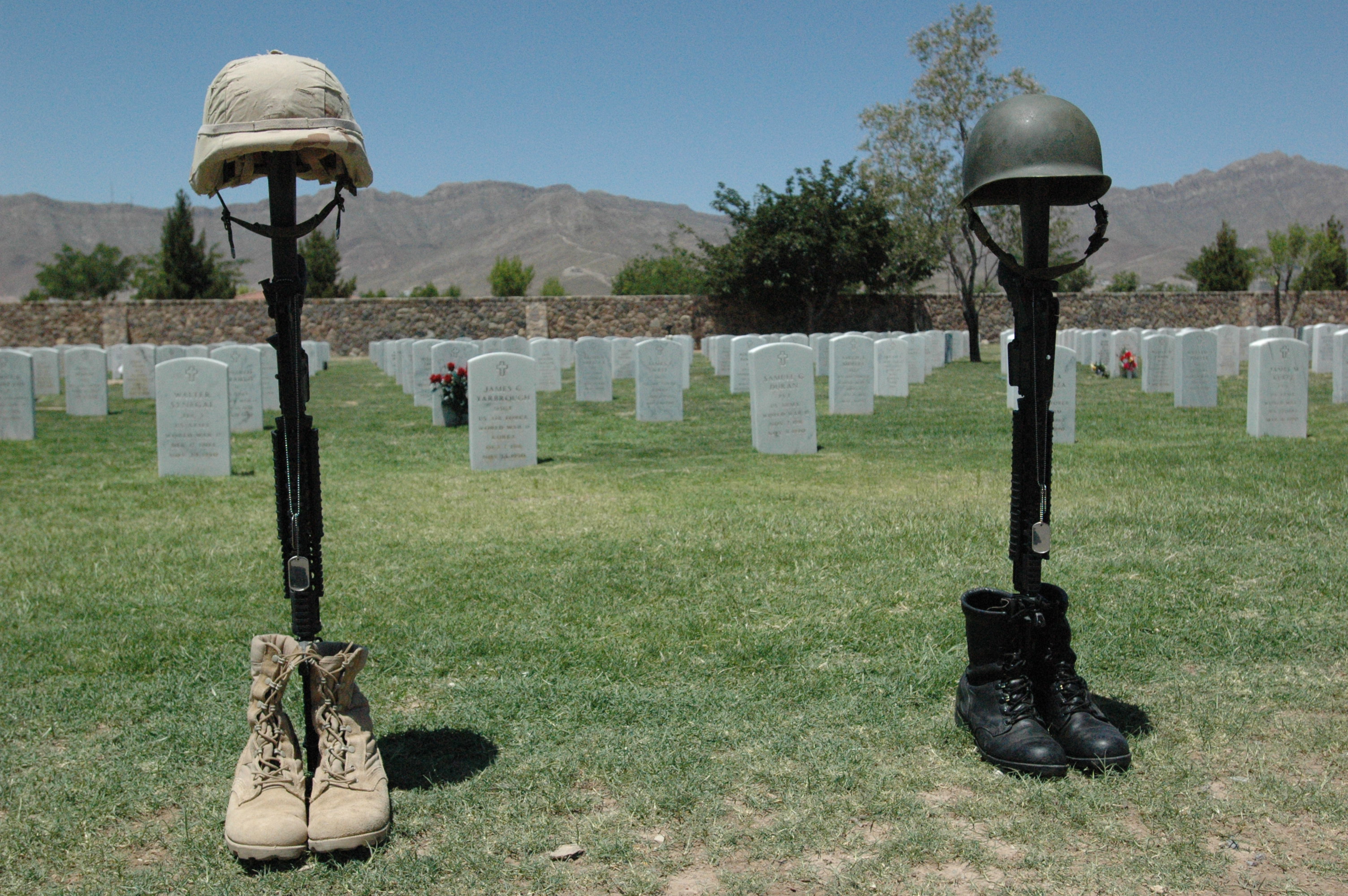
Fort Bliss National Cemetery
Long before Fort Bliss was formally established in the 1840s, burials were being made in the West Texas desert that would become the cemetery grounds. Today Fort Bliss National Cemetery holds more than 50,000 interments, including five Medal of Honor recipients, Chinese Air Force cadets who died training in World War II, German prisoners of war, and the fort's namesake himself. This sprawling memorial landscape tells a story far more diverse than any single conflict or era, reflecting the complex history of an Army post that has served as a Confederate stronghold, cavalry training ground, and modern military installation.
Burials Before the Fort
The first recorded burials in what would become Fort Bliss National Cemetery date to 1833, more than a decade before the fort itself existed. When Fort Bliss was established in the 1840s, it served as a Confederate infantry post during the Civil War before becoming a cavalry training center during World War I and a demobilization camp afterward. The cemetery grew with each conflict. Union soldiers originally buried at the earlier fort location were exhumed and reinterred at Fort Snelling in Minnesota in 1883, while the original site was granted to the City of El Paso in 1893. In 1894, the current location was designated as Fort Bliss Post Cemetery, covering just a few acres. World War I brought expansion, and by 1939 the cemetery had achieved national cemetery status.
An International Resting Place
Fort Bliss National Cemetery is remarkable for the international diversity of those buried within its grounds. In 1944, the Chinese government selected Fort Bliss as the final resting place for 52 Republic of China Air Force cadets who died while training at the post during World War II. The cemetery also contains the graves of several German prisoners of war and three Japanese civilians transferred from a cemetery in Lordsburg, New Mexico. A German scientist who died while working on research projects at Fort Bliss during the war lies here, as does an officer of the British Royal Air Force. In 1955, the remains of Lieutenant Colonel William Wallace Smith Bliss, the fort's namesake and son-in-law of President Zachary Taylor, were brought from New Orleans along with his memorial monument when urban development required clearing the Girod Street Cemetery.
Heroes and Legends
Five Medal of Honor recipients rest at Fort Bliss, three of whom earned their medals for actions in the Korean War. Staff Sergeant Ambrosio Guillen and Corporal Benito Martinez both died in combat in Korea in the early 1950s, while Master Sergeant Victor Hugo Espinoza survived to live another three decades after his heroic actions. Two Indian Wars veterans, Corporal Frank Bratling and Private George Hooker, are commemorated by cenotaphs marking their honored place among the fallen. Beyond military heroes, the cemetery holds cultural icons: Goose Tatum of the Harlem Globetrotters, actor Sherman Hemsley of 'The Jeffersons,' and Colonel John Stapp, the Air Force flight surgeon who pioneered research into acceleration and deceleration forces on the human body through legendary rocket sled experiments.
Desert Adaptation
Maintaining a traditional green cemetery in the Chihuahuan Desert came at enormous cost. By 2002, Fort Bliss National Cemetery was consuming 90 million gallons of water annually to keep its grass alive. That year, discussions began about converting to xeriscaping, a landscaping approach using drought-resistant plants native to the region. In 2007, the cemetery completed a $4.2 million conversion to desert-appropriate landscaping. The results were dramatic: by 2013, the cemetery was saving an average of $400,000 annually on water and maintenance, earning the Texas Environmental Excellence Award. However, the transformation has not been without complications, as shifting soil conditions have damaged some 1,300 graves, prompting ongoing geological investigation into the causes and solutions.
From the Air
Fort Bliss National Cemetery lies at approximately 31.82°N, 106.42°W at about 4,000 feet MSL, northeast of downtown El Paso within the sprawling Fort Bliss military reservation. From the air, the cemetery appears as a geometrically ordered expanse of desert landscaping and white headstones, distinctly visible against the surrounding military infrastructure. Located approximately 8 miles northeast of El Paso International Airport (KELP), pilots transiting the area should be aware of the extensive restricted airspace associated with Fort Bliss and the adjacent White Sands Missile Range.