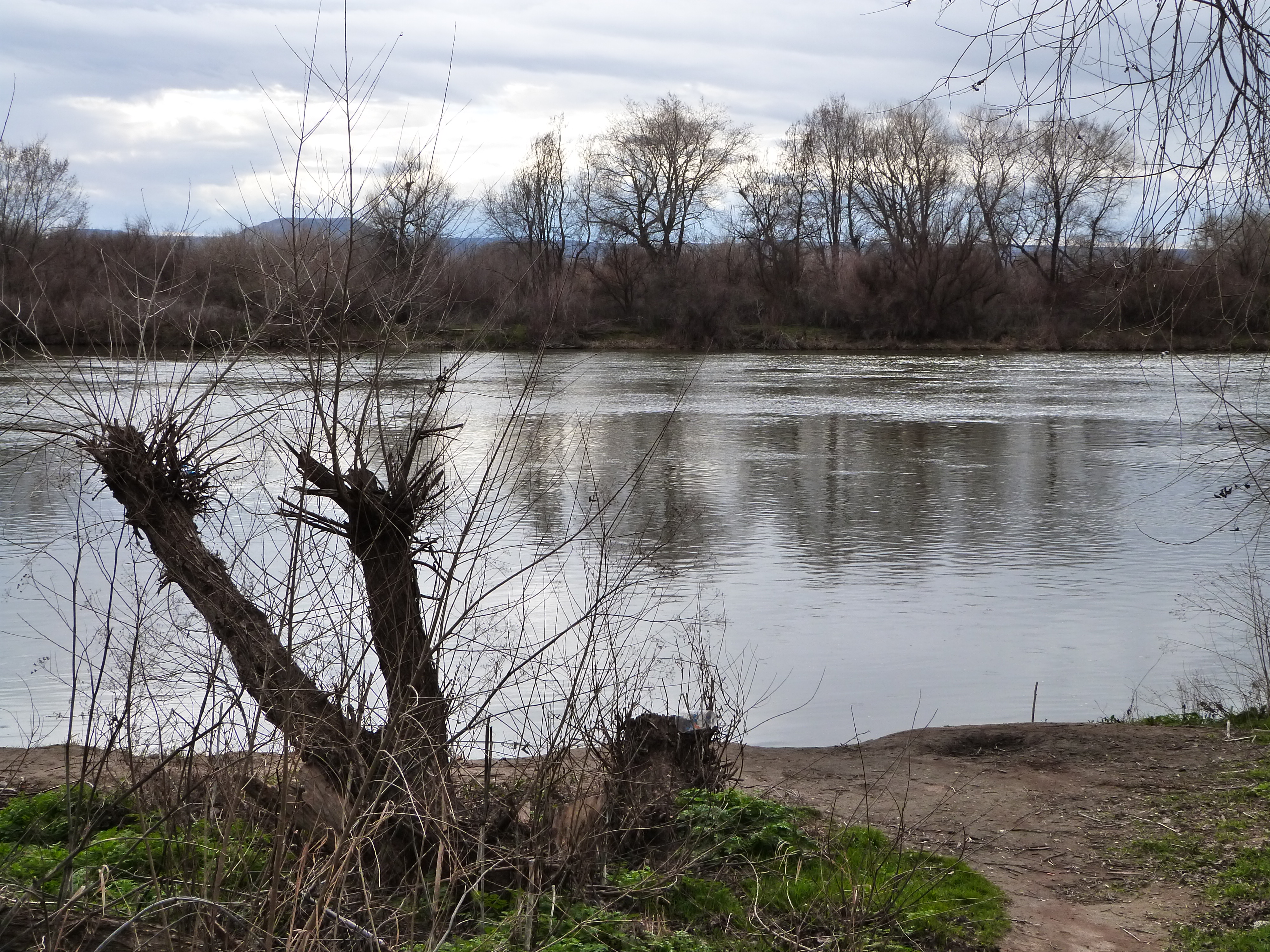
Fort Boise
Marie Dorion walked more than 200 miles through deep snow with her two children, fleeing the massacre that had claimed her husband and most of his party. It was 1813, and the outpost near the confluence of the Boise and Snake Rivers had proven what the land already knew: this was contested ground. The fort that would eventually rise here - and the second one that would follow decades later - would witness the twilight of the fur trade, the flood of emigrants along the Oregon Trail, and the birth of a state capital. But first, there was blood on the snow and a woman's desperate flight toward the Walla Walla people who might offer safety.
Empires of Beaver Pelts
The Astor Expedition explored this site in 1811, searching for locations to establish the Pacific Fur Company's network of trading posts. John Reid built the first outpost in 1813, the same year his party was killed. On an 1818 map, explorer David Thompson of the North West Company labeled the Boise as "Reid's River" and the abandoned post as "Reid's Fort." Donald Mackenzie tried again in 1819. Again, Indian hostilities drove traders away. Then in 1834, Thomas McKay - stepson of Hudson's Bay Company Chief Factor John McLoughlin - chose the same bloodied ground. This time the fort stuck. The HBC built it to challenge the American-owned Fort Hall further east on the Snake River. By 1836, the contest was over. McLoughlin had bought out his American competitors entirely, including Fort Hall itself, and the HBC controlled the Snake Country.
Adobe Walls and the Ward Massacre
In 1838, a man named Payette constructed a second Fort Boise near the river confluence, northwest of present-day Parma, Idaho. The structure was a parallelogram one hundred feet per side, surrounded by a stockade of poles fifteen feet high. Later, workers covered and replaced the logs with sun-dried adobe bricks. By 1846, the fort supported two tilled acres, twenty-seven cattle, and seventeen horses. Then came 1853 and the flood that damaged the walls. The following year brought worse: the Shoshone attacked an emigrant train within twenty miles of the fort, killing nineteen pioneers in what became known as the Ward Massacre. The military declared Fort Boise indefensible. With the fur trade dying anyway, traders packed what they could and headed for Flathead country. The adobe walls were abandoned in 1854.
Independence Day, 1863
The massacres along the Oregon Trail demanded a response. On July 4, 1863, as the Civil War raged in the East, Major Pinkney Lugenbeel of the Union Army arrived from Fort Vancouver to establish a new Fort Boise forty miles east of the abandoned trading post, up the Boise River. Territorial Governor William Wallace announced the new Idaho Territory that same day from Lewiston. Lugenbeel brought three companies of infantry and one of cavalry. They built a mule-driven sawmill, fired up a lime kiln, and opened a sandstone quarry at Table Rock. His greatest challenge was not the terrain but the nearby Boise Basin gold mines - more than fifty men deserted within the first months, lured by dreams of striking it rich. The fort they left behind would anchor the city that grew around it.
From Barracks to Baseball Diamonds
The U.S. Army remained at Fort Boise for forty-nine years, departing in 1912. The National Guard held it until 1919, when the Public Health Service converted it to a center for World War I veterans and tuberculosis patients. The Veterans Administration took over in 1938, and the Boise VA Medical Center operates on the site today. In 1950, the city acquired a portion for Fort Boise Park, which now features tennis courts, softball fields, and a skateboard park. During rehab efforts following the 1997 Foothills Fire, workers discovered unexploded artillery shells in the hills above - remnants of long-ago gunnery practice. And in October 1979, Clint Eastwood filmed the final wild west show scene of Bronco Billy in the park, bringing a touch of Hollywood to ground where the actual Wild West had played out for real.
From the Air
The original Fort Boise site lies near 43.82N, 117.02W at the confluence of the Boise and Snake Rivers, now within the Fort Boise Wildlife Management Area near Parma, Idaho. A reconstructed replica stands in Parma. The later military Fort Boise site is in downtown Boise, now occupied by the VA Medical Center and Fort Boise Park. The nearest major airport is Boise Air Terminal (KBOI). Both sites are best viewed at lower altitudes in clear weather. The Snake and Boise Rivers provide excellent visual navigation references.