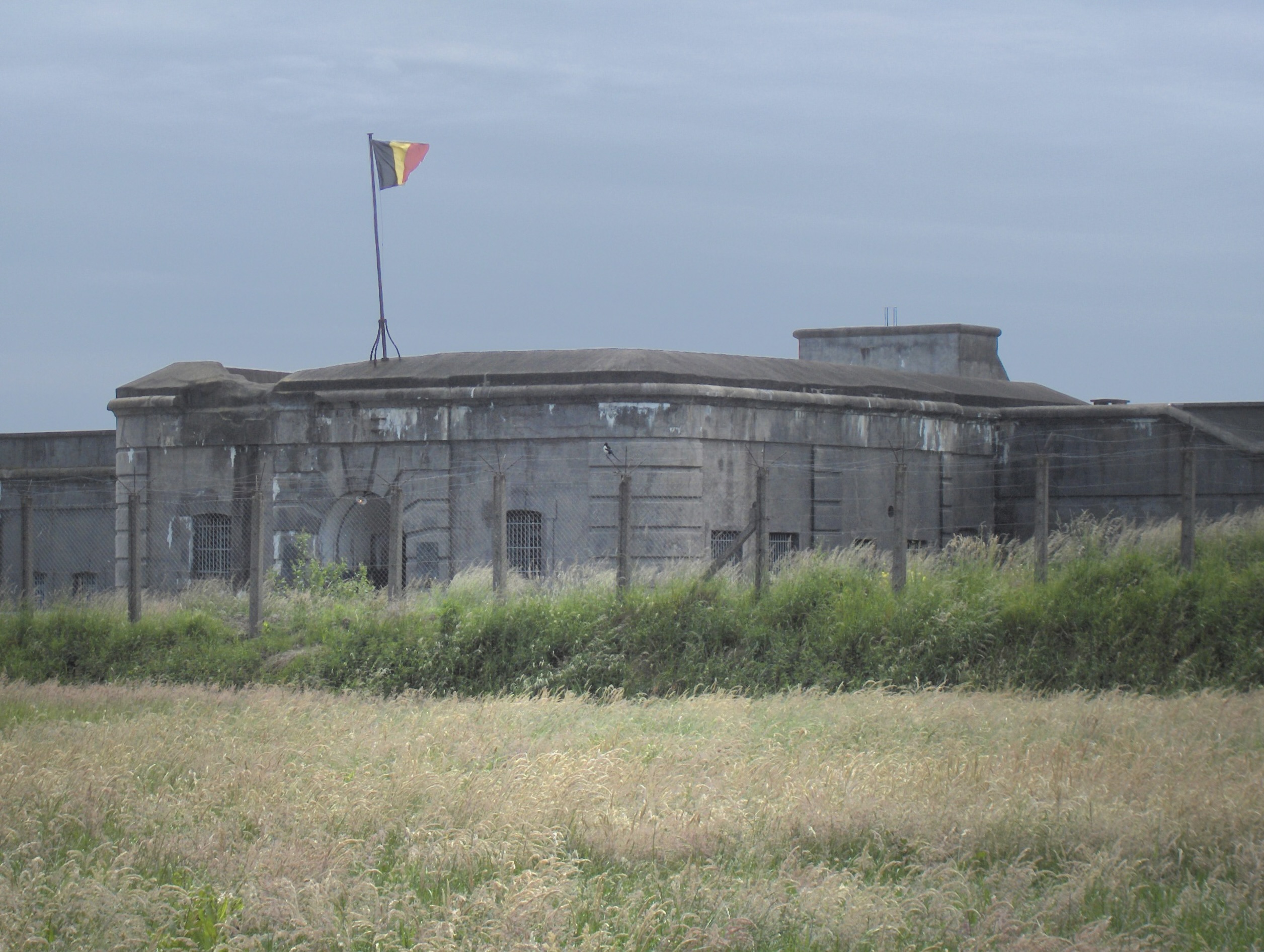
Fort Breendonk
The soil covering Fort Breendonk was five meters thick when the SS took control in 1940. By the time they fled in 1944, prisoners had removed it with hand tools, load by grueling load, over twelve-hour days, seven days a week. The Nazis wanted the earth moved to build a bank around the camp, hiding their crimes from outside view. This backbreaking labor, performed by political prisoners, resistance fighters, and Jews on starvation rations, killed countless men before they could be transported to larger death camps in the east. Fort Breendonk was technically classified as a prison, not a concentration camp. The distinction meant nothing to the 3,590 who passed through its gates, nearly half of whom would not survive the war.
From Defense to Detention
Fort Breendonk was built between 1906 and 1913 as part of Belgium's National Redoubt, a ring of fortifications protecting the vital port of Antwerp. Its massive concrete walls, designed to withstand artillery bombardment, were covered with earth and surrounded by a water-filled moat. During the German invasion in World War I, the fort saw action during the siege of Antwerp, its garrison surrendering on October 9, 1914 after German forces bypassed the defenses. In May 1940, as German armies again swept into Belgium, the fort briefly served as headquarters for King Leopold III and the Belgian General Staff. It was already militarily obsolete. Within weeks of Belgium's surrender on May 28, 1940, the SS requisitioned Breendonk and transformed it into something its builders never imagined: a prison designed to break human beings.
The Hell of Breendonk
The first prisoners arrived on September 20, 1940. Initially they were petty criminals and those deemed anti-social by Nazi racial standards. Later came resistance fighters, political prisoners, hostages, and Jews. The regime was deliberately brutal. Camp commandant Philipp Schmitt set his German Shepherd, named Lump, on prisoners. His wife wandered the camp, ordering punishments at whim. During the winter of 1942-43, after the German defeat at Stalingrad, Flemish SS guards forced Jewish prisoners into the freezing moat and held them there with shovels until they drowned. Prisoners slept fifty to a room designed for thirty-eight, in windowless stone barracks heated by a single stove. The torture chamber, installed in an old gunpowder magazine, extracted confessions with methods preserved today in the memorial museum.
Survival and Witness
Fewer than ten percent of Breendonk's inmates survived the war. Of the 3,590 prisoners held there, 303 died or were executed within the fort itself; 1,741 others died after being transported to larger concentration camps. Those who did survive bore witness. Jean Amery, the Austrian-born author and philosopher, was captured as a resistance fighter in 1943 and severely tortured at Breendonk before being sent to Auschwitz. He later wrote At the Mind's Limits, a devastating meditation on the dehumanization he experienced. Comic artist Marc Sleen was imprisoned with his brother because their third brother was a resistance member. Placed in a death cell where one prisoner was shot daily, Sleen was saved only by the chaos of D-Day. He suffered nightmares about Breendonk for the rest of his life.
Memory and Memorial
On September 4, 1944, as Allied forces approached, the SS evacuated Breendonk. Remaining prisoners were shipped to Buchenwald. Briefly, the fort was used to intern Belgian collaborators before they were transferred to other facilities. In 1947, Belgium declared Breendonk a national memorial. War crimes trials in Mechelen and Antwerp brought justice to some perpetrators: 18 Flemish SS guards were sentenced to death, though two had sentences commuted; Schmitt himself was executed by firing squad on August 9, 1950, never showing remorse, claiming he was merely re-educating inmates as ordered. Today the fort stands virtually unchanged from 1944. The execution poles and gallows remain. The torture chamber is preserved. Visitors walk the same corridors where prisoners moved in terror, a visceral reminder of how ordinary structures can become instruments of atrocity.
From the Air
Fort Breendonk is located near the town of Breendonk at coordinates 51.056N, 4.341E, approximately 20 kilometers south of Antwerp and 20 kilometers north of Brussels. The fort's distinctive geometric shape, a large trapezoid surrounded by its moat, is clearly visible from lower altitudes. The A12 motorway between Brussels and Antwerp passes immediately to the west. Brussels Airport (EBBR) lies 15 kilometers to the south, while Antwerp Airport (EBAW) is 15 kilometers to the north. The surrounding landscape is flat agricultural land typical of the Belgian lowlands.