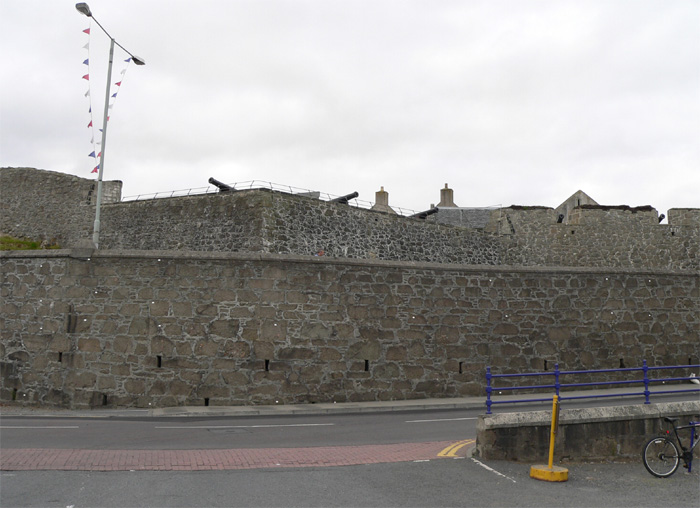
Fort Charlotte, Shetland
In 1667, a Dutch fleet appeared in the waters off Lerwick and decided not to attack Fort Charlotte. The fort's walls were unfinished, it had few guns, and the garrison was small -- but the Dutch did not know any of this. The bluff held. Six years later, during the Third Anglo-Dutch War, the Dutch came back. This time the fort was unmanned, and they burned it. The history of Fort Charlotte is a story of timing: built, abandoned, burned, rebuilt, and repurposed so many times that its five-sided walls have seen more careers than most buildings manage in a century.
Three Wars, Three Forts
The first fort on this site was built between 1652 and 1653 during the First Anglo-Dutch War. Almost nothing is known about it, and no trace has been found. The second structure was built on the same site in 1665 by Robert Mylne, on the orders of Charles II, at a cost of 28,000 pounds -- a substantial investment in what was then a remote outpost. It was this unfinished fort that deterred the Dutch in 1667, an achievement that owed more to appearance than armament. After the war ended, the government decided not to maintain a garrison in Lerwick, and the fort was slighted -- deliberately damaged to prevent its use by an enemy. When the Dutch arrived in 1673 during the Third Anglo-Dutch War, they found the walls unmanned and burned what remained.
Charlotte's Fort
The fort was rebuilt in its current form in 1781 and named after Queen Charlotte, consort of George III. The design is roughly five-sided, with full bastions on each of three landward corners and half-bastions on the two seaward corners -- a star-shaped plan typical of 18th-century artillery fortifications. Despite the new construction, Fort Charlotte has never seen combat since its rebuilding. It housed a garrison during the Napoleonic Wars and later served as a base for the Royal Naval Reserve. From 1837 to 1875, the military fort found a decidedly unmilitary purpose as the town jail and courthouse. It subsequently became a custom house and a coastguard station, each new role further distancing it from its original purpose.
Hidden Behind the Town
One of the most unusual things about Fort Charlotte is that you can walk past it without realising it is there. Land reclamation and the construction of buildings along Lerwick's waterfront mean that the fort no longer dominates the shoreline as its builders intended. The star-shaped ground plan, designed to be visible and intimidating from the sea, can now only be appreciated from the air. The town has grown around and in front of the fort, absorbing it into the urban fabric of Lerwick. Today, Fort Charlotte is managed by Historic Environment Scotland and serves as the base for 212 Highland Battery, part of Britain's Army Reserve. The guns point at buildings where fish merchants once traded. The ramparts overlook rooftops rather than open water. It is a fort that has been swallowed by the peace it was built to protect.
From the Air
Located at 60.16N, 1.14W in central Lerwick. The five-sided star-shaped fort plan is clearly visible from the air, though obscured at ground level by surrounding buildings. Nearest airport: Sumburgh (EGPB), approximately 25 miles south. Tingwall Airport (EGET) is approximately 6 miles west.