Fort Christanna
The children shrieked with delight as they ran through the rain. Lieutenant John Fontaine, visiting in 1715, recorded the scene at Fort Christanna -- hordes of happy Indian children playing outside a pentagonal stockade overlooking the Meherrin River in what is now Brunswick County, Virginia. Inside, a schoolmaster named Charles Griffin was teaching as many as a hundred Saponi, Tutelo, and Occaneechi children to speak English, read the Bible, and recite their catechisms. The Siouan peoples adored Griffin so much, one visitor reported, that they would gladly have crowned him king of the Saponi nation. It was a remarkable experiment in cross-cultural education on the edge of the British Empire -- and it lasted barely four years before colonial commerce killed it.
Spotswood's Ambitious Design
The Tuscarora War erupted in 1711, sending shockwaves through the Virginia Colony. Lieutenant Governor Alexander Spotswood saw an opportunity within the crisis. He proposed gathering the tributary Siouan and Iroquoian tribes of Virginia -- peoples who had accepted English authority since 1677 -- into a single fortified settlement where they could be protected from hostile nations, trade under regulated conditions, and educate their children in English ways. The Virginia House of Burgesses approved the plan in late 1713, placing it under the newly formed Virginia Indian Company, which held a trade monopoly. Spotswood named his creation Christ-Anna, joining Christ with Queen Anne, who would die later that year. The fort was built to the highest military standards of the day: a pentagon with blockhouses mounting 1,400-pound cannon at each of its five corners, spaced a hundred yards apart so each position commanded a clear line of sight to the next two.
A School on the Frontier
In 1714, Spotswood personally visited the site and persuaded the Saponi, Tutelo, Occaneechi, and Eno peoples to occupy a 36-square-mile tract surveyed around the fort. Some Nansemond from the north side of the Meherrin River joined them. The Iroquoian tribes -- the Nottoway and Meherrin -- flatly refused, declaring they would not live with the Siouans. Spotswood considered abducting them, but they eluded every attempt. The Siouan tribes built a town outside the fort walls. Charles Griffin, the schoolmaster Spotswood financed, taught children to speak and write English and to read the Bible and Book of Common Prayer. The Reverend Hugh Jones reported that 77 students could read, write, and recite their catechisms tolerably well. Lieutenant Fontaine, stationed there in 1715 and 1716, recorded roughly 45 to 50 words and phrases of the Tutelo-Saponi language -- one of the earliest documented vocabularies of a Virginia Siouan tongue.
Commerce Devours the Experiment
The Virginia Indian Company's trade monopoly infuriated private merchants, none more than William Byrd II, who had inherited his father's profitable Indian trade. Byrd traveled to London and lobbied the Lords of Trade directly, arguing that Christanna was an unnecessary public expense. Despite Spotswood's protests, the Lords of Trade dissolved the company on November 12, 1717. When a treaty with the Iroquois of New York followed in May 1718 -- the northern nations agreeing not to venture east of the Blue Ridge -- the House of Burgesses saw no further need for the fort and voted to discontinue manning it. Griffin stayed until September, then transferred to Williamsburg, where he continued teaching Indian children at the Brafferton school of the College of William and Mary. The grand experiment on the Meherrin was over.
Scattered to the Winds
The Saponi, Tutelo, and remnants of perhaps fifteen other tribes lingered on the tract for years at a village they called Junkatapurse -- from the Tutelo words chunketa pasui, meaning horse's head. Around 1728, many migrated south to join the Catawba, fellow speakers of an eastern Siouan language. Others drifted north, reaching Shamokin, Pennsylvania by 1740 and gaining formal adoption by the Cayuga nation in New York by 1753. Colonists, meanwhile, poured into the surrounding land in such numbers that Brunswick County was carved out as a new jurisdiction in 1720. The five massive cannon that once guarded the fort's corners were supposedly buried in the well, but despite archaeological excavations, they have never been found. A smaller cannon attributed to Christanna sat for decades in a private yard, fired every Fourth of July and Christmas, before being moved to the Christopher Wren Building at William and Mary in 1900.
Ghosts in the Bastions
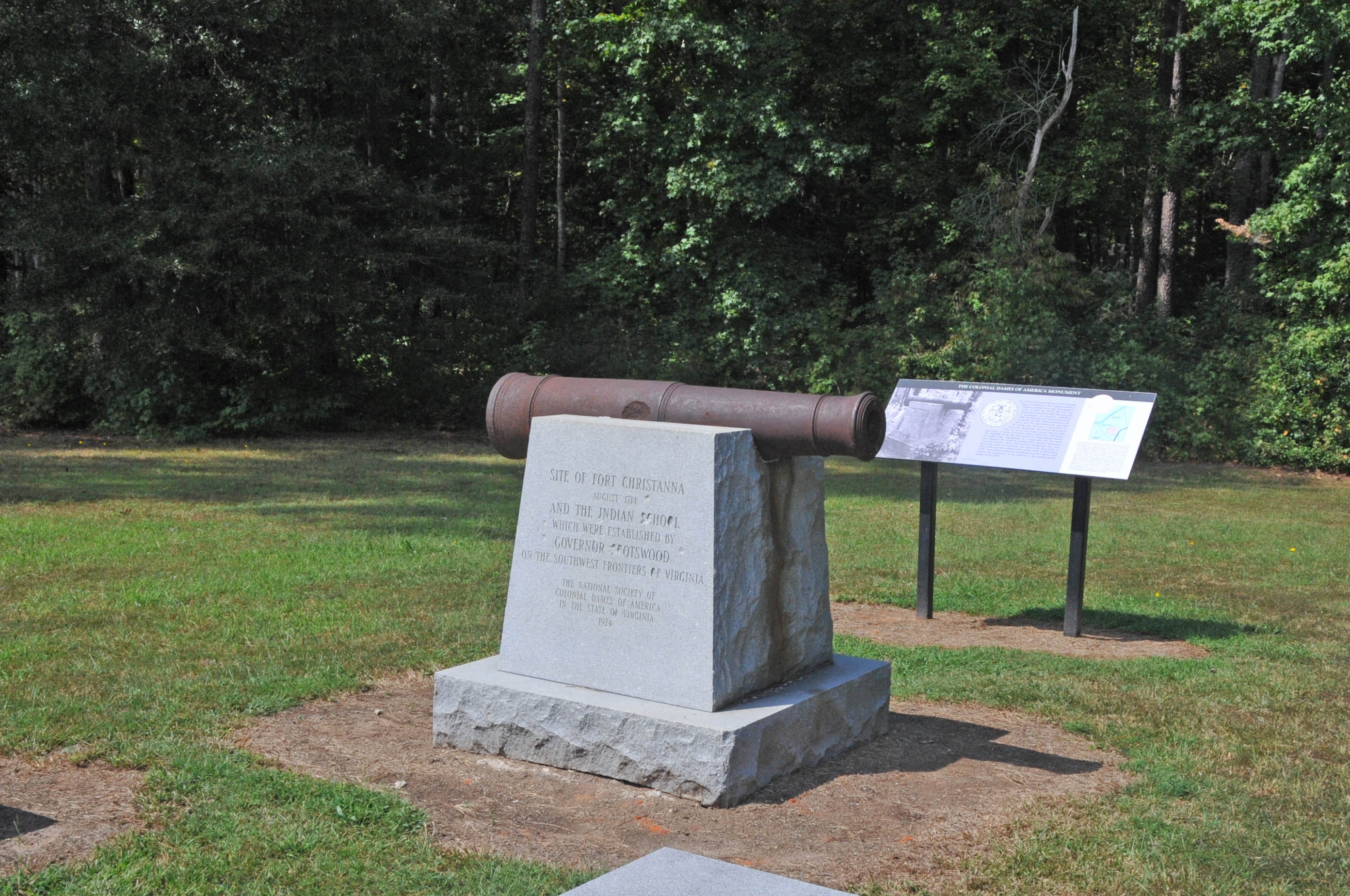
The Colonial Dames of America acquired about ten acres of the site in 1924 and erected a historical marker dedicated at a ceremony with native dancers and a descendant of Governor Spotswood. Archaeological excavations in the 1970s confirmed the fort's exact location. Brunswick County acquired roughly 25 additional acres around 2000, and the site is now a county park, dedicated in 2004 and rededicated in March 2025. The bastions that once formed the fort's five corners are outlined on the ground, joined by walking trails and interpretive areas. Fort Christanna was added to the National Register of Historic Places in 1980 as a national historic district, and it sits on the Virginia Civil Rights in Education Heritage Trail -- an acknowledgment that the story of Griffin's school and its Siouan students belongs not only to colonial military history but to the longer American story of education, displacement, and what might have been.
From the Air
Located at 36.72N, 77.87W in Brunswick County, Virginia, along the Meherrin River near Gholsonville. From altitude, the fort site sits in the rural Southside Virginia landscape between Emporia to the southeast and Lawrenceville to the southwest. Look for the meandering course of the Meherrin River. Nearest airports include Emporia-Greensville Regional Airport (EMV/KEMV) approximately 15 nm southeast, and Mecklenburg-Brunswick Regional Airport (AVC) roughly 30 nm west.