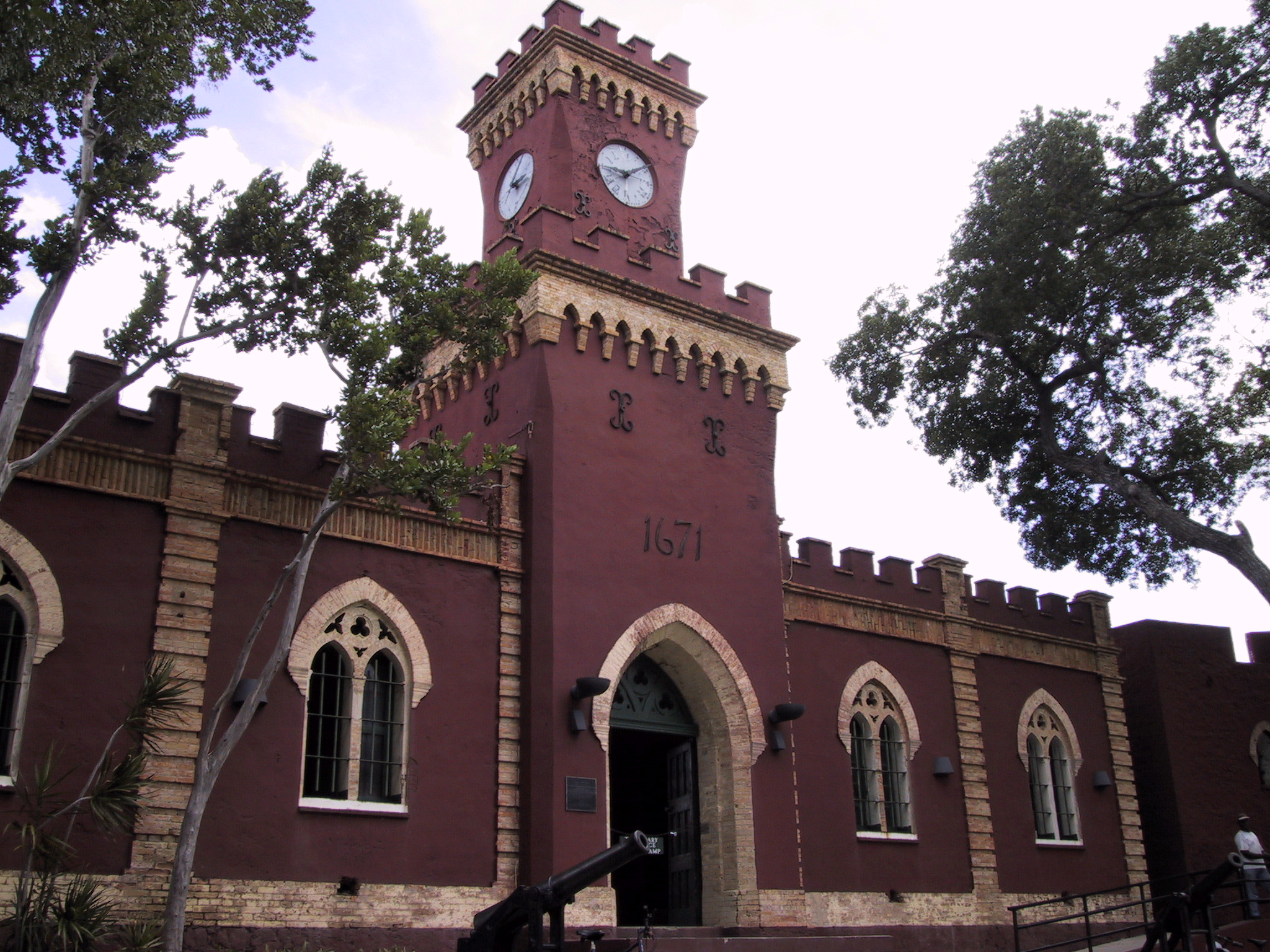
Fort Christian
The fort has been nearly everything a building can be. Governor's residence, church, town center, courthouse, police station, jail -- Fort Christian has cycled through identities the way the islands above it have cycled through flags. Built between 1672 and 1680 on a rocky peninsula in Charlotte Amalie harbor, it was named for King Christian V of Denmark, and it was the first substantial structure the Danes erected after Governor Jorgen Iversen Dyppel arrived with his second expeditionary force on May 25, 1672. The first attempt to colonize St. Thomas, in 1665, had failed partly because the settlers were raided for supplies by combatants in the Second Anglo-Dutch War. This time, the Danes started by building something that could not be raided so easily.
Stone, Brick, and Buttress
Fort Christian was constructed on a rocky peninsula at the harbor's edge, its thick walls of stone and brick reinforced by large buttresses designed to absorb cannon fire. The placement was deliberate: positioned at sea level, the fort's guns could direct fire at any vessel attempting to enter the harbor. But its low position also limited its sight lines, which is why the Danes built Skytsborg Tower -- later Blackbeard's Castle -- on Government Hill seven years later to serve as the fort's eyes. Together, the two structures formed a defense system: the hilltop watchtower spotted threats, the waterfront fort engaged them. In the 18th century, the fort was expanded to accommodate its growing role as the center of colonial administration. The most visible addition came in 1874, when a Victorian clock tower was grafted onto the entrance -- an incongruously cheerful face on a building whose walls had witnessed centuries of conflict, governance, and imprisonment.
The Weight of What Happened Here
Fort Christian's original purpose included defending against what the colonial record called "rebellious enslaved populations" -- a phrase that reveals what the fort actually protected: a system of human bondage that powered the sugar economy of the Danish West Indies. Charlotte Amalie's harbor was a transshipment point in the Atlantic slave trade; enslaved people from Africa were brought through these waters to be sold in the colony and across the region. The fort that kept the harbor secure kept that commerce flowing. After slavery was abolished in the Danish West Indies in 1848, Fort Christian continued as a seat of government and justice. For decades it served as the territory's primary jail, its cells holding prisoners in the same walls that had once been built, in part, by forced labor. The building's history does not divide cleanly into villains and heroes -- it holds the full, uncomfortable weight of colonial power exercised over centuries.
Three Centuries, Three Flags
Denmark ruled the Virgin Islands for 245 years, and Fort Christian stood at the administrative center for nearly all of them. When the United States purchased the islands in 1917 for $25 million, the fort transferred to American hands. It was designated a National Historic Site in 1960, then redesignated and transferred to territorial control in 1975 to be administered as a park. Two years later, in 1977, it earned National Historic Landmark status -- the highest level of recognition for historic properties in the United States. But recognition did not guarantee preservation. The fort was closed for a full decade of renovations, reopening in 2017 just in time for the Transfer Day centennial -- the hundredth anniversary of the American purchase. Inside, the St. Thomas Museum now houses artifacts and artwork from the Danish colonial period, turning a fortress into a place of reflection on the era it represents.
Still Standing at the Harbor's Edge
Fort Christian sits opposite Emancipation Garden in downtown Charlotte Amalie, its red-brick walls and clock tower visible from the harbor and from the cruise ships that now dock where warships and sugar barges once anchored. It remains the oldest standing structure in the US Virgin Islands -- older than any building in most American cities, older than the nation that now claims it. The Victorian clock tower, added nearly two centuries after the original construction, has become the fort's most recognizable feature, though it represents only a fraction of the building's life. Below it, the original Danish walls endure: thick, buttressed, built to last by people who understood that controlling this harbor meant controlling the gateway between the Atlantic and the Caribbean. The fort no longer controls anything. But it remembers everything.
From the Air
Located at 18.34N, 64.93W on the waterfront in Charlotte Amalie, St. Thomas, US Virgin Islands. Fort Christian's distinctive red walls and Victorian clock tower are visible from harbor approaches, sitting directly on the waterfront opposite Emancipation Garden. The fort is best spotted from lower altitudes in clear conditions. Nearest airport is Cyril E. King Airport (TIST), approximately 2nm west. The fort sits between the harbor and the hillside where Blackbeard's Castle (Skytsborg Tower) stands -- both are visible together from a southern approach.