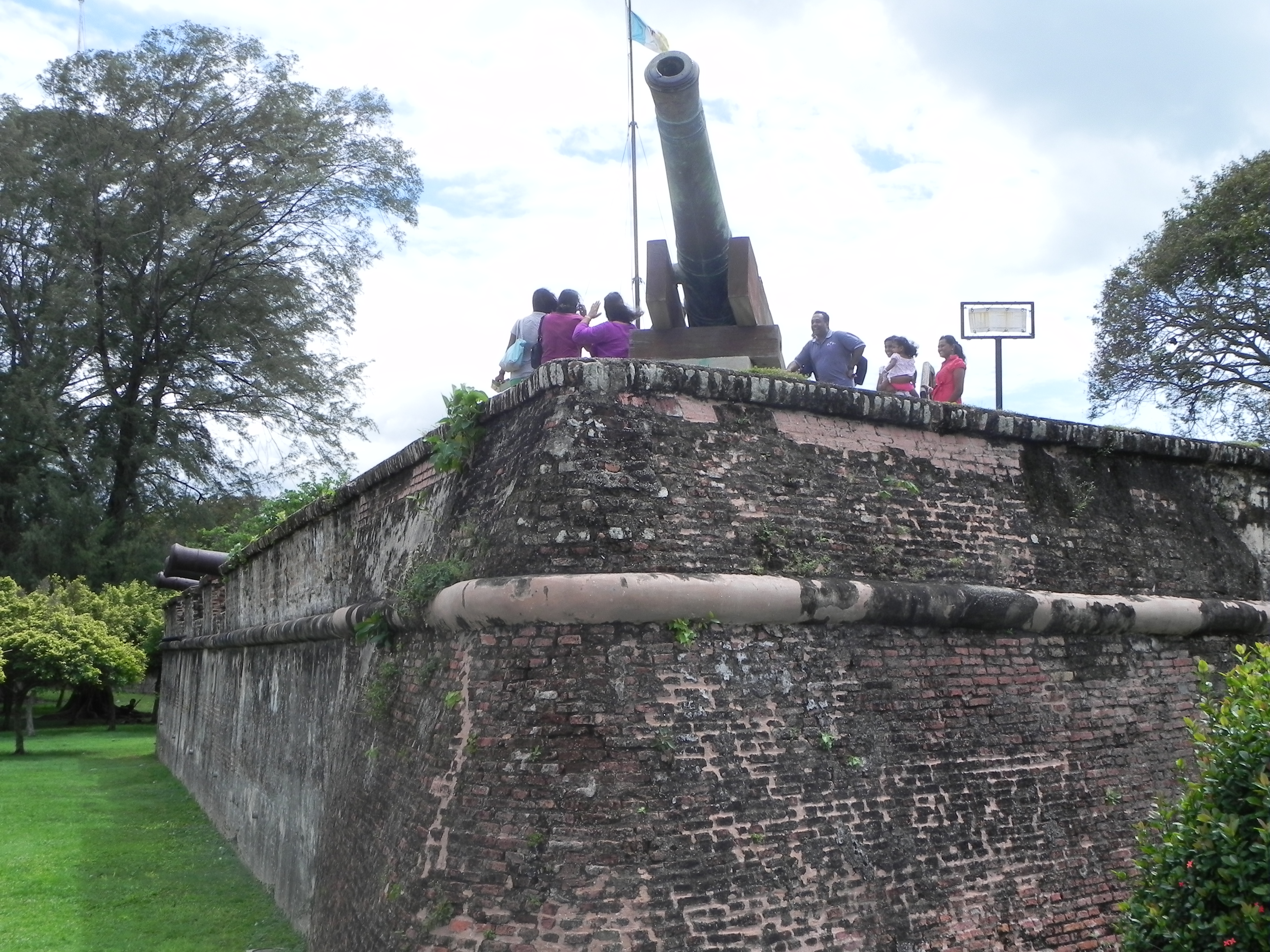
Fort Cornwallis
The largest standing fort in Malaysia has never been attacked. Fort Cornwallis sits at the northeastern tip of Penang Island, its star-shaped walls facing the Strait of Malacca, its cannons pointed at enemies who never arrived. Captain Francis Light built the original structure in 1786 as a crude stockade of nibong -- palm trunk -- covering barely 418 square feet. It was meant to defend against pirates and the Sultan of Kedah, from whom Light had just acquired the island under terms the Sultan would later dispute. But the fort's story is less about war than about paperwork, courtrooms, and the slow administrative machinery of empire.
Built by Convicts for Wars That Never Came
The nibong stockade lasted barely two decades. In 1804, with the Napoleonic Wars rattling nerves across British colonies, Colonel R.T. Farquhar ordered the fort rebuilt in brick and stone. The labor fell to Indian convict workers -- a common practice in the Straits Settlements, where convicted prisoners from the subcontinent were transported to build the infrastructure of colonial expansion. They completed the fort in 1810 at a cost of $80,000, during Governor Norman Macalister's tenure. A moat nine metres wide and two metres deep surrounded the walls. Napoleon's threat to Southeast Asia never materialized. The fort's most significant military-adjacent moment came not from invaders but from mosquitoes: the moat was filled in during the 1920s after it became a breeding ground for malaria.
The Administrator's Fort
Fort Cornwallis found its true purpose behind desks, not battlements. When the Supreme Court of Penang opened on 31 May 1808, its judge -- Sir Edmond Stanley, an Anglo-Irish barrister -- was housed inside the fort. By the 1920s, Sikh police of the Straits Settlements had replaced soldiers within its walls. The building that most visitors assume is the fort's chapel, tucked into the southwest bastion, is almost certainly the main powder magazine -- its massive roof and surrounding buttresses are textbook magazine architecture. The actual chapel, built in 1799, hosted the first recorded marriage at the fort that same year: John Timmers married Martina Rozells, the widow of Francis Light himself, who had died of malaria in 1794. Light never saw his stockade become the administrative center he probably envisioned.
The Cannon That Crossed an Archipelago
Among the old cannons decorating the fort, one stands apart. Seri Rambai was cast in 1603, making it older than the fort by nearly two centuries. Its journey across Southeast Asia reads like a novel of shifting colonial power. In 1606, the Dutch East India Company presented it to the Sultan of Johore. Seven years later, Acehnese forces seized it and carried it to Aceh, on the northern tip of Sumatra. The Acehnese eventually gave it to Kuala Selangor in 1795. When the British launched a punitive raid on Kuala Selangor in 1871 during the Selangor Civil War, they took Seri Rambai as booty and shipped it to Penang. The government finally moved it to Fort Cornwallis in the 1950s, where it rests today -- a single artifact that connects Dutch merchants, Malay sultans, Acehnese warriors, and British imperialists across four centuries.
A Lighthouse with Nothing to Guide
In 1882, workers erected a 21-metre skeletal steel lighthouse in the fort's northeast corner. Originally called Fort Point Lighthouse, it was renovated in 1914 and 1925, then renamed Penang Harbour Lighthouse. It is the second-oldest lighthouse in Malaysia, after the Cape Rachado Lighthouse at Tanjung Tuan in Malacca. But here is the peculiar detail: it no longer serves any navigational purpose. It is, according to the State Tourism Development Committee, the only lighthouse in Peninsular Malaysia that guides no ships. Like the fort that houses it -- built for defense that never came -- the lighthouse stands as a monument to intentions unfulfilled. The fort was gazetted as an Ancient Monument and Historic Site on 8 September 1977, under the Antiquities Act. Today it is one of Penang's top tourist attractions, its walls enclosing not soldiers but souvenir vendors, its ramparts offering views of the strait that its cannons were never called upon to protect.
From the Air
Located at 5.4206N, 100.3435E on the northeastern tip of Penang Island, directly adjacent to the Esplanade. The star-shaped fort outline is visible from low altitude. The 21-metre steel lighthouse in the northeast corner is a useful visual reference. Penang International Airport (WMKP) lies approximately 16 km to the south. The Penang Bridge (ICAO waypoint nearby) is visible to the southeast. Best viewed at 1,500-2,500 feet on a coastal approach from the northeast.