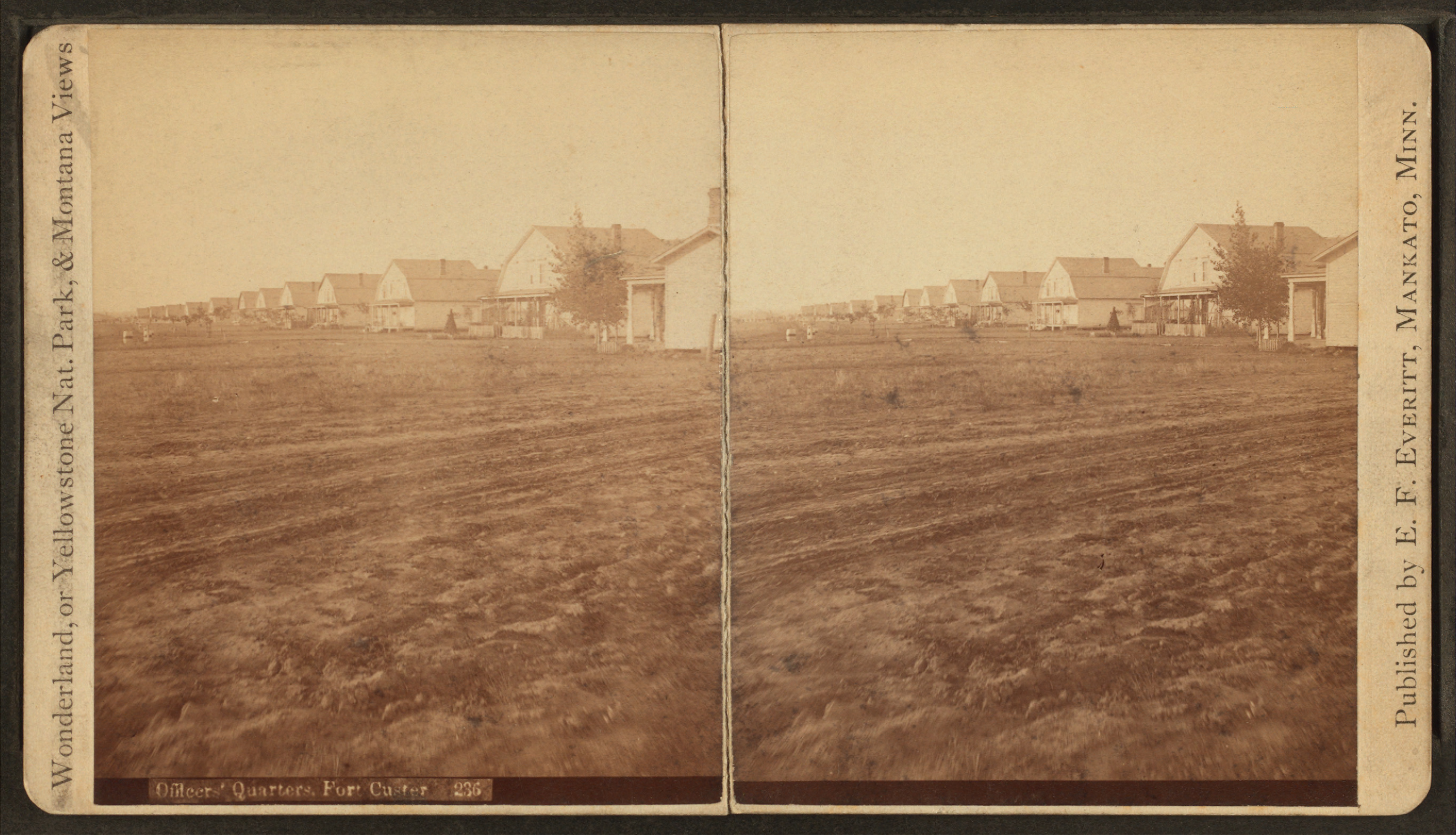
Fort Custer
The soldiers who built Fort Custer in 1877 worked in the shadow of fresh tragedy. Just miles away, Lieutenant Colonel George Armstrong Custer and 268 of his men had been killed at the Battle of the Little Bighorn the previous summer. Now the army was constructing a permanent presence on an elevated plateau overlooking the confluence of the Bighorn and Little Bighorn rivers, naming it for the fallen officer whose defeat had shocked the nation. The irony was not lost on anyone.
Built from the Land Itself
Lieutenant Colonel George P. Buell arrived by steamer in June 1877 with four companies of the 11th Infantry and a force of mechanics and laborers. His orders were to build the post from materials found in the country. The men cut cottonwood logs, baked bricks on site, and sawed lumber from the surrounding timber. The buildings rose not as traditional framed structures but as solid walls of planks laid flat, two inches thick by six inches wide, stacked to form walls six inches thick. Officers' quarters had a single story plus an attic; all other buildings were strictly one story. The construction reflected both the urgency of the mission and the remoteness of the location.
The Plateau in the Fork
Buell had been instructed to place the fort on the left bank of the Bighorn, near the mouth of the Little Bighorn. Upon arrival, he surveyed the entire area and chose differently. An extensive elevated plateau in the fork of the two streams offered superior advantages for defense and visibility. His superiors approved the change. The fort eventually housed quarters for ten companies, with stables for six cavalry troops, all arranged around a large parade ground. Unlike many frontier posts, Fort Custer had no walls or other fortifications. By the time construction was complete, most Native Americans in the vicinity had been confined to reservations.
Garrison Life and Service
The Second Cavalry Regimental Headquarters arrived in November 1877, along with companies of the 11th Infantry. The fort supplied troops for Plains campaigns including the Bannock War of 1878. In January 1881, Lieutenant Charles F. Roe led Troop M from Fort Custer to the Little Bighorn battlefield, carrying materials for the monument that would honor the fallen. In 1884, the First Cavalry replaced the Second, joining infantry companies from the Fifth and Seventeenth regiments. The garrison maintained order as the Indian Wars wound down, their primary role gradually shifting from combat readiness to administrative presence.
A Fort Becomes a Town
On April 17, 1898, Fort Custer closed after twenty-one years of operation. The buildings were sold, and their materials were hauled away to construct the town of Hardin, Montana. Today, the fort site lies within the Crow Indian Reservation, marked only by scattered cellars and ground depressions on an abandoned golf course. A Daughters of the American Revolution marker designates the location just off Interstate 90 where the highway crosses the Big Horn River. Remnants of the fort can be found in Fort Smith, Montana, where a building operates as a bed and breakfast managed by the Crow Indians, while a replica stands at the Bighorn County Historical Museum.
From the Air
Located at 45.727N, 107.574W, the former Fort Custer site sits on an elevated plateau at the confluence of the Bighorn and Little Bighorn rivers. The terrain shows as flat benchland above the river valleys. The nearby town of Hardin is visible to the north, and Interstate 90 crosses the area. The Little Bighorn Battlefield National Monument lies approximately 15 miles south. Nearest airports: Billings Logan International (KBIL) 60 miles northwest, or the smaller Hardin Airport. Best viewed at 2,000-4,000 feet AGL to appreciate the strategic plateau location selected by Colonel Buell.