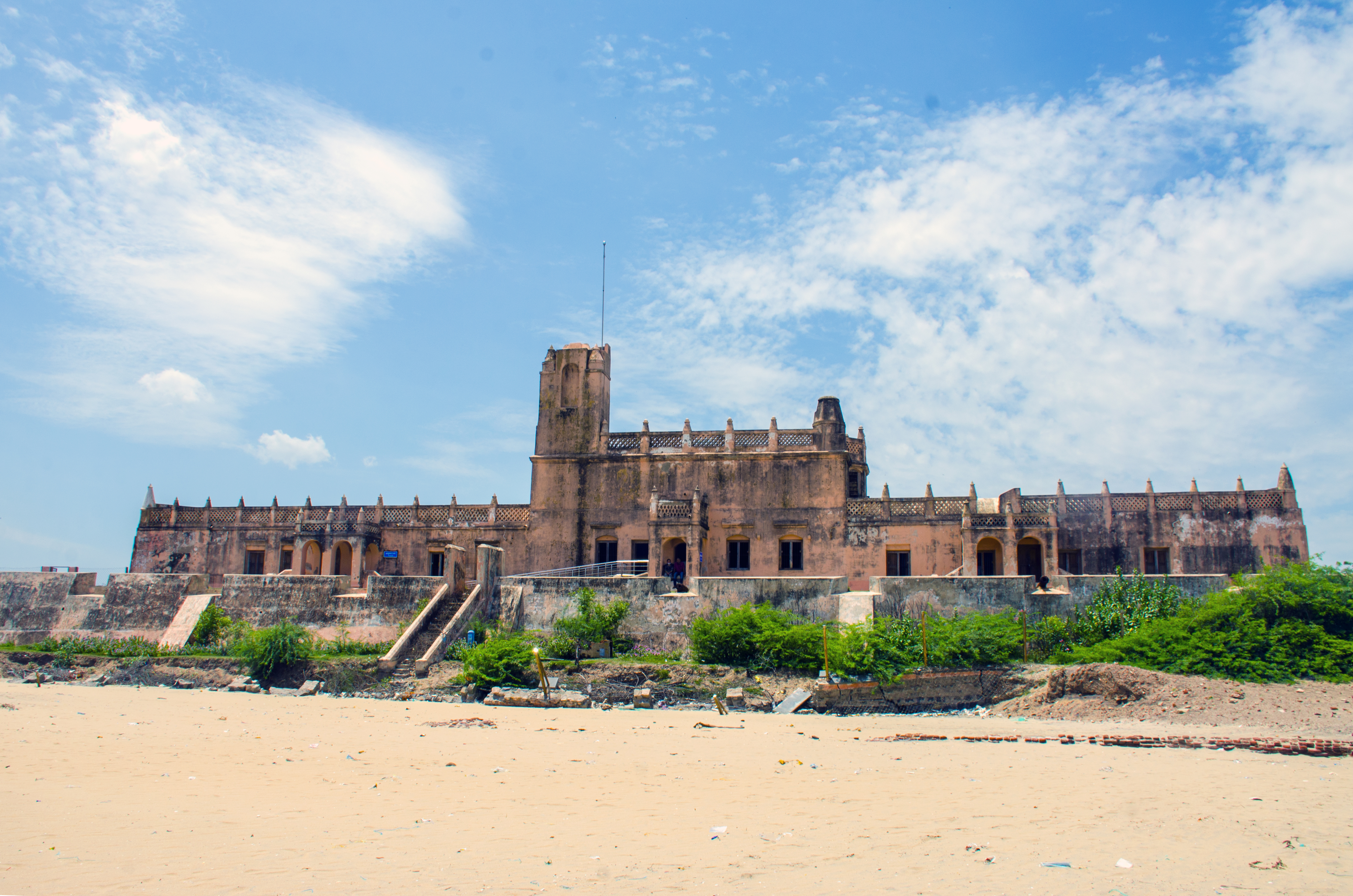
Fort Dansborg
The treaty was written on gold leaf. In November 1620, Danish Admiral Ove Gjedde and Thanjavur King Raghunatha Nayak signed an agreement ceding a strip of coastline -- eight kilometers by four -- to the Danish East India Company. The annual rent: 3,111 coins. The result: Fort Dansborg, a European fortress planted on the Coromandel Coast of Tamil Nadu, in what was then the fishing village of Tharangambadi. That the Danes, of all European colonial powers, would build their second-largest fort here -- surpassed only by Kronborg, Shakespeare's model for Elsinore -- is one of those historical facts that sounds invented. But the fort still stands, its camel-humped domes and columned halls facing the Bay of Bengal, a physical reminder that colonialism's reach extended to places most people never think to look.
Copenhagen's Gamble on the Coromandel
The Coromandel Coast had been an international trading corridor since the third century BCE, and by the early 1600s, the Portuguese, Dutch, British, and French were all jostling for position along it. Denmark was the latecomer, establishing its East India Company in Copenhagen in 1616 and dispatching Ove Gjedde to secure a foothold. The Portuguese resisted, but Gjedde negotiated directly with the Nayak ruler and won his lease. Local laborers built the fort in Danish style, with large halls, high ceilings, and projecting drapery. The basement served as a storehouse, prison, and barracks for soldiers; the governor and priests lived on the upper floor. From this modest base, Denmark ran a cotton textile trade that connected southern India to northern Europe -- a supply chain spanning half the planet, operated by one of Europe's smallest colonial powers.
Bibles, Coins, and a Printing Press
Fort Dansborg was more than a trading post. A mint inside the walls struck coins bearing the initials TB or DB -- for Tranquebar or Dansborg. In 1706, King Frederick IV sent two German missionaries, Bartholomaeus Ziegenbalg and Heinrich Plutschau, to establish what would become the first Protestant mission in India. Working inside the fort, they learned Tamil, translated the New Testament into the language, and printed it on a press they had shipped from Europe. A medical missionary named Friedrich Koenig later compiled a Tamil-Latin dictionary of 9,000 words within these walls. The source letters for that dictionary still sit in the royal archives in Copenhagen. For a fort built to protect a cotton trade, Dansborg generated an outsized cultural legacy -- one measured in languages preserved and texts translated rather than battles won.
Decline, Tsunami, and Revival
By the mid-eighteenth century, the textile trade had shifted north to Serampore in Bengal, and Tranquebar's commercial importance faded. The Danes sold the fort and the entire settlement to the British in 1845, who had little use for a redundant trading post. After Indian independence in 1947, the government repurposed the fort as an inspection bungalow -- a glorified guest house -- until Tamil Nadu's archaeology department took control in 1978 and converted it into a museum. The 2004 Indian Ocean tsunami battered the coastline, accelerating erosion that had been eating the fort's seaward walls for centuries. Restoration followed: the Tranquebar Association, supported by the Danish royal family and Indian experts, rebuilt the southern end using original materials -- brick and black stone. Cobblestone pathways now thread around the facade, and cast-iron street lamps line the approach, part of a broader effort to preserve this improbable Danish outpost on the Bay of Bengal.
A Fort Between Two Worlds
Fort Dansborg stands today as a museum housing artifacts from four centuries of Danish presence in India: portraits of Raja Raghunatha Nayak and King Christian IV, colonial pottery, and the site map of the original settlement. The architecture itself tells the story -- those four camel-hump domes supported by a single central pillar, the brick staircases, the guard rooms on the second storey where sentries once watched for predatory cavalry raids. The citadel walls that once faced the sea have largely eroded, victims of salt and time. What remains is a hybrid place, neither fully Danish nor fully Tamil, where European colonial ambition and Indian craftsmanship produced something that belongs to both histories. That the original treaty -- the gold leaf manuscript that started it all -- still exists in Copenhagen's royal archives only deepens the strangeness of finding this piece of Scandinavia on the Coromandel Coast.
From the Air
Fort Dansborg sits at 11.0246°N, 79.8558°E on the southern edge of Tharangambadi, directly on the Bay of Bengal shoreline. From the air, look for the rectangular fort structure at the water's edge, with the town's colonial-era grid layout stretching north. The Masilamaninathar Temple is nearby along the coast. The town is 283 km south of Chennai. Nearest major airport: Tiruchirappalli International (VOTR), approximately 125 km west. Chennai International (VOMM) is 283 km north. Best viewed at 2,000-3,000 feet for the fort's relationship to the coastline and the contrast between the colonial town grid and surrounding rural landscape.